Zishuai Zhang, Aubry S. R. Williams, Shaoxuan Ren, Benjamin A. W. Mowbray, Colin T. E. Parkyn, Yongwook Kim, Tengxiao Ji and Curtis P. Berlinguette
{"title":"Electrolytic cement clinker precursor production sustained through orthogonalization of ion vectors†","authors":"Zishuai Zhang, Aubry S. R. Williams, Shaoxuan Ren, Benjamin A. W. Mowbray, Colin T. E. Parkyn, Yongwook Kim, Tengxiao Ji and Curtis P. Berlinguette","doi":"10.1039/D4EE04881D","DOIUrl":null,"url":null,"abstract":"<p >Electrochemical reactors can reduce the carbon intensity of cement production by using electricity to convert limestone (CaCO<small><sub>3</sub></small>) into Ca(OH)<small><sub>2</sub></small>, which can be converted into cement clinker by reacting with silica (SiO<small><sub>2</sub></small>) at high temperatures. A key challenge with electrochemical reactors is that the deposition of solid Ca(OH)<small><sub>2</sub></small> at the membrane leads to unacceptably low energy efficiencies. To address this challenge, we connected the electrochemical reactor used for limestone calcination (“cement electrolyser”) to a distinctive chemical reactor (“calcium reactor”) so that Ca(OH)<small><sub>2</sub></small> forms in the calcium reactor instead of within the electrochemical reactor. In this tandem system, the cement electrolyser generates H<small><sup>+</sup></small> and OH<small><sup>−</sup></small> in the respective chemical and cathode compartments. The H<small><sup>+</sup></small> then reacts with CaCO<small><sub>3</sub></small> to release Ca<small><sup>2+</sup></small>, which is diverted into the calcium reactor to react with the OH<small><sup>−</sup></small> to form Ca(OH)<small><sub>2</sub></small>. We fabricated a composite membrane to selectively block the transport of Ca<small><sup>2+</sup></small> into the cathode compartment. Charge balance in the cement electrolyser was enabled with monovalent ions (<em>e.g.</em>, K<small><sup>+</sup></small>) as the positive charge carrier. This orthogonalized ion management was validated by <em>operando</em> imaging. The tandem reactor enabled the electrolysis process to operate for 50 hours at 100 mA cm<small><sup>−2</sup></small> without any voltage increase, which represents a meaningful step forward for electrochemical cement clinker precursor production.</p>","PeriodicalId":72,"journal":{"name":"Energy & Environmental Science","volume":" 5","pages":" 2395-2404"},"PeriodicalIF":30.8000,"publicationDate":"2025-01-29","publicationTypes":"Journal Article","fieldsOfStudy":null,"isOpenAccess":false,"openAccessPdf":"","citationCount":"0","resultStr":null,"platform":"Semanticscholar","paperid":null,"PeriodicalName":"Energy & Environmental Science","FirstCategoryId":"88","ListUrlMain":"https://pubs.rsc.org/en/content/articlelanding/2025/ee/d4ee04881d","RegionNum":1,"RegionCategory":"材料科学","ArticlePicture":[],"TitleCN":null,"AbstractTextCN":null,"PMCID":null,"EPubDate":"","PubModel":"","JCR":"Q1","JCRName":"CHEMISTRY, MULTIDISCIPLINARY","Score":null,"Total":0}
引用次数: 0
Abstract
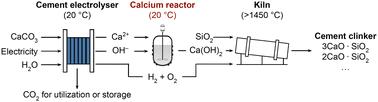
Electrochemical reactors can reduce the carbon intensity of cement production by using electricity to convert limestone (CaCO3) into Ca(OH)2, which can be converted into cement clinker by reacting with silica (SiO2) at high temperatures. A key challenge with electrochemical reactors is that the deposition of solid Ca(OH)2 at the membrane leads to unacceptably low energy efficiencies. To address this challenge, we connected the electrochemical reactor used for limestone calcination (“cement electrolyser”) to a distinctive chemical reactor (“calcium reactor”) so that Ca(OH)2 forms in the calcium reactor instead of within the electrochemical reactor. In this tandem system, the cement electrolyser generates H+ and OH− in the respective chemical and cathode compartments. The H+ then reacts with CaCO3 to release Ca2+, which is diverted into the calcium reactor to react with the OH− to form Ca(OH)2. We fabricated a composite membrane to selectively block the transport of Ca2+ into the cathode compartment. Charge balance in the cement electrolyser was enabled with monovalent ions (e.g., K+) as the positive charge carrier. This orthogonalized ion management was validated by operando imaging. The tandem reactor enabled the electrolysis process to operate for 50 hours at 100 mA cm−2 without any voltage increase, which represents a meaningful step forward for electrochemical cement clinker precursor production.
电化学反应器利用电将石灰石(CaCO3)转化为Ca(OH)2,在高温下与二氧化硅(SiO2)反应,转化为水泥熟料,从而降低水泥生产中的碳强度。电化学反应器面临的一个关键挑战是固体Ca(OH)2在膜上的沉积导致能量效率低得令人无法接受。为了应对这一挑战,我们将用于石灰石煅烧的电化学反应器(“水泥电解槽”)连接到一个独特的化学反应器(“钙反应器”)上,这样Ca(OH)2就会在钙反应器中形成,而不是在电化学反应器中形成。在这种串联系统中,水泥电解槽在各自的化学室和阴极室中产生H+和OH−。然后,H+与CaCO3反应释放Ca2+, Ca2+被转移到钙反应器中与OH -反应生成Ca(OH)2。我们制造了一种复合膜来选择性地阻断Ca2+进入阴极室的运输。以单价离子(如K+)为正电荷载体,实现水泥电解槽内的电荷平衡。这种正交化离子管理方法通过手术成像得到了验证。串联反应器使电解过程在100 mA cm−2下运行50小时,没有任何电压增加,这代表了电化学水泥熟料前驱体生产的重要一步。
期刊介绍:
Energy & Environmental Science, a peer-reviewed scientific journal, publishes original research and review articles covering interdisciplinary topics in the (bio)chemical and (bio)physical sciences, as well as chemical engineering disciplines. Published monthly by the Royal Society of Chemistry (RSC), a not-for-profit publisher, Energy & Environmental Science is recognized as a leading journal. It boasts an impressive impact factor of 8.500 as of 2009, ranking 8th among 140 journals in the category "Chemistry, Multidisciplinary," second among 71 journals in "Energy & Fuels," second among 128 journals in "Engineering, Chemical," and first among 181 scientific journals in "Environmental Sciences."
Energy & Environmental Science publishes various types of articles, including Research Papers (original scientific work), Review Articles, Perspectives, and Minireviews (feature review-type articles of broad interest), Communications (original scientific work of an urgent nature), Opinions (personal, often speculative viewpoints or hypotheses on current topics), and Analysis Articles (in-depth examination of energy-related issues).




 京公网安备 11010802042870号
京ICP备2023020795号-1
京公网安备 11010802042870号
京ICP备2023020795号-1

 分享
分享
 求助内容:
求助内容: 应助结果提醒方式:
 扫码关注我们
