First-Principles Thermodynamic Background of the Comprehensive Reaction Network of NO Oxidation over CuSSZ-13 Catalysts─Influence of Copper Speciation and Interpretation of TPD and TPSR Profiles
Bartosz Mozgawa, Filip Zasada, Monika Fedyna, Kinga Góra-Marek, Chengyang Yin, Zhen Zhao, Zbigniew Sojka, Piotr Pietrzyk
{"title":"First-Principles Thermodynamic Background of the Comprehensive Reaction Network of NO Oxidation over CuSSZ-13 Catalysts─Influence of Copper Speciation and Interpretation of TPD and TPSR Profiles","authors":"Bartosz Mozgawa, Filip Zasada, Monika Fedyna, Kinga Góra-Marek, Chengyang Yin, Zhen Zhao, Zbigniew Sojka, Piotr Pietrzyk","doi":"10.1021/acscatal.4c06619","DOIUrl":null,"url":null,"abstract":"A thorough molecular DFT modeling coupled with first-principles thermodynamic (FPT), spectroscopic (EPR/IR), and catalytic investigations into a complex network of reactions involved in the interaction of NO and O<sub>2</sub> with a comprehensive variety of active centers present in the CuSSZ-13 zeolites (Cu<sup>2+</sup>, Cu<sup>+</sup>, Cu<sup>2+</sup>–OH<sup>–</sup>, Cu<sup>2+</sup>–O<sup>2–</sup>–Cu<sup>2+</sup>, Cu<sup>2+</sup>–O<sub>2</sub><sup>2–</sup>–Cu<sup>2+</sup>, and segregated CuO) were carried out. The molecular structure, energetics, and electronic and magnetic properties of the identified profuse adspecies and intermediates were ascertained. Their thermal stability and reactivity at a wide range of experimental conditions were interpreted by using the constructed thermodynamic Δ<i>G</i>(<i>p</i>,<i>T</i>) diagrams. The course of selective catalytic oxidation of NO (NO–SCO) with <sup>16</sup>O<sub>2</sub> or <sup>18</sup>O<sub>2</sub> was examined by a temperature-programmed surface reaction (TPSR) using two types of CuSSZ-13 catalysts of intentionally diverse copper speciation. The results obtained, supported by the corroborative IR and EPR measurements, revealed multiple molecular pathways of the NO and O<sub>2</sub> interactions with the single (Cu<sup>2+</sup>, Cu<sup>+</sup>, Cu<sup>2+</sup>–OH<sup>–</sup>) and dual (Cu<sup>2+</sup>–O<sup>2–</sup>–Cu<sup>2+</sup>, Cu<sup>2+</sup>–O<sub>2</sub><sup>2–</sup>–Cu<sup>2+</sup>) copper centers of the 6MR and 8MR topologies and with segregated CuO. The complex reaction network and temperature behavior of the critical intermediates (HONO, nitrate, and nitrite), and their evolvement routes into NO<sub>2</sub>, were rationalized using the calculated FPT thermodynamic profiles. The unraveled reactions were classified into metal (cationic) redox, ligand (anionic) redox, and HONO redox cycles. The Cu<sup>2+</sup>–OH<sup>–</sup> species were identified as prime active centers for the formation of NO<sub>2</sub> via the HONO pathway. The elusive HONO intermediates allow for chemical communication between the individual redox cycles. Depending on the actual reaction conditions, HONO can act as a reduction agent for Cu<sup>2+</sup> with the electroprotic formation of NO<sub>2</sub>, a source of nitrites upon deprotonation, or as an oxidant of Cu<sup>+</sup> with the formation of H<sub>2</sub>O and NO. For the metal redox pathway, a significant difference in the reactivity between the Cu<sup>2+</sup> cations accommodated in the 6MRs and 8MRs was observed, with the Cu<sup>2+</sup>/6MR being spectators and the Cu<sup>2+</sup>/8MR active species. Dimeric copper centers with bridging oxo and peroxy moieties can produce a variety of nitrates and nitrites via ligand redox mechanisms. Segregated CuO nanocrystals contribute to NO oxidation only at high temperatures (<i>T</i> > 400 °C), leading to the isotopic scrambling of <sup>18</sup>O-labeled oxygen and nitric oxide. The established complex reaction network was successfully used to clarify the temperature dependence of the experimental NO–SCO profiles, also providing a suitable mechanistic background for interpreting the nature of the oxidative half-cycle of the selective catalytic reduction of NO over Cu-SSZ-13 catalysts.","PeriodicalId":9,"journal":{"name":"ACS Catalysis ","volume":"27 1","pages":""},"PeriodicalIF":13.1000,"publicationDate":"2025-01-30","publicationTypes":"Journal Article","fieldsOfStudy":null,"isOpenAccess":false,"openAccessPdf":"","citationCount":"0","resultStr":null,"platform":"Semanticscholar","paperid":null,"PeriodicalName":"ACS Catalysis ","FirstCategoryId":"92","ListUrlMain":"https://doi.org/10.1021/acscatal.4c06619","RegionNum":1,"RegionCategory":"化学","ArticlePicture":[],"TitleCN":null,"AbstractTextCN":null,"PMCID":null,"EPubDate":"","PubModel":"","JCR":"Q1","JCRName":"CHEMISTRY, PHYSICAL","Score":null,"Total":0}
引用次数: 0
Abstract
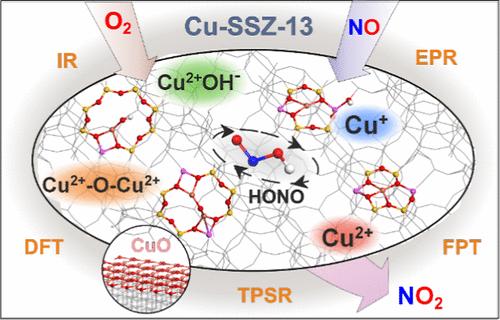
A thorough molecular DFT modeling coupled with first-principles thermodynamic (FPT), spectroscopic (EPR/IR), and catalytic investigations into a complex network of reactions involved in the interaction of NO and O2 with a comprehensive variety of active centers present in the CuSSZ-13 zeolites (Cu2+, Cu+, Cu2+–OH–, Cu2+–O2––Cu2+, Cu2+–O22––Cu2+, and segregated CuO) were carried out. The molecular structure, energetics, and electronic and magnetic properties of the identified profuse adspecies and intermediates were ascertained. Their thermal stability and reactivity at a wide range of experimental conditions were interpreted by using the constructed thermodynamic ΔG(p,T) diagrams. The course of selective catalytic oxidation of NO (NO–SCO) with 16O2 or 18O2 was examined by a temperature-programmed surface reaction (TPSR) using two types of CuSSZ-13 catalysts of intentionally diverse copper speciation. The results obtained, supported by the corroborative IR and EPR measurements, revealed multiple molecular pathways of the NO and O2 interactions with the single (Cu2+, Cu+, Cu2+–OH–) and dual (Cu2+–O2––Cu2+, Cu2+–O22––Cu2+) copper centers of the 6MR and 8MR topologies and with segregated CuO. The complex reaction network and temperature behavior of the critical intermediates (HONO, nitrate, and nitrite), and their evolvement routes into NO2, were rationalized using the calculated FPT thermodynamic profiles. The unraveled reactions were classified into metal (cationic) redox, ligand (anionic) redox, and HONO redox cycles. The Cu2+–OH– species were identified as prime active centers for the formation of NO2 via the HONO pathway. The elusive HONO intermediates allow for chemical communication between the individual redox cycles. Depending on the actual reaction conditions, HONO can act as a reduction agent for Cu2+ with the electroprotic formation of NO2, a source of nitrites upon deprotonation, or as an oxidant of Cu+ with the formation of H2O and NO. For the metal redox pathway, a significant difference in the reactivity between the Cu2+ cations accommodated in the 6MRs and 8MRs was observed, with the Cu2+/6MR being spectators and the Cu2+/8MR active species. Dimeric copper centers with bridging oxo and peroxy moieties can produce a variety of nitrates and nitrites via ligand redox mechanisms. Segregated CuO nanocrystals contribute to NO oxidation only at high temperatures (T > 400 °C), leading to the isotopic scrambling of 18O-labeled oxygen and nitric oxide. The established complex reaction network was successfully used to clarify the temperature dependence of the experimental NO–SCO profiles, also providing a suitable mechanistic background for interpreting the nature of the oxidative half-cycle of the selective catalytic reduction of NO over Cu-SSZ-13 catalysts.
期刊介绍:
ACS Catalysis is an esteemed journal that publishes original research in the fields of heterogeneous catalysis, molecular catalysis, and biocatalysis. It offers broad coverage across diverse areas such as life sciences, organometallics and synthesis, photochemistry and electrochemistry, drug discovery and synthesis, materials science, environmental protection, polymer discovery and synthesis, and energy and fuels.
The scope of the journal is to showcase innovative work in various aspects of catalysis. This includes new reactions and novel synthetic approaches utilizing known catalysts, the discovery or modification of new catalysts, elucidation of catalytic mechanisms through cutting-edge investigations, practical enhancements of existing processes, as well as conceptual advances in the field. Contributions to ACS Catalysis can encompass both experimental and theoretical research focused on catalytic molecules, macromolecules, and materials that exhibit catalytic turnover.



 京公网安备 11010802042870号
京ICP备2023020795号-1
京公网安备 11010802042870号
京ICP备2023020795号-1

 分享
分享
 求助内容:
求助内容: 应助结果提醒方式:
 扫码关注我们
