Doaa Omar A. Ali, Mickaël Beaudhuin, Michael Marek Koza, Romain Viennois
{"title":"Lattice Dynamics of Ca3Si4 and Ca14Si19 Compounds","authors":"Doaa Omar A. Ali, Mickaël Beaudhuin, Michael Marek Koza, Romain Viennois","doi":"10.1021/acs.jpcc.4c06459","DOIUrl":null,"url":null,"abstract":"The vibrational properties of Ca<sub>3</sub>Si<sub>4</sub> and Ca<sub>14</sub>Si<sub>19</sub> were studied by inelastic neutron scattering (INS) experiments as a function of temperature and by density functional theory (DFT) lattice dynamics calculations. The good agreement between the DFT calculations and INS experiments shows that the vibrational dynamics of both structures can be described by normal modes. Phonons of strong linear dispersion, which may be interpreted as acoustic modes, are observed up to about 10 meV in both compounds. Above 10 meV, phonons are progressively localized toward higher energies, taking on the maximum values of 50 meV in Ca<sub>3</sub>Si<sub>4</sub> and 53 meV in Ca<sub>14</sub>Si<sub>19</sub>. Thereby, Ca contributes to phonons with high amplitudes below about 25 meV and Si dominates the vibrational properties above 25 meV. However, localization effects over an extended <i>Q</i> range in the phonon properties are observed already at energies of 10 and 6.5 meV in Ca<sub>3</sub>Si<sub>4</sub> and Ca<sub>14</sub>Si<sub>19</sub>, respectively. Ca<sub>14</sub>Si<sub>19</sub> shows in the phonon dispersion a strong anticrossing behavior due to equal symmetries of the low-energy localized and acoustic modes. We observe a weak relative shift of 2–4% of phonon energies upon heating to 540 K and estimate the contribution from thermal expansion to this anharmonic response to more than 50%.","PeriodicalId":61,"journal":{"name":"The Journal of Physical Chemistry C","volume":"53 1","pages":""},"PeriodicalIF":3.2000,"publicationDate":"2025-01-30","publicationTypes":"Journal Article","fieldsOfStudy":null,"isOpenAccess":false,"openAccessPdf":"","citationCount":"0","resultStr":null,"platform":"Semanticscholar","paperid":null,"PeriodicalName":"The Journal of Physical Chemistry C","FirstCategoryId":"1","ListUrlMain":"https://doi.org/10.1021/acs.jpcc.4c06459","RegionNum":3,"RegionCategory":"化学","ArticlePicture":[],"TitleCN":null,"AbstractTextCN":null,"PMCID":null,"EPubDate":"","PubModel":"","JCR":"Q2","JCRName":"CHEMISTRY, PHYSICAL","Score":null,"Total":0}
引用次数: 0
Abstract
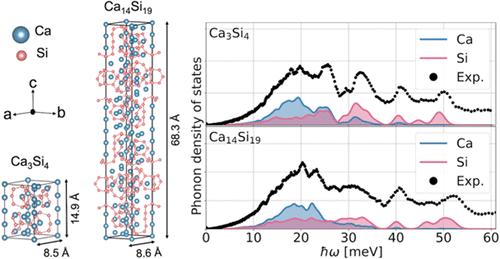
The vibrational properties of Ca3Si4 and Ca14Si19 were studied by inelastic neutron scattering (INS) experiments as a function of temperature and by density functional theory (DFT) lattice dynamics calculations. The good agreement between the DFT calculations and INS experiments shows that the vibrational dynamics of both structures can be described by normal modes. Phonons of strong linear dispersion, which may be interpreted as acoustic modes, are observed up to about 10 meV in both compounds. Above 10 meV, phonons are progressively localized toward higher energies, taking on the maximum values of 50 meV in Ca3Si4 and 53 meV in Ca14Si19. Thereby, Ca contributes to phonons with high amplitudes below about 25 meV and Si dominates the vibrational properties above 25 meV. However, localization effects over an extended Q range in the phonon properties are observed already at energies of 10 and 6.5 meV in Ca3Si4 and Ca14Si19, respectively. Ca14Si19 shows in the phonon dispersion a strong anticrossing behavior due to equal symmetries of the low-energy localized and acoustic modes. We observe a weak relative shift of 2–4% of phonon energies upon heating to 540 K and estimate the contribution from thermal expansion to this anharmonic response to more than 50%.
期刊介绍:
The Journal of Physical Chemistry A/B/C is devoted to reporting new and original experimental and theoretical basic research of interest to physical chemists, biophysical chemists, and chemical physicists.




 京公网安备 11010802042870号
京ICP备2023020795号-1
京公网安备 11010802042870号
京ICP备2023020795号-1

 分享
分享
 求助内容:
求助内容: 应助结果提醒方式:
 扫码关注我们
