Pengpeng Li, Zuying Liao, Bo Zhang, Liyan Yin, Wei Li, Hong Sheng Jiang
{"title":"Bicarbonate use reduces the photorespiration in Ottelia alismoides adapting to the CO<sub>2</sub>-fluctuated aquatic systems.","authors":"Pengpeng Li, Zuying Liao, Bo Zhang, Liyan Yin, Wei Li, Hong Sheng Jiang","doi":"10.1111/ppl.70085","DOIUrl":null,"url":null,"abstract":"<p><p>Underwater CO<sub>2</sub> concentration fluctuates extremely in natural water bodies. Under low CO<sub>2</sub>, the unique CO<sub>2</sub> concentrating mechanism in aquatic plants, bicarbonate use, can suppress photorespiration. However, it remains unknown (1) to what extent bicarbonate use reduces photorespiration, (2) how exactly photorespiration varies between bicarbonate-users and CO<sub>2</sub>-obligate users under CO<sub>2</sub>-fluctuated environments, and (3) what are differences in Rubisco characteristics between these two types of aquatic plants. In the present study, the bicarbonate user Ottelia alismoides and its phylogenetically close CO<sub>2</sub>-obligate user Blyxa japonica were chosen to answer these questions. The results showed that bicarbonate use saved ~13% carbon loss under low CO<sub>2</sub> via decreasing photorespiration in O. alismoides. Through bicarbonate use, the photorespiration of O. alismoides was kept stable both under high and low underwater CO<sub>2</sub> concentrations, while the photorespiration significantly increased in the CO<sub>2</sub>-obligate user B. japonica under low CO<sub>2</sub>. However, B. japonica showed a significantly higher photosynthesis rate than O. alsimoides when CO<sub>2</sub> was sufficient. These differences could be related to the kinetic characteristics of Rubisco showing a higher carboxylation turnover rate (Kcat) in B. japonica, and the similar affinity to CO<sub>2</sub> (Kc) and specificity factor (Sc/o) in these two species that might be determined by the variation of six amino acid residuals in Rubisco large subunit sequences, especially the site 281 (A vs. S) and 282 (H vs. F). All these differences in photorespiration and kinetic characteristics of Rubisco could explain the distribution patterns of bicarbonate users and CO<sub>2</sub>-obligate users in the field.</p>","PeriodicalId":20164,"journal":{"name":"Physiologia plantarum","volume":"177 1","pages":"e70085"},"PeriodicalIF":3.6000,"publicationDate":"2025-01-01","publicationTypes":"Journal Article","fieldsOfStudy":null,"isOpenAccess":false,"openAccessPdf":"","citationCount":"0","resultStr":null,"platform":"Semanticscholar","paperid":null,"PeriodicalName":"Physiologia plantarum","FirstCategoryId":"99","ListUrlMain":"https://doi.org/10.1111/ppl.70085","RegionNum":2,"RegionCategory":"生物学","ArticlePicture":[],"TitleCN":null,"AbstractTextCN":null,"PMCID":null,"EPubDate":"","PubModel":"","JCR":"Q1","JCRName":"PLANT SCIENCES","Score":null,"Total":0}
引用次数: 0
Abstract
Underwater CO2 concentration fluctuates extremely in natural water bodies. Under low CO2, the unique CO2 concentrating mechanism in aquatic plants, bicarbonate use, can suppress photorespiration. However, it remains unknown (1) to what extent bicarbonate use reduces photorespiration, (2) how exactly photorespiration varies between bicarbonate-users and CO2-obligate users under CO2-fluctuated environments, and (3) what are differences in Rubisco characteristics between these two types of aquatic plants. In the present study, the bicarbonate user Ottelia alismoides and its phylogenetically close CO2-obligate user Blyxa japonica were chosen to answer these questions. The results showed that bicarbonate use saved ~13% carbon loss under low CO2 via decreasing photorespiration in O. alismoides. Through bicarbonate use, the photorespiration of O. alismoides was kept stable both under high and low underwater CO2 concentrations, while the photorespiration significantly increased in the CO2-obligate user B. japonica under low CO2. However, B. japonica showed a significantly higher photosynthesis rate than O. alsimoides when CO2 was sufficient. These differences could be related to the kinetic characteristics of Rubisco showing a higher carboxylation turnover rate (Kcat) in B. japonica, and the similar affinity to CO2 (Kc) and specificity factor (Sc/o) in these two species that might be determined by the variation of six amino acid residuals in Rubisco large subunit sequences, especially the site 281 (A vs. S) and 282 (H vs. F). All these differences in photorespiration and kinetic characteristics of Rubisco could explain the distribution patterns of bicarbonate users and CO2-obligate users in the field.
在自然水体中,水下二氧化碳浓度波动极大。在低CO2条件下,水生植物独特的CO2浓缩机制,碳酸氢盐的使用,可以抑制光呼吸。然而,目前尚不清楚(1)碳酸氢盐的使用在多大程度上减少了光呼吸;(2)在二氧化碳波动的环境下,碳酸氢盐使用者和二氧化碳特异性使用者之间的光呼吸变化究竟如何;(3)这两种类型的水生植物之间的Rubisco特征有什么差异。在本研究中,选择碳酸氢盐使用者Ottelia alismoides及其系统亲缘性接近的co2 -特异性使用者Blyxa japonica来回答这些问题。结果表明,在低CO2条件下,碳酸氢盐的使用通过减少光呼吸减少了约13%的碳损失。通过碳酸氢盐的使用,在高、低CO2浓度下均能保持O. aliismoides的光呼吸稳定,而在低CO2浓度下,对CO2有特殊需求的B. japonica的光呼吸显著增加。而在CO2充足的条件下,粳稻的光合速率显著高于欧氏稻。这些差异可能与Rubisco的动力学特征有关,在粳米中表现出较高的羧基化周转率(Kcat),以及两种物种对CO2的亲和力(Kc)和特异性因子(Sc/o)相似,这可能是由Rubisco大亚基序列中6个氨基酸残基的变化决定的。特别是281位点(A vs. S)和282位点(H vs. F)。所有这些Rubisco光呼吸和动力学特性的差异可以解释野外碳酸氢盐使用者和二氧化碳专一性使用者的分布模式。
期刊介绍:
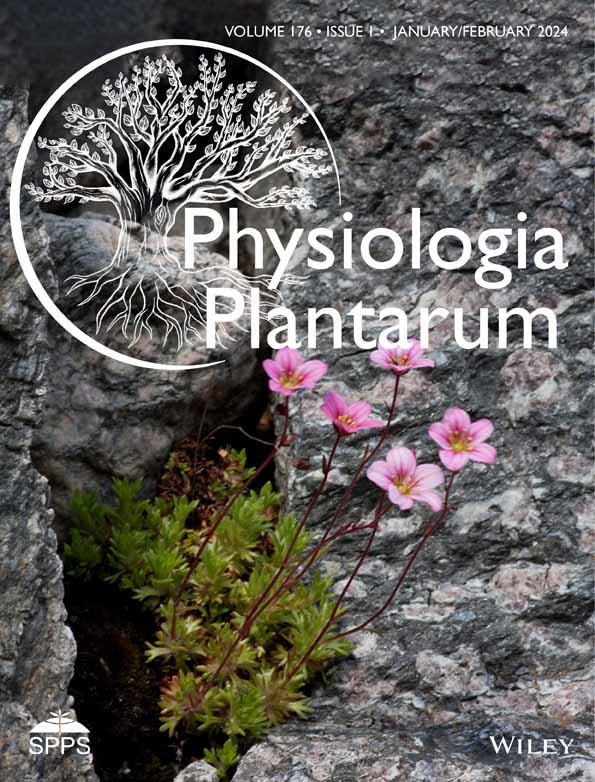
Physiologia Plantarum is an international journal committed to publishing the best full-length original research papers that advance our understanding of primary mechanisms of plant development, growth and productivity as well as plant interactions with the biotic and abiotic environment. All organisational levels of experimental plant biology – from molecular and cell biology, biochemistry and biophysics to ecophysiology and global change biology – fall within the scope of the journal. The content is distributed between 5 main subject areas supervised by Subject Editors specialised in the respective domain: (1) biochemistry and metabolism, (2) ecophysiology, stress and adaptation, (3) uptake, transport and assimilation, (4) development, growth and differentiation, (5) photobiology and photosynthesis.



 京公网安备 11010802042870号
京ICP备2023020795号-1
京公网安备 11010802042870号
京ICP备2023020795号-1

 分享
分享
 求助内容:
求助内容: 应助结果提醒方式:
 扫码关注我们
