{"title":"Scale-Up of Tailor-Made Onsite Enzyme Blend From Cassava Peels for Industrial Bioethanol Production.","authors":"Martison Budu, Patrick Boakye, Joseph A Bentil","doi":"10.1155/tswj/2296078","DOIUrl":null,"url":null,"abstract":"<p><p>Bioethanol production is one of the key alternatives for fossil fuel use due to climate change. The study seeks to upscale tailor-made onsite enzyme blends for the bioconversion of cassava peels to bioethanol in simultaneous saccharification and fermentation (SSF) process using cassava peels-degrading fungi. The starch and cellulose contents of peels were determined. The results showed significant levels of cellulose (39.78%) and starch (31.21%), indicating that cassava peels are valuable raw materials for bioethanol production. To investigate cassava-degrading microbes, <i>Aspergillus niger</i> demonstrated the highest enzyme activity with a diameter of zone of clearance of 16 mm. Tailor-made enzyme blends were produced with the <i>A</i>. <i>niger</i> using various substrate concentrations (1%, 3%, 5%, 8%, and 10%) of milled cassava peels at periods of 2, 4, 6, 8, and 10 days with a spore concentration of 2.1 × 10<sup>5</sup> cells/mL. The amylolytic and cellulolytic activities were determined as 4.759 U/mL and 4.265 U/mL, respectively, at 5% and 6-day optimal conditions. The enzyme blend was upscaled using three fermentation vessels, thus 0.250 L flask, 1.0 L flask, and 10 L fermenter at optimized conditions in the SSF process for bioethanol production. These optimal conditions were firstly applied to a 0.250 L flask in the SSF process, a fixed enzyme dose of 20 mL and 1.5 g of <i>Saccharomyces cerevisiae</i> with varying substrate concentrations of 5%, 10%, and 20% and ethanol analyzed daily for 10 days. The theoretical ethanol yields recorded were 15.64%, 16.02%, and 14.91% for 0.250, 1, and 10 volumes obtained at different fermentation days. These optimized conditions demonstrate the potential for industrial bioethanol production in Ghana.</p>","PeriodicalId":22985,"journal":{"name":"The Scientific World Journal","volume":"2025 ","pages":"2296078"},"PeriodicalIF":0.0000,"publicationDate":"2025-01-21","publicationTypes":"Journal Article","fieldsOfStudy":null,"isOpenAccess":false,"openAccessPdf":"https://www.ncbi.nlm.nih.gov/pmc/articles/PMC11774575/pdf/","citationCount":"0","resultStr":null,"platform":"Semanticscholar","paperid":null,"PeriodicalName":"The Scientific World Journal","FirstCategoryId":"1085","ListUrlMain":"https://doi.org/10.1155/tswj/2296078","RegionNum":0,"RegionCategory":null,"ArticlePicture":[],"TitleCN":null,"AbstractTextCN":null,"PMCID":null,"EPubDate":"2025/1/1 0:00:00","PubModel":"eCollection","JCR":"Q2","JCRName":"Environmental Science","Score":null,"Total":0}
引用次数: 0
Abstract
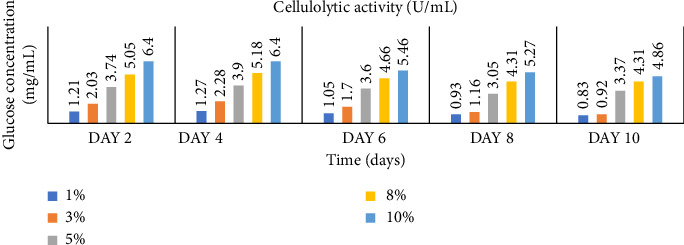
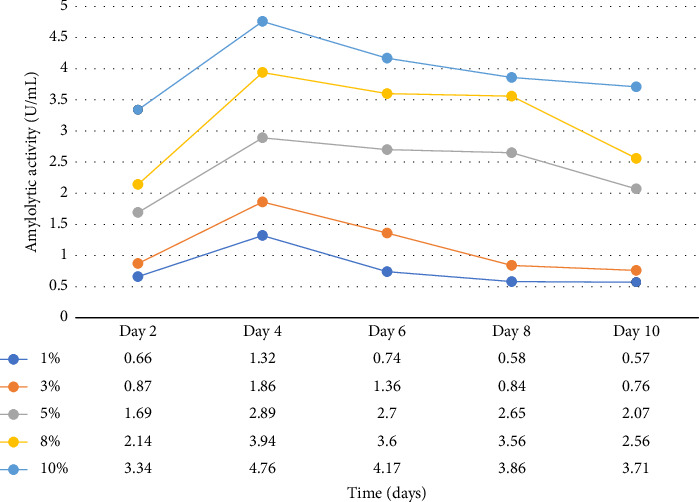
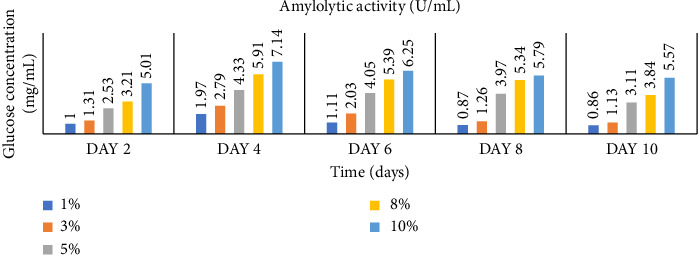
Bioethanol production is one of the key alternatives for fossil fuel use due to climate change. The study seeks to upscale tailor-made onsite enzyme blends for the bioconversion of cassava peels to bioethanol in simultaneous saccharification and fermentation (SSF) process using cassava peels-degrading fungi. The starch and cellulose contents of peels were determined. The results showed significant levels of cellulose (39.78%) and starch (31.21%), indicating that cassava peels are valuable raw materials for bioethanol production. To investigate cassava-degrading microbes, Aspergillus niger demonstrated the highest enzyme activity with a diameter of zone of clearance of 16 mm. Tailor-made enzyme blends were produced with the A. niger using various substrate concentrations (1%, 3%, 5%, 8%, and 10%) of milled cassava peels at periods of 2, 4, 6, 8, and 10 days with a spore concentration of 2.1 × 10⁵ cells/mL. The amylolytic and cellulolytic activities were determined as 4.759 U/mL and 4.265 U/mL, respectively, at 5% and 6-day optimal conditions. The enzyme blend was upscaled using three fermentation vessels, thus 0.250 L flask, 1.0 L flask, and 10 L fermenter at optimized conditions in the SSF process for bioethanol production. These optimal conditions were firstly applied to a 0.250 L flask in the SSF process, a fixed enzyme dose of 20 mL and 1.5 g of Saccharomyces cerevisiae with varying substrate concentrations of 5%, 10%, and 20% and ethanol analyzed daily for 10 days. The theoretical ethanol yields recorded were 15.64%, 16.02%, and 14.91% for 0.250, 1, and 10 volumes obtained at different fermentation days. These optimized conditions demonstrate the potential for industrial bioethanol production in Ghana.
期刊介绍:
The Scientific World Journal is a peer-reviewed, Open Access journal that publishes original research, reviews, and clinical studies covering a wide range of subjects in science, technology, and medicine. The journal is divided into 81 subject areas.



 京公网安备 11010802042870号
京ICP备2023020795号-1
京公网安备 11010802042870号
京ICP备2023020795号-1

 分享
分享
 求助内容:
求助内容: 应助结果提醒方式:
 扫码关注我们
