Perceptions and Attitudes of People With Cancer and Diabetes Towards Patient Guidelines: A Mixed Methods Study

IF 3.2 3区 医学 Q2 HEALTH CARE SCIENCES & SERVICES Health Expectations Pub Date : 2025-01-28 DOI:10.1111/hex.70164
Lijiao Yan, Ning Liang, Zeyu Yu, Loraine Cook, Sarah E. Scott, Karen Graham, Xing Liao, Haili Zhang, Jiale Hu, Nannan Shi, Jianping Liu
{"title":"Perceptions and Attitudes of People With Cancer and Diabetes Towards Patient Guidelines: A Mixed Methods Study","authors":"Lijiao Yan,&nbsp;Ning Liang,&nbsp;Zeyu Yu,&nbsp;Loraine Cook,&nbsp;Sarah E. Scott,&nbsp;Karen Graham,&nbsp;Xing Liao,&nbsp;Haili Zhang,&nbsp;Jiale Hu,&nbsp;Nannan Shi,&nbsp;Jianping Liu","doi":"10.1111/hex.70164","DOIUrl":null,"url":null,"abstract":"<div>\n \n \n <section>\n \n <h3> Objective</h3>\n \n <p>To explore patients' perceptions and attitudes towards patient guidelines (PGs) and to identify specific factors related to PG content, design, presentation, and management that may influence patients' use or adoption of PGs.</p>\n </section>\n \n <section>\n \n <h3> Methods</h3>\n \n <p>An exploratory sequential mixed-methods design was employed. Initial semi-structured interviews were conducted with a diverse group of individuals, including people with diabetes or oncology, and clinicians. These interviews were analysed through directed content analysis. Findings from the qualitative study were used to develop a questionnaire. The questionnaire was circulated to patients with diabetes and cancer and asked them to report their awareness, attitudes, and the PG-related factors influencing their use and adoption of PGs.</p>\n </section>\n \n <section>\n \n <h3> Results</h3>\n \n <p>In total, 25 participants were interviewed qualitatively, and 400 participated in the quantitative survey. Analysis of interviews yielded three themes: perception of PGs, attitude towards PGs, and key PG attributes influencing patients' use or adoption of PG. Qualitative findings indicated limited awareness of PGs, supported quantitatively by only 26.5% of patients being aware of PGs. Attitudes varied, with 73.0% expressing an overall positive attitude towards PG, but only 17.3% preferred PGs for evidence-based answers and 32.3% favoured them for decision support, citing concerns that general recommendations may not meet individual needs. Participants suggested tailoring recommendations based on subgroups considering age, comorbidity, and weight, explaining why treatments work or don't work in different populations. Eight PG attributes influencing their use or adoption were found: accessibility, identifiability, attractiveness, credibility, usability, timeliness, relevance and simplicity. Lack of credibility was the most frequently mentioned hindrance, with 34.8% identifying unverifiable information as a barrier. Further qualitative and quantitative analyses revealed that medical staff were trusted sources for conveying PGs to patients.</p>\n </section>\n \n <section>\n \n <h3> Conclusions and Practice Implications</h3>\n \n <p>This study underscores the necessity for PGs to acknowledge individual differences and provide recommendations that are more tailored considering age, comorbidities, weight, and other factors influencing decision-making, ensuring that they address patients' specific needs and support informed decision-making. Additionally, there was a significant need to improve the dissemination of PGs, using medical staff as key channels to improve patients' use or adoption of PGs.</p>\n </section>\n \n <section>\n \n <h3> Patient or Public Contribution</h3>\n \n <p>In this study, patients were actively involved in several stages. During the development of the interview guide, feedback from two patients, alongside one patient guidelines (PGs) developer and three clinicians, was incorporated to ensure the guide's relevance and comprehensiveness. Patients' insights were integral to refining the interview questions, ensuring they were appropriate and effective. Additionally, the survey questionnaire was pre-tested among 20 patients using the Think-Aloud method, which led to significant revisions for better comprehension and response quality. These steps highlight the essential role of patients in shaping the data collection instruments and enhancing the overall quality and relevance of the study.</p>\n </section>\n </div>","PeriodicalId":55070,"journal":{"name":"Health Expectations","volume":"28 1","pages":""},"PeriodicalIF":3.2000,"publicationDate":"2025-01-28","publicationTypes":"Journal Article","fieldsOfStudy":null,"isOpenAccess":false,"openAccessPdf":"https://www.ncbi.nlm.nih.gov/pmc/articles/PMC11775387/pdf/","citationCount":"0","resultStr":null,"platform":"Semanticscholar","paperid":null,"PeriodicalName":"Health Expectations","FirstCategoryId":"3","ListUrlMain":"https://onlinelibrary.wiley.com/doi/10.1111/hex.70164","RegionNum":3,"RegionCategory":"医学","ArticlePicture":[],"TitleCN":null,"AbstractTextCN":null,"PMCID":null,"EPubDate":"","PubModel":"","JCR":"Q2","JCRName":"HEALTH CARE SCIENCES & SERVICES","Score":null,"Total":0}
引用次数: 0

Abstract

Objective

To explore patients' perceptions and attitudes towards patient guidelines (PGs) and to identify specific factors related to PG content, design, presentation, and management that may influence patients' use or adoption of PGs.

Methods

An exploratory sequential mixed-methods design was employed. Initial semi-structured interviews were conducted with a diverse group of individuals, including people with diabetes or oncology, and clinicians. These interviews were analysed through directed content analysis. Findings from the qualitative study were used to develop a questionnaire. The questionnaire was circulated to patients with diabetes and cancer and asked them to report their awareness, attitudes, and the PG-related factors influencing their use and adoption of PGs.

Results

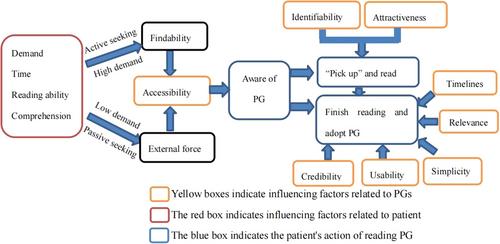
In total, 25 participants were interviewed qualitatively, and 400 participated in the quantitative survey. Analysis of interviews yielded three themes: perception of PGs, attitude towards PGs, and key PG attributes influencing patients' use or adoption of PG. Qualitative findings indicated limited awareness of PGs, supported quantitatively by only 26.5% of patients being aware of PGs. Attitudes varied, with 73.0% expressing an overall positive attitude towards PG, but only 17.3% preferred PGs for evidence-based answers and 32.3% favoured them for decision support, citing concerns that general recommendations may not meet individual needs. Participants suggested tailoring recommendations based on subgroups considering age, comorbidity, and weight, explaining why treatments work or don't work in different populations. Eight PG attributes influencing their use or adoption were found: accessibility, identifiability, attractiveness, credibility, usability, timeliness, relevance and simplicity. Lack of credibility was the most frequently mentioned hindrance, with 34.8% identifying unverifiable information as a barrier. Further qualitative and quantitative analyses revealed that medical staff were trusted sources for conveying PGs to patients.

Conclusions and Practice Implications

This study underscores the necessity for PGs to acknowledge individual differences and provide recommendations that are more tailored considering age, comorbidities, weight, and other factors influencing decision-making, ensuring that they address patients' specific needs and support informed decision-making. Additionally, there was a significant need to improve the dissemination of PGs, using medical staff as key channels to improve patients' use or adoption of PGs.

Patient or Public Contribution

In this study, patients were actively involved in several stages. During the development of the interview guide, feedback from two patients, alongside one patient guidelines (PGs) developer and three clinicians, was incorporated to ensure the guide's relevance and comprehensiveness. Patients' insights were integral to refining the interview questions, ensuring they were appropriate and effective. Additionally, the survey questionnaire was pre-tested among 20 patients using the Think-Aloud method, which led to significant revisions for better comprehension and response quality. These steps highlight the essential role of patients in shaping the data collection instruments and enhancing the overall quality and relevance of the study.
Abstract Image

查看原文
分享 分享
微信好友 朋友圈 QQ好友 复制链接
本刊更多论文
癌症和糖尿病患者对患者指南的认知和态度:一项混合方法研究。
目的:探讨患者对患者指南(PG)的看法和态度,并确定与PG内容、设计、呈现和管理相关的可能影响患者使用或采用PG的具体因素。方法:采用探索性顺序混合方法设计。最初的半结构化访谈是对不同人群进行的,包括糖尿病患者或肿瘤患者以及临床医生。通过定向内容分析对这些访谈进行分析。质性研究的结果被用来制作一份问卷。问卷分发给糖尿病和癌症患者,要求他们报告他们的认知、态度以及影响他们使用和采用pg的相关因素。结果:共有25名参与者参与了定性访谈,400名参与者参与了定量调查。访谈分析得出三个主题:对PG的认知、对PG的态度以及影响患者使用或采用PG的关键PG属性。定性研究结果表明PG的认知有限,定量研究结果表明只有26.5%的患者意识到PG。态度各不相同,73.0%的人对PG表示总体积极态度,但只有17.3%的人倾向于基于证据的PG答案,32.3%的人倾向于决策支持PG,理由是担心一般建议可能无法满足个人需求。参与者提出了基于考虑年龄、合并症和体重的亚组的定制建议,解释为什么治疗在不同人群中起作用或不起作用。发现了影响其使用或采用的八个PG属性:可访问性、可识别性、吸引力、可信度、可用性、及时性、相关性和简单性。缺乏可信度是最常提到的障碍,34.8%的人认为无法核实的信息是一个障碍。进一步的定性和定量分析表明,医务人员是向患者传递pg的可靠来源。结论和实践意义:本研究强调了pg承认个体差异的必要性,并提供更有针对性的建议,考虑年龄、合并症、体重和其他影响决策的因素,确保他们满足患者的特定需求并支持明智的决策。此外,迫切需要改善pg的传播,以医务人员为主要渠道,提高患者对pg的使用或采用。患者或公众贡献:在本研究中,患者积极参与了多个阶段。在访谈指南的制定过程中,两位患者、一位患者指南(pg)开发者和三位临床医生的反馈被纳入其中,以确保指南的相关性和全面性。病人的见解是完善面试问题不可或缺的一部分,确保他们是适当和有效的。此外,调查问卷在20名患者中使用Think-Aloud方法进行了预测试,这导致了更好的理解和反应质量的重大修改。这些步骤强调了患者在形成数据收集工具和提高研究的整体质量和相关性方面的重要作用。
本文章由计算机程序翻译,如有差异,请以英文原文为准。
求助全文
约1分钟内获得全文 去求助
来源期刊
Health Expectations
Health Expectations 医学-公共卫生、环境卫生与职业卫生
CiteScore
5.20
自引率
9.40%
发文量
251
审稿时长
>12 weeks
期刊介绍: Health Expectations promotes critical thinking and informed debate about all aspects of patient and public involvement and engagement (PPIE) in health and social care, health policy and health services research including: • Person-centred care and quality improvement • Patients'' participation in decisions about disease prevention and management • Public perceptions of health services • Citizen involvement in health care policy making and priority-setting • Methods for monitoring and evaluating participation • Empowerment and consumerism • Patients'' role in safety and quality • Patient and public role in health services research • Co-production (researchers working with patients and the public) of research, health care and policy Health Expectations is a quarterly, peer-reviewed journal publishing original research, review articles and critical commentaries. It includes papers which clarify concepts, develop theories, and critically analyse and evaluate specific policies and practices. The Journal provides an inter-disciplinary and international forum in which researchers (including PPIE researchers) from a range of backgrounds and expertise can present their work to other researchers, policy-makers, health care professionals, managers, patients and consumer advocates.
期刊最新文献
'What Do People With Long Covid Want From Healthcare Services?' A Qualitative Exploration From Lived Experience. Lived Experiences of Returning to Participation After Mild Stroke: A Phenomenological Study in Spain. Preconception Perceptions, Knowledge and Behaviours of Women With Gestational Diabetes Mellitus: A Qualitative Study. Social Needs Screening Tools for Clinical Populations in Australia and New Zealand: A Scoping Review and Critical Analysis. Socio-Ecological Factors Influencing Maternal and Child Health Outcomes During Floods in South Punjab Pakistan 2025: A Mixed-Methods Approach.
×
引用
GB/T 7714-2015
复制
MLA
复制
APA
复制
导出至
BibTeX EndNote RefMan NoteFirst NoteExpress
×
×
提示
您的信息不完整,为了账户安全,请先补充。
现在去补充
×
提示
您因"违规操作"
具体请查看互助需知
我知道了
×
提示
现在去查看 取消
×
提示
确定
0
微信
客服QQ
Book学术公众号 扫码关注我们
反馈
×
意见反馈
请填写您的意见或建议
请填写您的手机或邮箱
已复制链接
已复制链接
快去分享给好友吧!
我知道了
×
扫码分享
扫码分享
Book学术官方微信
Book学术文献互助
Book学术文献互助群
群 号:604180095
Book学术
文献互助 智能选刊 最新文献 互助须知 联系我们:info@booksci.cn
Book学术提供免费学术资源搜索服务,方便国内外学者检索中英文文献。致力于提供最便捷和优质的服务体验。
Copyright © 2023 Book学术 All rights reserved.
ghs 京公网安备 11010802042870号 京ICP备2023020795号-1





