{"title":"Multimodal learning for mapping genotype–phenotype dynamics","authors":"Farhan Khodaee, Rohola Zandie, Elazer R. Edelman","doi":"10.1038/s43588-024-00765-7","DOIUrl":null,"url":null,"abstract":"How complex phenotypes emerge from intricate gene expression patterns is a fundamental question in biology. Integrating high-content genotyping approaches such as single-cell RNA sequencing and advanced learning methods such as language models offers an opportunity for dissecting this complex relationship. Here we present a computational integrated genetics framework designed to analyze and interpret the high-dimensional landscape of genotypes and their associated phenotypes simultaneously. We applied this approach to develop a multimodal foundation model to explore the genotype–phenotype relationship manifold for human transcriptomics at the cellular level. Analyzing this joint manifold showed a refined resolution of cellular heterogeneity, uncovered potential cross-tissue biomarkers and provided contextualized embeddings to investigate the polyfunctionality of genes shown for the von Willebrand factor (VWF) gene in endothelial cells. Overall, this study advances our understanding of the dynamic interplay between gene expression and phenotypic manifestation and demonstrates the potential of integrated genetics in uncovering new dimensions of cellular function and complexity. A multimodal computational framework is proposed to integrate single-cell RNA sequencing data with phenotypic information to map complex genotype–phenotype relationships. This approach helps to refine cellular heterogeneity analysis, identify cross-tissue biomarkers and reveal polyfunctional characteristics of genes with cellular resolution.","PeriodicalId":74246,"journal":{"name":"Nature computational science","volume":"5 4","pages":"333-344"},"PeriodicalIF":18.3000,"publicationDate":"2025-01-28","publicationTypes":"Journal Article","fieldsOfStudy":null,"isOpenAccess":false,"openAccessPdf":"","citationCount":"0","resultStr":null,"platform":"Semanticscholar","paperid":null,"PeriodicalName":"Nature computational science","FirstCategoryId":"1085","ListUrlMain":"https://www.nature.com/articles/s43588-024-00765-7","RegionNum":0,"RegionCategory":null,"ArticlePicture":[],"TitleCN":null,"AbstractTextCN":null,"PMCID":null,"EPubDate":"","PubModel":"","JCR":"Q1","JCRName":"COMPUTER SCIENCE, INTERDISCIPLINARY APPLICATIONS","Score":null,"Total":0}
引用次数: 0
Abstract
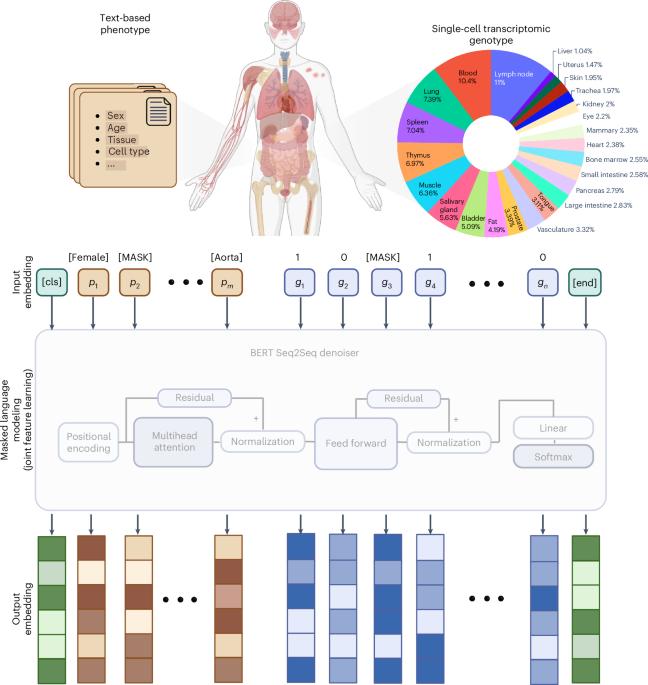
How complex phenotypes emerge from intricate gene expression patterns is a fundamental question in biology. Integrating high-content genotyping approaches such as single-cell RNA sequencing and advanced learning methods such as language models offers an opportunity for dissecting this complex relationship. Here we present a computational integrated genetics framework designed to analyze and interpret the high-dimensional landscape of genotypes and their associated phenotypes simultaneously. We applied this approach to develop a multimodal foundation model to explore the genotype–phenotype relationship manifold for human transcriptomics at the cellular level. Analyzing this joint manifold showed a refined resolution of cellular heterogeneity, uncovered potential cross-tissue biomarkers and provided contextualized embeddings to investigate the polyfunctionality of genes shown for the von Willebrand factor (VWF) gene in endothelial cells. Overall, this study advances our understanding of the dynamic interplay between gene expression and phenotypic manifestation and demonstrates the potential of integrated genetics in uncovering new dimensions of cellular function and complexity. A multimodal computational framework is proposed to integrate single-cell RNA sequencing data with phenotypic information to map complex genotype–phenotype relationships. This approach helps to refine cellular heterogeneity analysis, identify cross-tissue biomarkers and reveal polyfunctional characteristics of genes with cellular resolution.



 京公网安备 11010802042870号
京ICP备2023020795号-1
京公网安备 11010802042870号
京ICP备2023020795号-1

 分享
分享

 求助内容:
求助内容: 应助结果提醒方式:
 扫码关注我们
