{"title":"An examination of the use of standard operating procedures on family-operated farms","authors":"M. Beecher, T. Lawton, C. Hogan","doi":"10.3168/jdsc.2024-0587","DOIUrl":null,"url":null,"abstract":"<div><div>Standard operating procedures (SOPs) can improve farm work organization by ensuring processes are standardized among the different people completing the same task. In this study, we examined the use of SOPs on family-operated farms and determined the influence of the number of people working on a farm on SOP use. A survey of 315 Irish dairy farms was completed examining the human resource and workload management practices; this study used a subset of questions from that survey. Of the 315 farms surveyed, the average herd size was 125 cows and there was 1 other person working with the farmer (range 0 to 5 people). Categorizing farms based on the number of people working on farm, 35% of the farms were owner-operators, 37% had 1 other worker, and 28% had 2 or more workers. Overall, 31.3% (n = 98) of all farms surveyed had written SOPs, whereas 68.7% (n = 217) had no written SOPs. Interest in ready-made SOPs among farmers was high (77%). Farms without SOPs found it significantly more difficult to write down work processes and lacked time to create SOPs compared with farms with SOPs. Standard operating procedures most frequently existed for milking (89%), management of fresh cows (35%), and reproduction (29%). Respondents indicated that consistency in work completion was the greatest benefit of having SOPs (39.8%; n = 39), followed by increase in efficiency (17.3%; n = 17) and health and safety (12.2; n = 12). Forty-three percent of farms with more 3 or more people had significantly more written SOPs present compared with 25% of owner-operator farms and 27% farms with 2 people. This research provides a greater understanding of the use of SOPs on family-operated dairy farms, highlighting that the presence of SOPs increases as the number of workers on farm increases.</div></div>","PeriodicalId":94061,"journal":{"name":"JDS communications","volume":"6 1","pages":"Pages 39-43"},"PeriodicalIF":2.2000,"publicationDate":"2025-01-01","publicationTypes":"Journal Article","fieldsOfStudy":null,"isOpenAccess":false,"openAccessPdf":"https://www.ncbi.nlm.nih.gov/pmc/articles/PMC11770289/pdf/","citationCount":"0","resultStr":null,"platform":"Semanticscholar","paperid":null,"PeriodicalName":"JDS communications","FirstCategoryId":"1085","ListUrlMain":"https://www.sciencedirect.com/science/article/pii/S2666910224001248","RegionNum":0,"RegionCategory":null,"ArticlePicture":[],"TitleCN":null,"AbstractTextCN":null,"PMCID":null,"EPubDate":"","PubModel":"","JCR":"","JCRName":"","Score":null,"Total":0}
引用次数: 0
Abstract
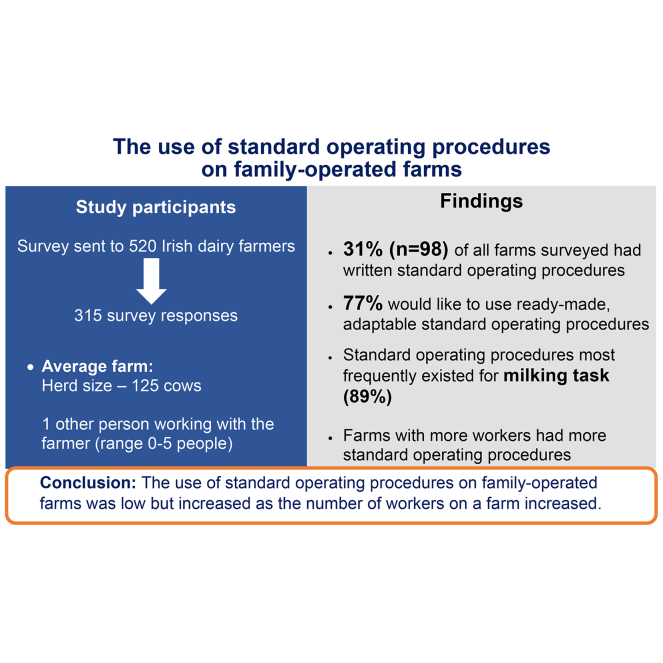
Standard operating procedures (SOPs) can improve farm work organization by ensuring processes are standardized among the different people completing the same task. In this study, we examined the use of SOPs on family-operated farms and determined the influence of the number of people working on a farm on SOP use. A survey of 315 Irish dairy farms was completed examining the human resource and workload management practices; this study used a subset of questions from that survey. Of the 315 farms surveyed, the average herd size was 125 cows and there was 1 other person working with the farmer (range 0 to 5 people). Categorizing farms based on the number of people working on farm, 35% of the farms were owner-operators, 37% had 1 other worker, and 28% had 2 or more workers. Overall, 31.3% (n = 98) of all farms surveyed had written SOPs, whereas 68.7% (n = 217) had no written SOPs. Interest in ready-made SOPs among farmers was high (77%). Farms without SOPs found it significantly more difficult to write down work processes and lacked time to create SOPs compared with farms with SOPs. Standard operating procedures most frequently existed for milking (89%), management of fresh cows (35%), and reproduction (29%). Respondents indicated that consistency in work completion was the greatest benefit of having SOPs (39.8%; n = 39), followed by increase in efficiency (17.3%; n = 17) and health and safety (12.2; n = 12). Forty-three percent of farms with more 3 or more people had significantly more written SOPs present compared with 25% of owner-operator farms and 27% farms with 2 people. This research provides a greater understanding of the use of SOPs on family-operated dairy farms, highlighting that the presence of SOPs increases as the number of workers on farm increases.





 京公网安备 11010802042870号
京ICP备2023020795号-1
京公网安备 11010802042870号
京ICP备2023020795号-1

 分享
分享
 求助内容:
求助内容: 应助结果提醒方式:
 扫码关注我们
