Sen Cui, Kai Song, Houjiang Liu, Hongyan Li, Yufei Zhang, Weijie Ren, Rui Zhang, Kun Li, Fang He, Zhenxing Qin, Huilin Hou
{"title":"Surface Nd Sites Boost Charge Transfer of Fe<sub>2</sub>O<sub>3</sub> Photoanodes for Enhanced Solar Water Oxidation.","authors":"Sen Cui, Kai Song, Houjiang Liu, Hongyan Li, Yufei Zhang, Weijie Ren, Rui Zhang, Kun Li, Fang He, Zhenxing Qin, Huilin Hou","doi":"10.1021/acsami.4c20958","DOIUrl":null,"url":null,"abstract":"<p><p>Photoelectrochemical (PEC) water splitting for hydrogen production is a promising technology for sustainable energy generation. In this work, we introduce Nd sites boost the PEC performance of Fe<sub>2</sub>O<sub>3</sub> photoanodes through a precise gas-phase cation exchange process, which substitutes surface Fe atoms with Nd. The incorporation of Nd significantly enhances charge transfer properties, increases carrier concentration, and reduces internal resistance, leading to a substantial increase in photocurrent density from 0.44 to 0.92 mA cm<sup>-2</sup> at 1.23 V<sub>RHE</sub>. Further enhancement of catalytic activity was achieved by depositing a NiCo(OH)<sub><i>x</i></sub> layer and a photocurrent density of 1.15 mA cm<sup>-2</sup> at 1.23 V<sub>RHE</sub> were obtained. Theoretical calculations corroborate these experimental results, revealing that Nd doping narrows the bandgap, improves charge separation efficiency, and lowers the reaction potential barrier, thereby accelerating water oxidation kinetics. These findings underscore the effectiveness of surface cation exchange and targeted metallic element doping in overcoming the intrinsic limitations of Fe<sub>2</sub>O<sub>3</sub>, providing a viable pathway for developing high-performance PEC systems for efficient hydrogen production.</p>","PeriodicalId":5,"journal":{"name":"ACS Applied Materials & Interfaces","volume":" ","pages":"9440-9451"},"PeriodicalIF":8.2000,"publicationDate":"2025-02-12","publicationTypes":"Journal Article","fieldsOfStudy":null,"isOpenAccess":false,"openAccessPdf":"","citationCount":"0","resultStr":null,"platform":"Semanticscholar","paperid":null,"PeriodicalName":"ACS Applied Materials & Interfaces","FirstCategoryId":"88","ListUrlMain":"https://doi.org/10.1021/acsami.4c20958","RegionNum":2,"RegionCategory":"材料科学","ArticlePicture":[],"TitleCN":null,"AbstractTextCN":null,"PMCID":null,"EPubDate":"2025/1/31 0:00:00","PubModel":"Epub","JCR":"Q1","JCRName":"MATERIALS SCIENCE, MULTIDISCIPLINARY","Score":null,"Total":0}
引用次数: 0
Abstract
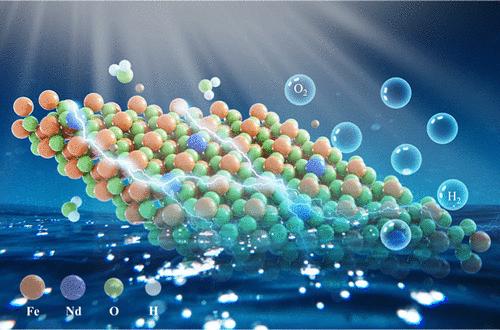
Photoelectrochemical (PEC) water splitting for hydrogen production is a promising technology for sustainable energy generation. In this work, we introduce Nd sites boost the PEC performance of Fe2O3 photoanodes through a precise gas-phase cation exchange process, which substitutes surface Fe atoms with Nd. The incorporation of Nd significantly enhances charge transfer properties, increases carrier concentration, and reduces internal resistance, leading to a substantial increase in photocurrent density from 0.44 to 0.92 mA cm-2 at 1.23 VRHE. Further enhancement of catalytic activity was achieved by depositing a NiCo(OH)x layer and a photocurrent density of 1.15 mA cm-2 at 1.23 VRHE were obtained. Theoretical calculations corroborate these experimental results, revealing that Nd doping narrows the bandgap, improves charge separation efficiency, and lowers the reaction potential barrier, thereby accelerating water oxidation kinetics. These findings underscore the effectiveness of surface cation exchange and targeted metallic element doping in overcoming the intrinsic limitations of Fe2O3, providing a viable pathway for developing high-performance PEC systems for efficient hydrogen production.
光电化学水分解制氢技术是一种很有前途的可持续能源生产技术。在这项工作中,我们引入Nd位点,通过精确的气相阳离子交换过程,用Nd取代表面铁原子,提高Fe2O3光阳极的PEC性能。Nd的掺入显著提高了电荷转移性能,增加了载流子浓度,降低了内阻,导致光电流密度在1.23 VRHE下从0.44 mA cm-2大幅增加到0.92 mA cm-2。通过沉积NiCo(OH)x层进一步提高了催化活性,在1.23 VRHE下获得了1.15 mA cm-2的光电流密度。理论计算证实了这些实验结果,发现Nd掺杂缩小了带隙,提高了电荷分离效率,降低了反应势垒,从而加速了水的氧化动力学。这些发现强调了表面阳离子交换和靶向金属元素掺杂在克服Fe2O3固有局限性方面的有效性,为开发高效制氢的高性能PEC系统提供了可行的途径。
期刊介绍:
ACS Applied Materials & Interfaces is a leading interdisciplinary journal that brings together chemists, engineers, physicists, and biologists to explore the development and utilization of newly-discovered materials and interfacial processes for specific applications. Our journal has experienced remarkable growth since its establishment in 2009, both in terms of the number of articles published and the impact of the research showcased. We are proud to foster a truly global community, with the majority of published articles originating from outside the United States, reflecting the rapid growth of applied research worldwide.



 京公网安备 11010802042870号
京ICP备2023020795号-1
京公网安备 11010802042870号
京ICP备2023020795号-1

 分享
分享
 求助内容:
求助内容: 应助结果提醒方式:
 扫码关注我们
