Jinhong Bing , Bangguo Zhou , Minqi Chen , Yucui Shen , Min Zhou , Han Lin , Wencheng Wu , Jianlin Shi
{"title":"Nanomedicine-enabled concurrent regulations of ROS generation and copper metabolism for sonodynamic-amplified tumor therapy","authors":"Jinhong Bing , Bangguo Zhou , Minqi Chen , Yucui Shen , Min Zhou , Han Lin , Wencheng Wu , Jianlin Shi","doi":"10.1016/j.biomaterials.2025.123137","DOIUrl":null,"url":null,"abstract":"<div><div>Sonodynamic therapy (SDT) shows substantial potentials in cancer treatment thanks to the deep tissue penetration of ultrasound. However, its clinical translation suffers from the potential damages to healthy tissues and the resistance of tumors, particularly from cancer stem-like cells (CSCs), to the ultrasound. To address these challenges, we designed a novel glutathione (GSH)-activated nanomedicine to simultaneously enhance the safety and efficacy of SDT by in situ regulating the generation of reactive oxygen species (ROS) and copper metabolism. This nanomedicine, Es@CuTCPP, was created by loading elesclomol (Es) onto CuTCPP nanosheets. By accumulating this nanomedicine in tumors, the Cu(II)-TCPP is reduced to the highly sonosensitive Cu(I)-TCPP by the intra-tumoral-overexpressed GSH, leading to the production of abundant ROS upon ultrasound exposure, which effectively kills large amounts of tumor cells. Concurrently, the released copper ions react with co-released Es to form a CuEs complex, which induces cuproptosis of CSCs surviving the ROS attack by disrupting cellular copper metabolism, evidently amplifying the effectiveness of SDT. This work presents the first paradigm of a GSH-activated and cuproptosis-enhanced SDT approach, offering a promising novel strategy for cancer therapy.</div></div>","PeriodicalId":254,"journal":{"name":"Biomaterials","volume":"318 ","pages":"Article 123137"},"PeriodicalIF":12.9000,"publicationDate":"2025-01-27","publicationTypes":"Journal Article","fieldsOfStudy":null,"isOpenAccess":false,"openAccessPdf":"","citationCount":"0","resultStr":null,"platform":"Semanticscholar","paperid":null,"PeriodicalName":"Biomaterials","FirstCategoryId":"5","ListUrlMain":"https://www.sciencedirect.com/science/article/pii/S0142961225000560","RegionNum":1,"RegionCategory":"医学","ArticlePicture":[],"TitleCN":null,"AbstractTextCN":null,"PMCID":null,"EPubDate":"","PubModel":"","JCR":"Q1","JCRName":"ENGINEERING, BIOMEDICAL","Score":null,"Total":0}
引用次数: 0
Abstract
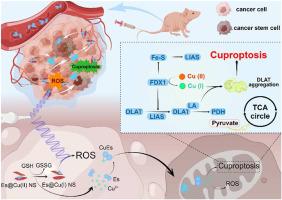
Sonodynamic therapy (SDT) shows substantial potentials in cancer treatment thanks to the deep tissue penetration of ultrasound. However, its clinical translation suffers from the potential damages to healthy tissues and the resistance of tumors, particularly from cancer stem-like cells (CSCs), to the ultrasound. To address these challenges, we designed a novel glutathione (GSH)-activated nanomedicine to simultaneously enhance the safety and efficacy of SDT by in situ regulating the generation of reactive oxygen species (ROS) and copper metabolism. This nanomedicine, Es@CuTCPP, was created by loading elesclomol (Es) onto CuTCPP nanosheets. By accumulating this nanomedicine in tumors, the Cu(II)-TCPP is reduced to the highly sonosensitive Cu(I)-TCPP by the intra-tumoral-overexpressed GSH, leading to the production of abundant ROS upon ultrasound exposure, which effectively kills large amounts of tumor cells. Concurrently, the released copper ions react with co-released Es to form a CuEs complex, which induces cuproptosis of CSCs surviving the ROS attack by disrupting cellular copper metabolism, evidently amplifying the effectiveness of SDT. This work presents the first paradigm of a GSH-activated and cuproptosis-enhanced SDT approach, offering a promising novel strategy for cancer therapy.
期刊介绍:
Biomaterials is an international journal covering the science and clinical application of biomaterials. A biomaterial is now defined as a substance that has been engineered to take a form which, alone or as part of a complex system, is used to direct, by control of interactions with components of living systems, the course of any therapeutic or diagnostic procedure. It is the aim of the journal to provide a peer-reviewed forum for the publication of original papers and authoritative review and opinion papers dealing with the most important issues facing the use of biomaterials in clinical practice. The scope of the journal covers the wide range of physical, biological and chemical sciences that underpin the design of biomaterials and the clinical disciplines in which they are used. These sciences include polymer synthesis and characterization, drug and gene vector design, the biology of the host response, immunology and toxicology and self assembly at the nanoscale. Clinical applications include the therapies of medical technology and regenerative medicine in all clinical disciplines, and diagnostic systems that reply on innovative contrast and sensing agents. The journal is relevant to areas such as cancer diagnosis and therapy, implantable devices, drug delivery systems, gene vectors, bionanotechnology and tissue engineering.



 京公网安备 11010802042870号
京ICP备2023020795号-1
京公网安备 11010802042870号
京ICP备2023020795号-1

 分享
分享
 求助内容:
求助内容: 应助结果提醒方式:
 扫码关注我们
