{"title":"Assessment of cardiac iron deposition and genotypic classification in pediatric beta-thalassemia major: the role of cardiac MRI.","authors":"Siqi Zhang, Wen Zhao, Longwei Sun, Guohua Liang, Xiaodong Wang, Hongwu Zeng","doi":"10.1186/s12880-025-01567-7","DOIUrl":null,"url":null,"abstract":"<p><strong>Background: </strong>Beta thalassemia major (β-TM) is a severe genetic anemia with considerable phenotypic heterogeneity. This study investigated whether genotype correlates with distinct myocardial iron overload patterns, assessed by cardiovascular magnetic resonance (CMR) T2* values.</p><p><strong>Methods: </strong>CMR data for cardiac iron deposition evaluation, which recruited pediatric participants between January 2021 and December 2024, were analyzed with CVI42. The patients were classified into three genetic subgroups of β<sup>0</sup>/β<sup>0</sup>, β<sup>0</sup>/β<sup>+</sup>, and β<sup>+</sup>/β<sup>+</sup> based on their genetic outcomes. The CMR results classified patients into normal myocardial T2* value and myocardial iron overload groups. Qualitative and quantitative factors were subsequently compared by groups using comparative statistics.</p><p><strong>Results: </strong>The study included 145 pediatric β-TM patients, with 24 (17%) exhibiting cardiac iron deposition based on CMR T2* values. There were significant differences in iron chelation treatment strategies across genotypes, with the β<sup>0</sup>/β<sup>0</sup> genotype accounting for 54% (13/24) of patients in the cardiac iron deposition group. Regardless of genotype, the mid-inferolateral segment consistently showed the lowest CMR T2* values and the highest prevalence of iron deposition.</p><p><strong>Conclusion: </strong>The risk of cardiac iron deposition increases as age progresses, and the mid-inferolateral segment is more susceptible to iron accumulation. The β<sup>0</sup>/β<sup>0</sup> genotype is more likely to suffer from cardiac iron overload, emphasizing the need for closer clinical monitoring and regular cardiac MRI evaluations.</p>","PeriodicalId":9020,"journal":{"name":"BMC Medical Imaging","volume":"25 1","pages":"31"},"PeriodicalIF":3.2000,"publicationDate":"2025-01-30","publicationTypes":"Journal Article","fieldsOfStudy":null,"isOpenAccess":false,"openAccessPdf":"https://www.ncbi.nlm.nih.gov/pmc/articles/PMC11783902/pdf/","citationCount":"0","resultStr":null,"platform":"Semanticscholar","paperid":null,"PeriodicalName":"BMC Medical Imaging","FirstCategoryId":"3","ListUrlMain":"https://doi.org/10.1186/s12880-025-01567-7","RegionNum":3,"RegionCategory":"医学","ArticlePicture":[],"TitleCN":null,"AbstractTextCN":null,"PMCID":null,"EPubDate":"","PubModel":"","JCR":"Q2","JCRName":"RADIOLOGY, NUCLEAR MEDICINE & MEDICAL IMAGING","Score":null,"Total":0}
引用次数: 0
Abstract
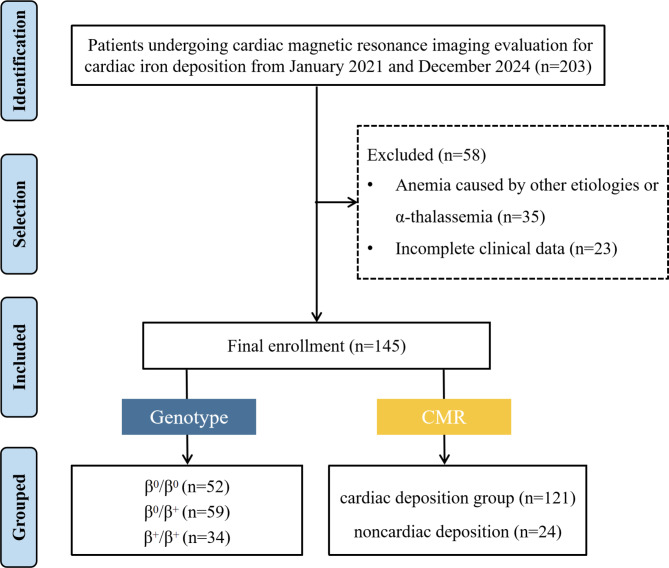
Background: Beta thalassemia major (β-TM) is a severe genetic anemia with considerable phenotypic heterogeneity. This study investigated whether genotype correlates with distinct myocardial iron overload patterns, assessed by cardiovascular magnetic resonance (CMR) T2* values.
Methods: CMR data for cardiac iron deposition evaluation, which recruited pediatric participants between January 2021 and December 2024, were analyzed with CVI42. The patients were classified into three genetic subgroups of β0/β0, β0/β+, and β+/β+ based on their genetic outcomes. The CMR results classified patients into normal myocardial T2* value and myocardial iron overload groups. Qualitative and quantitative factors were subsequently compared by groups using comparative statistics.
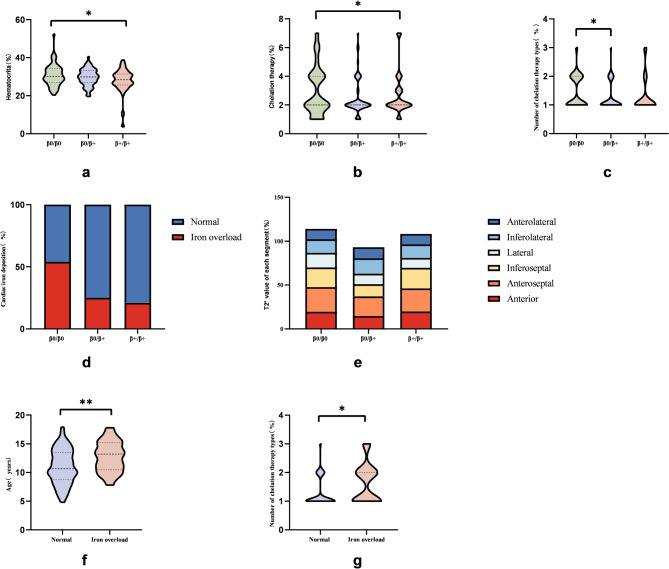
Results: The study included 145 pediatric β-TM patients, with 24 (17%) exhibiting cardiac iron deposition based on CMR T2* values. There were significant differences in iron chelation treatment strategies across genotypes, with the β0/β0 genotype accounting for 54% (13/24) of patients in the cardiac iron deposition group. Regardless of genotype, the mid-inferolateral segment consistently showed the lowest CMR T2* values and the highest prevalence of iron deposition.
Conclusion: The risk of cardiac iron deposition increases as age progresses, and the mid-inferolateral segment is more susceptible to iron accumulation. The β0/β0 genotype is more likely to suffer from cardiac iron overload, emphasizing the need for closer clinical monitoring and regular cardiac MRI evaluations.
期刊介绍:
BMC Medical Imaging is an open access journal publishing original peer-reviewed research articles in the development, evaluation, and use of imaging techniques and image processing tools to diagnose and manage disease.




 京公网安备 11010802042870号
京ICP备2023020795号-1
京公网安备 11010802042870号
京ICP备2023020795号-1

 分享
分享
 求助内容:
求助内容: 应助结果提醒方式:
 扫码关注我们
