{"title":"Global remapping emerges as the mechanism for renewal of context-dependent behavior in a reinforcement learning model.","authors":"David Kappel, Sen Cheng","doi":"10.3389/fncom.2024.1462110","DOIUrl":null,"url":null,"abstract":"<p><strong>Introduction: </strong>The hippocampal formation exhibits complex and context-dependent activity patterns and dynamics, e.g., place cell activity during spatial navigation in rodents or remapping of place fields when the animal switches between contexts. Furthermore, rodents show context-dependent renewal of extinguished behavior. However, the link between context-dependent neural codes and context-dependent renewal is not fully understood.</p><p><strong>Methods: </strong>We use a deep neural network-based reinforcement learning agent to study the learning dynamics that occur during spatial learning and context switching in a simulated ABA extinction and renewal paradigm in a 3D virtual environment.</p><p><strong>Results: </strong>Despite its simplicity, the network exhibits a number of features typically found in the CA1 and CA3 regions of the hippocampus. A significant proportion of neurons in deeper layers of the network are tuned to a specific spatial position of the agent in the environment-similar to place cells in the hippocampus. These complex spatial representations and dynamics occur spontaneously in the hidden layer of a deep network during learning. These spatial representations exhibit global remapping when the agent is exposed to a new context. The spatial maps are restored when the agent returns to the previous context, accompanied by renewal of the conditioned behavior. Remapping is facilitated by memory replay of experiences during training.</p><p><strong>Discussion: </strong>Our results show that integrated codes that jointly represent spatial and task-relevant contextual variables are the mechanism underlying renewal in a simulated DQN agent.</p>","PeriodicalId":12363,"journal":{"name":"Frontiers in Computational Neuroscience","volume":"18 ","pages":"1462110"},"PeriodicalIF":2.3000,"publicationDate":"2025-01-15","publicationTypes":"Journal Article","fieldsOfStudy":null,"isOpenAccess":false,"openAccessPdf":"https://www.ncbi.nlm.nih.gov/pmc/articles/PMC11774835/pdf/","citationCount":"0","resultStr":null,"platform":"Semanticscholar","paperid":null,"PeriodicalName":"Frontiers in Computational Neuroscience","FirstCategoryId":"3","ListUrlMain":"https://doi.org/10.3389/fncom.2024.1462110","RegionNum":4,"RegionCategory":"医学","ArticlePicture":[],"TitleCN":null,"AbstractTextCN":null,"PMCID":null,"EPubDate":"2024/1/1 0:00:00","PubModel":"eCollection","JCR":"Q2","JCRName":"MATHEMATICAL & COMPUTATIONAL BIOLOGY","Score":null,"Total":0}
引用次数: 0
Abstract
Introduction: The hippocampal formation exhibits complex and context-dependent activity patterns and dynamics, e.g., place cell activity during spatial navigation in rodents or remapping of place fields when the animal switches between contexts. Furthermore, rodents show context-dependent renewal of extinguished behavior. However, the link between context-dependent neural codes and context-dependent renewal is not fully understood.
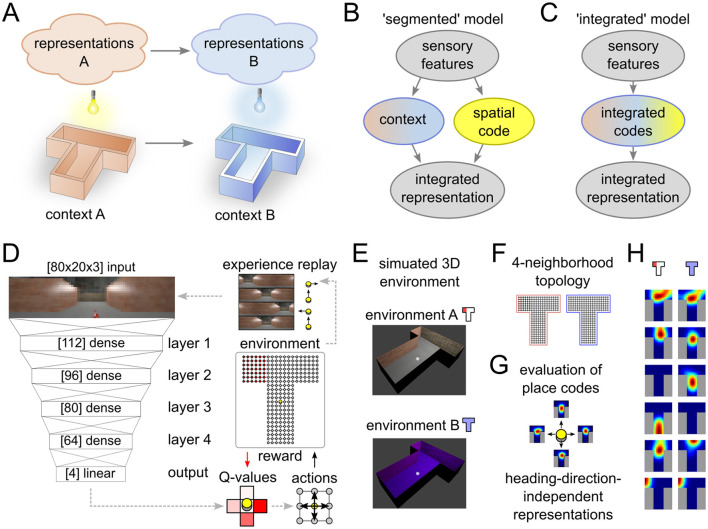
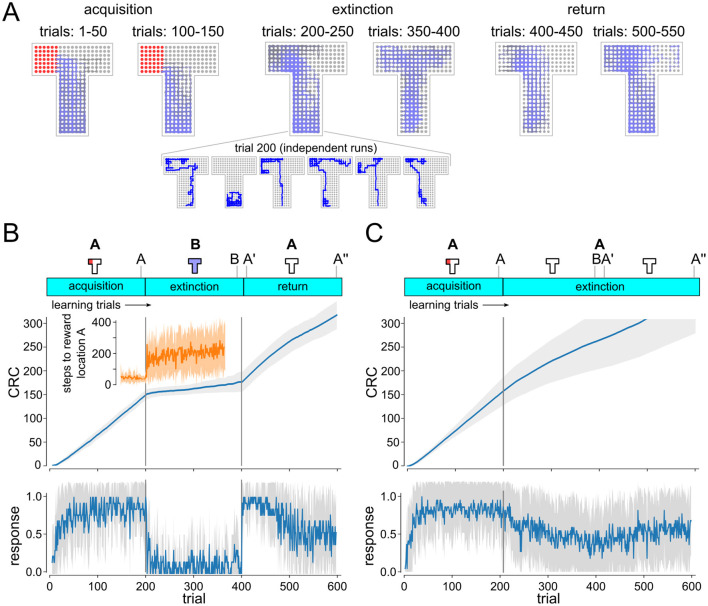
Methods: We use a deep neural network-based reinforcement learning agent to study the learning dynamics that occur during spatial learning and context switching in a simulated ABA extinction and renewal paradigm in a 3D virtual environment.
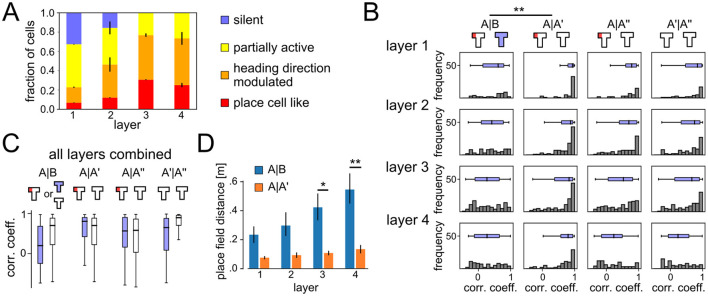
Results: Despite its simplicity, the network exhibits a number of features typically found in the CA1 and CA3 regions of the hippocampus. A significant proportion of neurons in deeper layers of the network are tuned to a specific spatial position of the agent in the environment-similar to place cells in the hippocampus. These complex spatial representations and dynamics occur spontaneously in the hidden layer of a deep network during learning. These spatial representations exhibit global remapping when the agent is exposed to a new context. The spatial maps are restored when the agent returns to the previous context, accompanied by renewal of the conditioned behavior. Remapping is facilitated by memory replay of experiences during training.
Discussion: Our results show that integrated codes that jointly represent spatial and task-relevant contextual variables are the mechanism underlying renewal in a simulated DQN agent.
期刊介绍:
Frontiers in Computational Neuroscience is a first-tier electronic journal devoted to promoting theoretical modeling of brain function and fostering interdisciplinary interactions between theoretical and experimental neuroscience. Progress in understanding the amazing capabilities of the brain is still limited, and we believe that it will only come with deep theoretical thinking and mutually stimulating cooperation between different disciplines and approaches. We therefore invite original contributions on a wide range of topics that present the fruits of such cooperation, or provide stimuli for future alliances. We aim to provide an interactive forum for cutting-edge theoretical studies of the nervous system, and for promulgating the best theoretical research to the broader neuroscience community. Models of all styles and at all levels are welcome, from biophysically motivated realistic simulations of neurons and synapses to high-level abstract models of inference and decision making. While the journal is primarily focused on theoretically based and driven research, we welcome experimental studies that validate and test theoretical conclusions.
Also: comp neuro




 京公网安备 11010802042870号
京ICP备2023020795号-1
京公网安备 11010802042870号
京ICP备2023020795号-1

 分享
分享
 求助内容:
求助内容: 应助结果提醒方式:
 扫码关注我们
