Emilia Hagman, Resthie R. Putri, Pernilla Danielsson, Claude Marcus
{"title":"Pediatric obesity and the risk of multiple sclerosis: a nationwide prospective cohort study","authors":"Emilia Hagman, Resthie R. Putri, Pernilla Danielsson, Claude Marcus","doi":"10.1038/s41366-025-01727-3","DOIUrl":null,"url":null,"abstract":"Emerging evidence implies a link between high pediatric body mass index (BMI) and an increased risk of multiple sclerosis (MS). However, previous research suggests this association is only present for adolescent obesity and not childhood obesity. The present study aimed to assess the association between pediatric obesity and risk of developing MS, and to investigate if degree of obesity and age at obesity treatment initiation affects the risk. In a subgroup, response to obesity treatment on MS risk was assessed. In this cohort study, patients aged 2–19 years from the Swedish Childhood Obesity Treatment Register (BORIS), and matched individuals from the general population were followed prospectively. MS was identified through the National Patient Register. Hazard ratios (HR) adjusted for parental MS were calculated. The study included 21,652 individuals with pediatric obesity and 102,187 general population comparators. The median age at follow-up was 21 (Q1, Q3 18, 25) years. The adjusted HR (95% CI) for developing MS in the pediatric obesity cohort was 2.28 (1.45–3.58). In stratified analyses, obesity class I was not associated with MS, HR = 1.34 (0.64–2.81), while the association between obesity class II and MS was strengthened, HR = 3.42 (1.89–6.19). MS was associated with both childhood obesity, HR = 3.16 (1.12–8.87), and adolescent obesity, HR = 2.12 (1.28–3.51). A decrease in BMI SDS was not associated with lower likelihood of MS, HR = 1.09 (0.92–1.29) per 0.25 BMI SDS unit decrease. Both childhood and adolescent obesity are associated with an increased risk of MS. Moreover, a dose-response relationship between the degree of obesity and the risk of future MS was indicated, while response to pediatric obesity treatment did not affect the association, highlighting the importance of preventing high degree of obesity early in life.","PeriodicalId":14183,"journal":{"name":"International Journal of Obesity","volume":"49 6","pages":"1031-1036"},"PeriodicalIF":3.8000,"publicationDate":"2025-01-30","publicationTypes":"Journal Article","fieldsOfStudy":null,"isOpenAccess":false,"openAccessPdf":"https://www.ncbi.nlm.nih.gov/pmc/articles/PMC12158760/pdf/","citationCount":"0","resultStr":null,"platform":"Semanticscholar","paperid":null,"PeriodicalName":"International Journal of Obesity","FirstCategoryId":"3","ListUrlMain":"https://www.nature.com/articles/s41366-025-01727-3","RegionNum":2,"RegionCategory":"医学","ArticlePicture":[],"TitleCN":null,"AbstractTextCN":null,"PMCID":null,"EPubDate":"","PubModel":"","JCR":"Q1","JCRName":"ENDOCRINOLOGY & METABOLISM","Score":null,"Total":0}
引用次数: 0
Abstract
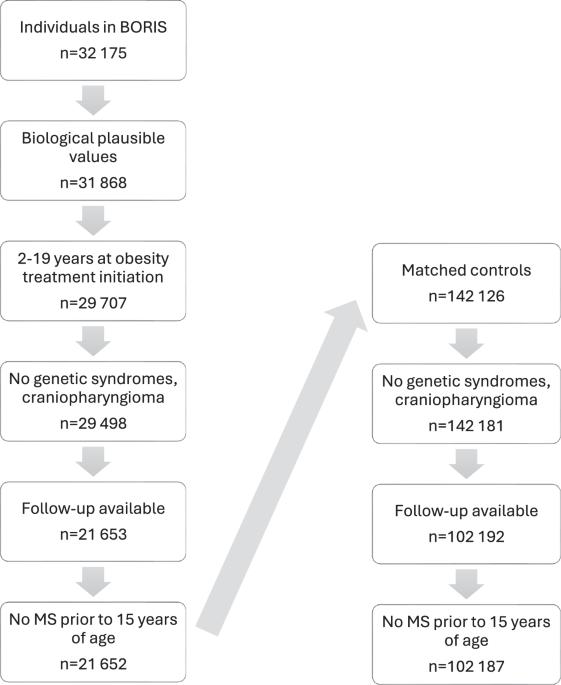
Emerging evidence implies a link between high pediatric body mass index (BMI) and an increased risk of multiple sclerosis (MS). However, previous research suggests this association is only present for adolescent obesity and not childhood obesity. The present study aimed to assess the association between pediatric obesity and risk of developing MS, and to investigate if degree of obesity and age at obesity treatment initiation affects the risk. In a subgroup, response to obesity treatment on MS risk was assessed. In this cohort study, patients aged 2–19 years from the Swedish Childhood Obesity Treatment Register (BORIS), and matched individuals from the general population were followed prospectively. MS was identified through the National Patient Register. Hazard ratios (HR) adjusted for parental MS were calculated. The study included 21,652 individuals with pediatric obesity and 102,187 general population comparators. The median age at follow-up was 21 (Q1, Q3 18, 25) years. The adjusted HR (95% CI) for developing MS in the pediatric obesity cohort was 2.28 (1.45–3.58). In stratified analyses, obesity class I was not associated with MS, HR = 1.34 (0.64–2.81), while the association between obesity class II and MS was strengthened, HR = 3.42 (1.89–6.19). MS was associated with both childhood obesity, HR = 3.16 (1.12–8.87), and adolescent obesity, HR = 2.12 (1.28–3.51). A decrease in BMI SDS was not associated with lower likelihood of MS, HR = 1.09 (0.92–1.29) per 0.25 BMI SDS unit decrease. Both childhood and adolescent obesity are associated with an increased risk of MS. Moreover, a dose-response relationship between the degree of obesity and the risk of future MS was indicated, while response to pediatric obesity treatment did not affect the association, highlighting the importance of preventing high degree of obesity early in life.
期刊介绍:
The International Journal of Obesity is a multi-disciplinary forum for research describing basic, clinical and applied studies in biochemistry, physiology, genetics and nutrition, molecular, metabolic, psychological and epidemiological aspects of obesity and related disorders.
We publish a range of content types including original research articles, technical reports, reviews, correspondence and brief communications that elaborate on significant advances in the field and cover topical issues.



 京公网安备 11010802042870号
京ICP备2023020795号-1
京公网安备 11010802042870号
京ICP备2023020795号-1

 分享
分享
 求助内容:
求助内容: 应助结果提醒方式:
 扫码关注我们
