Pascal Raszke, Godwin Denk Giebel, Carina Abels, Jürgen Wasem, Michael Adamzik, Hartmuth Nowak, Lars Palmowski, Philipp Heinz, Silke Mreyen, Nina Timmesfeld, Marianne Tokic, Frank Martin Brunkhorst, Nikola Blase
{"title":"User-Oriented Requirements for Artificial Intelligence-Based Clinical Decision Support Systems in Sepsis: Protocol for a Multimethod Research Project.","authors":"Pascal Raszke, Godwin Denk Giebel, Carina Abels, Jürgen Wasem, Michael Adamzik, Hartmuth Nowak, Lars Palmowski, Philipp Heinz, Silke Mreyen, Nina Timmesfeld, Marianne Tokic, Frank Martin Brunkhorst, Nikola Blase","doi":"10.2196/62704","DOIUrl":null,"url":null,"abstract":"<p><strong>Background: </strong>Artificial intelligence (AI)-based clinical decision support systems (CDSS) have been developed for several diseases. However, despite the potential to improve the quality of care and thereby positively impact patient-relevant outcomes, the majority of AI-based CDSS have not been adopted in standard care. Possible reasons for this include barriers in the implementation and a nonuser-oriented development approach, resulting in reduced user acceptance.</p><p><strong>Objective: </strong>This research project has 2 objectives. First, problems and corresponding solutions that hinder or support the development and implementation of AI-based CDSS are identified. Second, the research project aims to increase user acceptance by creating a user-oriented requirement profile, using the example of sepsis.</p><p><strong>Methods: </strong>The research project is based on a multimethod approach combining (1) a scoping review, (2) focus groups with physicians and professional caregivers, and (3) semistructured interviews with relevant stakeholders. The research modules mentioned provide the basis for the development of a (4) survey, including a discrete choice experiment (DCE) with physicians. A minimum of 6667 physicians with expertise in the clinical picture of sepsis are contacted for this purpose. The survey is followed by the development of a requirement profile for AI-based CDSS and the derivation of policy recommendations for action, which are evaluated in a (5) expert roundtable discussion.</p><p><strong>Results: </strong>The multimethod research project started in November 2022. It provides an overview of the barriers and corresponding solutions related to the development and implementation of AI-based CDSS. Using sepsis as an example, a user-oriented requirement profile for AI-based CDSS is developed. The scoping review has been concluded and the qualitative modules have been subjected to analysis. The start of the survey, including the DCE, was at the end of July 2024.</p><p><strong>Conclusions: </strong>The results of the research project represent the first attempt to create a comprehensive user-oriented requirement profile for the development of sepsis-specific AI-based CDSS. In addition, general recommendations are derived, in order to reduce barriers in the development and implementation of AI-based CDSS. The findings of this research project have the potential to facilitate the integration of AI-based CDSS into standard care in the long term.</p><p><strong>International registered report identifier (irrid): </strong>DERR1-10.2196/62704.</p>","PeriodicalId":14755,"journal":{"name":"JMIR Research Protocols","volume":"14 ","pages":"e62704"},"PeriodicalIF":1.5000,"publicationDate":"2025-01-30","publicationTypes":"Journal Article","fieldsOfStudy":null,"isOpenAccess":false,"openAccessPdf":"https://www.ncbi.nlm.nih.gov/pmc/articles/PMC11826947/pdf/","citationCount":"0","resultStr":null,"platform":"Semanticscholar","paperid":null,"PeriodicalName":"JMIR Research Protocols","FirstCategoryId":"1085","ListUrlMain":"https://doi.org/10.2196/62704","RegionNum":0,"RegionCategory":null,"ArticlePicture":[],"TitleCN":null,"AbstractTextCN":null,"PMCID":null,"EPubDate":"","PubModel":"","JCR":"Q3","JCRName":"HEALTH CARE SCIENCES & SERVICES","Score":null,"Total":0}
引用次数: 0
Abstract
Background: Artificial intelligence (AI)-based clinical decision support systems (CDSS) have been developed for several diseases. However, despite the potential to improve the quality of care and thereby positively impact patient-relevant outcomes, the majority of AI-based CDSS have not been adopted in standard care. Possible reasons for this include barriers in the implementation and a nonuser-oriented development approach, resulting in reduced user acceptance.
Objective: This research project has 2 objectives. First, problems and corresponding solutions that hinder or support the development and implementation of AI-based CDSS are identified. Second, the research project aims to increase user acceptance by creating a user-oriented requirement profile, using the example of sepsis.
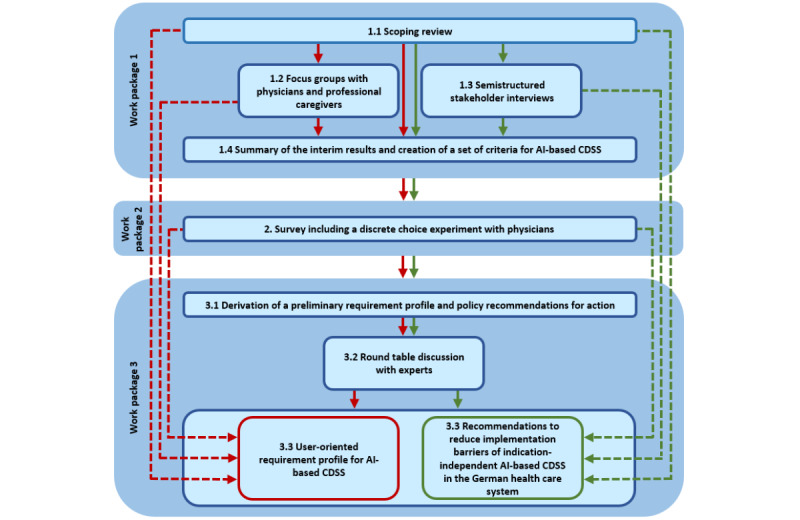
Methods: The research project is based on a multimethod approach combining (1) a scoping review, (2) focus groups with physicians and professional caregivers, and (3) semistructured interviews with relevant stakeholders. The research modules mentioned provide the basis for the development of a (4) survey, including a discrete choice experiment (DCE) with physicians. A minimum of 6667 physicians with expertise in the clinical picture of sepsis are contacted for this purpose. The survey is followed by the development of a requirement profile for AI-based CDSS and the derivation of policy recommendations for action, which are evaluated in a (5) expert roundtable discussion.
Results: The multimethod research project started in November 2022. It provides an overview of the barriers and corresponding solutions related to the development and implementation of AI-based CDSS. Using sepsis as an example, a user-oriented requirement profile for AI-based CDSS is developed. The scoping review has been concluded and the qualitative modules have been subjected to analysis. The start of the survey, including the DCE, was at the end of July 2024.
Conclusions: The results of the research project represent the first attempt to create a comprehensive user-oriented requirement profile for the development of sepsis-specific AI-based CDSS. In addition, general recommendations are derived, in order to reduce barriers in the development and implementation of AI-based CDSS. The findings of this research project have the potential to facilitate the integration of AI-based CDSS into standard care in the long term.
International registered report identifier (irrid): DERR1-10.2196/62704.




 京公网安备 11010802042870号
京ICP备2023020795号-1
京公网安备 11010802042870号
京ICP备2023020795号-1

 分享
分享
 求助内容:
求助内容: 应助结果提醒方式:
 扫码关注我们
