Ricardo Smits Serena, Florian Hinterwimmer, Rainer Burgkart, Rudiger von Eisenhart-Rothe, Daniel Rueckert
{"title":"The Use of Artificial Intelligence and Wearable Inertial Measurement Units in Medicine: Systematic Review.","authors":"Ricardo Smits Serena, Florian Hinterwimmer, Rainer Burgkart, Rudiger von Eisenhart-Rothe, Daniel Rueckert","doi":"10.2196/60521","DOIUrl":null,"url":null,"abstract":"<p><strong>Background: </strong>Artificial intelligence (AI) has already revolutionized the analysis of image, text, and tabular data, bringing significant advances across many medical sectors. Now, by combining with wearable inertial measurement units (IMUs), AI could transform health care again by opening new opportunities in patient care and medical research.</p><p><strong>Objective: </strong>This systematic review aims to evaluate the integration of AI models with wearable IMUs in health care, identifying current applications, challenges, and future opportunities. The focus will be on the types of models used, the characteristics of the datasets, and the potential for expanding and enhancing the use of this technology to improve patient care and advance medical research.</p><p><strong>Methods: </strong>This study examines this synergy of AI models and IMU data by using a systematic methodology, following PRISMA (Preferred Reporting Items for Systematic Reviews and Meta-Analyses) guidelines, to explore 3 core questions: (1) Which medical fields are most actively researching AI and IMU data? (2) Which models are being used in the analysis of IMU data within these medical fields? (3) What are the characteristics of the datasets used for in this fields?</p><p><strong>Results: </strong>The median dataset size is of 50 participants, which poses significant limitations for AI models given their dependency on large datasets for effective training and generalization. Furthermore, our analysis reveals the current dominance of machine learning models in 76% on the surveyed studies, suggesting a preference for traditional models like linear regression, support vector machine, and random forest, but also indicating significant growth potential for deep learning models in this area. Impressively, 93% of the studies used supervised learning, revealing an underuse of unsupervised learning, and indicating an important area for future exploration on discovering hidden patterns and insights without predefined labels or outcomes. In addition, there was a preference for conducting studies in clinical settings (77%), rather than in real-life scenarios, a choice that, along with the underapplication of the full potential of wearable IMUs, is recognized as a limitation in terms of practical applicability. Furthermore, the focus of 65% of the studies on neurological issues suggests an opportunity to broaden research scope to other clinical areas such as musculoskeletal applications, where AI could have significant impacts.</p><p><strong>Conclusions: </strong>In conclusion, the review calls for a collaborative effort to address the highlighted challenges, including improvements in data collection, increasing dataset sizes, a move that inherently pushes the field toward the adoption of more complex deep learning models, and the expansion of the application of AI models on IMU data methodologies across various medical fields. This approach aims to enhance the reliability, generalizability, and clinical applicability of research findings, ultimately improving patient outcomes and advancing medical research.</p>","PeriodicalId":14756,"journal":{"name":"JMIR mHealth and uHealth","volume":"13 ","pages":"e60521"},"PeriodicalIF":6.2000,"publicationDate":"2025-01-29","publicationTypes":"Journal Article","fieldsOfStudy":null,"isOpenAccess":false,"openAccessPdf":"https://www.ncbi.nlm.nih.gov/pmc/articles/PMC11822330/pdf/","citationCount":"0","resultStr":null,"platform":"Semanticscholar","paperid":null,"PeriodicalName":"JMIR mHealth and uHealth","FirstCategoryId":"3","ListUrlMain":"https://doi.org/10.2196/60521","RegionNum":2,"RegionCategory":"医学","ArticlePicture":[],"TitleCN":null,"AbstractTextCN":null,"PMCID":null,"EPubDate":"","PubModel":"","JCR":"Q1","JCRName":"HEALTH CARE SCIENCES & SERVICES","Score":null,"Total":0}
引用次数: 0
Abstract
Background: Artificial intelligence (AI) has already revolutionized the analysis of image, text, and tabular data, bringing significant advances across many medical sectors. Now, by combining with wearable inertial measurement units (IMUs), AI could transform health care again by opening new opportunities in patient care and medical research.
Objective: This systematic review aims to evaluate the integration of AI models with wearable IMUs in health care, identifying current applications, challenges, and future opportunities. The focus will be on the types of models used, the characteristics of the datasets, and the potential for expanding and enhancing the use of this technology to improve patient care and advance medical research.
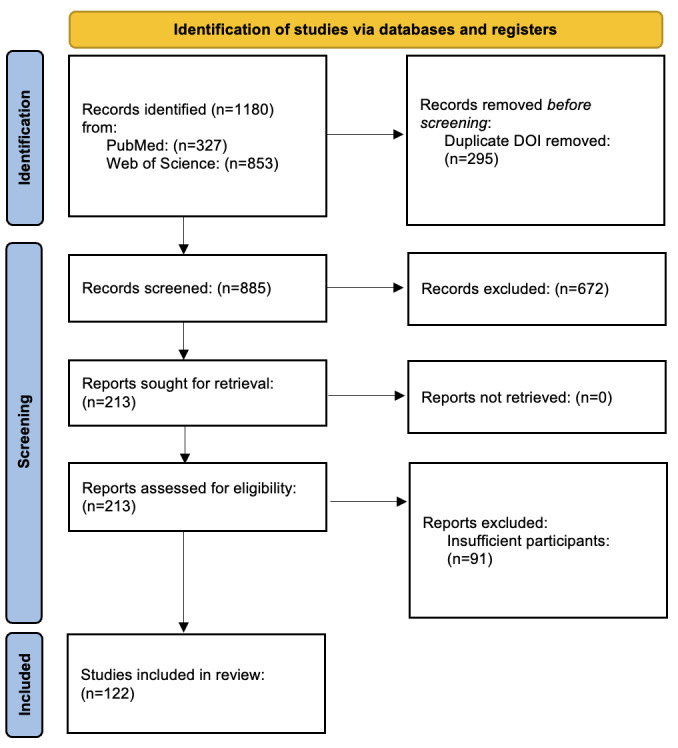
Methods: This study examines this synergy of AI models and IMU data by using a systematic methodology, following PRISMA (Preferred Reporting Items for Systematic Reviews and Meta-Analyses) guidelines, to explore 3 core questions: (1) Which medical fields are most actively researching AI and IMU data? (2) Which models are being used in the analysis of IMU data within these medical fields? (3) What are the characteristics of the datasets used for in this fields?
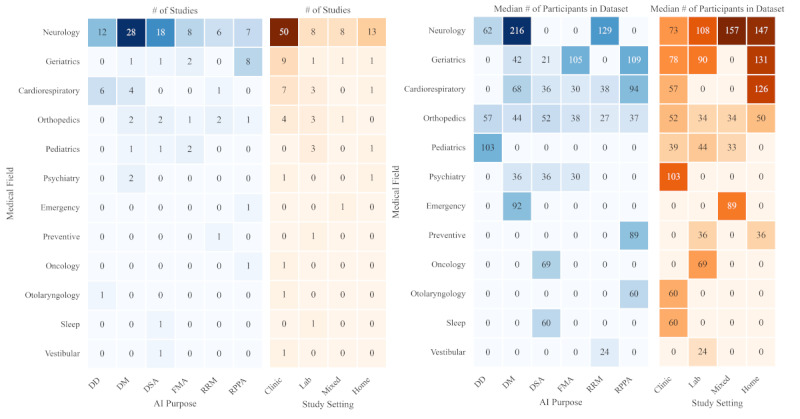
Results: The median dataset size is of 50 participants, which poses significant limitations for AI models given their dependency on large datasets for effective training and generalization. Furthermore, our analysis reveals the current dominance of machine learning models in 76% on the surveyed studies, suggesting a preference for traditional models like linear regression, support vector machine, and random forest, but also indicating significant growth potential for deep learning models in this area. Impressively, 93% of the studies used supervised learning, revealing an underuse of unsupervised learning, and indicating an important area for future exploration on discovering hidden patterns and insights without predefined labels or outcomes. In addition, there was a preference for conducting studies in clinical settings (77%), rather than in real-life scenarios, a choice that, along with the underapplication of the full potential of wearable IMUs, is recognized as a limitation in terms of practical applicability. Furthermore, the focus of 65% of the studies on neurological issues suggests an opportunity to broaden research scope to other clinical areas such as musculoskeletal applications, where AI could have significant impacts.
Conclusions: In conclusion, the review calls for a collaborative effort to address the highlighted challenges, including improvements in data collection, increasing dataset sizes, a move that inherently pushes the field toward the adoption of more complex deep learning models, and the expansion of the application of AI models on IMU data methodologies across various medical fields. This approach aims to enhance the reliability, generalizability, and clinical applicability of research findings, ultimately improving patient outcomes and advancing medical research.
期刊介绍:
JMIR mHealth and uHealth (JMU, ISSN 2291-5222) is a spin-off journal of JMIR, the leading eHealth journal (Impact Factor 2016: 5.175). JMIR mHealth and uHealth is indexed in PubMed, PubMed Central, and Science Citation Index Expanded (SCIE), and in June 2017 received a stunning inaugural Impact Factor of 4.636.
The journal focusses on health and biomedical applications in mobile and tablet computing, pervasive and ubiquitous computing, wearable computing and domotics.
JMIR mHealth and uHealth publishes since 2013 and was the first mhealth journal in Pubmed. It publishes even faster and has a broader scope with including papers which are more technical or more formative/developmental than what would be published in the Journal of Medical Internet Research.



 京公网安备 11010802042870号
京ICP备2023020795号-1
京公网安备 11010802042870号
京ICP备2023020795号-1

 分享
分享
 求助内容:
求助内容: 应助结果提醒方式:
 扫码关注我们
