Double-blind, randomized, placebo-controlled pilot clinical trial with gamma-band transcranial alternating current stimulation for the treatment of schizophrenia refractory auditory hallucinations.
{"title":"Double-blind, randomized, placebo-controlled pilot clinical trial with gamma-band transcranial alternating current stimulation for the treatment of schizophrenia refractory auditory hallucinations.","authors":"Xiaojuan Wang, Xiaochen Zhang, Yuan Chang, Jingmeng Liao, Shuang Liu, Dong Ming","doi":"10.1038/s41398-025-03256-z","DOIUrl":null,"url":null,"abstract":"<p><p>Gamma oscillations are essential for brain communication. The 40 Hz neural oscillation deficits in schizophrenia impair left frontotemporal connectivity and information communication, causing auditory hallucinations. Transcranial alternating current stimulation is thought to enhance connectivity between different brain regions by modulating brain oscillations. In this work, we applied a frontal-temporal-parietal 40 Hz-tACS stimulation strategy for treating auditory hallucinations and further explored the effect of tACS on functional connectivity of brain networks. 32 schizophrenia patients with refractory auditory hallucinations received 20daily 20-min, 40 Hz, 1 mA sessions of active or sham tACS on weekdays for 4 consecutive weeks, followed by a 2-week follow-up period without stimulation. Auditory hallucination symptom scores and 64-channel electroencephalograms were measured at baseline, week2, week4 and follow-up. For clinical symptom score, we observed a significant interaction between group and time for auditory hallucinations symptoms (F(3,90) = 26.964, p < 0.001), and subsequent analysis showed that the 40Hz-tACS group had a higher symptom reduction rate than the sham group at week4 (p = 0.036) and follow-up (p = 0.047). Multiple comparisons of corrected EEG results showed that the 40Hz-tACS group had higher functional connectivity in the right frontal to parietal (F (1,30) = 7.24, p = 0.012) and right frontal to occipital (F (1,30) = 7.98, p = 0.008) than the sham group at week4. Further, functional brain network controllability outcomes showed that the 40Hz-tACS group had increased average controllability (F (1,30) = 6.26, p = 0.018) and decreased modality controllability (F (1,30) = 6.50, p = 0.016) in the right frontal lobe compared to the sham group. Our polit study indicates that 40Hz-tACS combined with medicine may be an effective treatment for targeting symptoms specific to auditory hallucinations and altering functional connectivity and controllability at the network level.</p>","PeriodicalId":23278,"journal":{"name":"Translational Psychiatry","volume":"15 1","pages":"36"},"PeriodicalIF":6.2000,"publicationDate":"2025-01-30","publicationTypes":"Journal Article","fieldsOfStudy":null,"isOpenAccess":false,"openAccessPdf":"https://www.ncbi.nlm.nih.gov/pmc/articles/PMC11782534/pdf/","citationCount":"0","resultStr":null,"platform":"Semanticscholar","paperid":null,"PeriodicalName":"Translational Psychiatry","FirstCategoryId":"3","ListUrlMain":"https://doi.org/10.1038/s41398-025-03256-z","RegionNum":1,"RegionCategory":"医学","ArticlePicture":[],"TitleCN":null,"AbstractTextCN":null,"PMCID":null,"EPubDate":"","PubModel":"","JCR":"Q1","JCRName":"PSYCHIATRY","Score":null,"Total":0}
引用次数: 0
Abstract
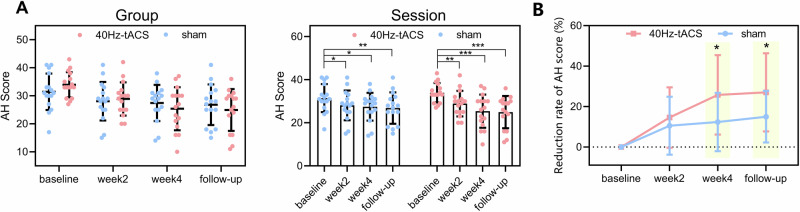
Gamma oscillations are essential for brain communication. The 40 Hz neural oscillation deficits in schizophrenia impair left frontotemporal connectivity and information communication, causing auditory hallucinations. Transcranial alternating current stimulation is thought to enhance connectivity between different brain regions by modulating brain oscillations. In this work, we applied a frontal-temporal-parietal 40 Hz-tACS stimulation strategy for treating auditory hallucinations and further explored the effect of tACS on functional connectivity of brain networks. 32 schizophrenia patients with refractory auditory hallucinations received 20daily 20-min, 40 Hz, 1 mA sessions of active or sham tACS on weekdays for 4 consecutive weeks, followed by a 2-week follow-up period without stimulation. Auditory hallucination symptom scores and 64-channel electroencephalograms were measured at baseline, week2, week4 and follow-up. For clinical symptom score, we observed a significant interaction between group and time for auditory hallucinations symptoms (F(3,90) = 26.964, p < 0.001), and subsequent analysis showed that the 40Hz-tACS group had a higher symptom reduction rate than the sham group at week4 (p = 0.036) and follow-up (p = 0.047). Multiple comparisons of corrected EEG results showed that the 40Hz-tACS group had higher functional connectivity in the right frontal to parietal (F (1,30) = 7.24, p = 0.012) and right frontal to occipital (F (1,30) = 7.98, p = 0.008) than the sham group at week4. Further, functional brain network controllability outcomes showed that the 40Hz-tACS group had increased average controllability (F (1,30) = 6.26, p = 0.018) and decreased modality controllability (F (1,30) = 6.50, p = 0.016) in the right frontal lobe compared to the sham group. Our polit study indicates that 40Hz-tACS combined with medicine may be an effective treatment for targeting symptoms specific to auditory hallucinations and altering functional connectivity and controllability at the network level.
期刊介绍:
Psychiatry has suffered tremendously by the limited translational pipeline. Nobel laureate Julius Axelrod''s discovery in 1961 of monoamine reuptake by pre-synaptic neurons still forms the basis of contemporary antidepressant treatment. There is a grievous gap between the explosion of knowledge in neuroscience and conceptually novel treatments for our patients. Translational Psychiatry bridges this gap by fostering and highlighting the pathway from discovery to clinical applications, healthcare and global health. We view translation broadly as the full spectrum of work that marks the pathway from discovery to global health, inclusive. The steps of translation that are within the scope of Translational Psychiatry include (i) fundamental discovery, (ii) bench to bedside, (iii) bedside to clinical applications (clinical trials), (iv) translation to policy and health care guidelines, (v) assessment of health policy and usage, and (vi) global health. All areas of medical research, including — but not restricted to — molecular biology, genetics, pharmacology, imaging and epidemiology are welcome as they contribute to enhance the field of translational psychiatry.





 京公网安备 11010802042870号
京ICP备2023020795号-1
京公网安备 11010802042870号
京ICP备2023020795号-1

 分享
分享
 求助内容:
求助内容: 应助结果提醒方式:
 扫码关注我们
