Harriet L S Lawford, Benn Sartorius, Helen J Mayfield, Filipina Amosa-Lei Sam, Satupaitea Viali, Tito Kamu, Robert Thomsen, Colleen L Lau
{"title":"Sensitivity of anti-filarial antibodies for lymphatic filariasis surveillance: Insights from a serological survey in Samoa in 2018.","authors":"Harriet L S Lawford, Benn Sartorius, Helen J Mayfield, Filipina Amosa-Lei Sam, Satupaitea Viali, Tito Kamu, Robert Thomsen, Colleen L Lau","doi":"10.1371/journal.pntd.0012835","DOIUrl":null,"url":null,"abstract":"<p><strong>Background: </strong>Sensitive diagnostic tools that signal lymphatic filariasis (LF) transmission are needed to monitor the progress of LF elimination programs. Anti-filarial antibody (Ab) markers could be more sensitive than antigen (Ag) point-of-care tests for monitoring LF transmission in some settings. This study aimed to investigate the sensitivity of anti-filarial Abs for detecting signals of LF transmission in Samoa by i) investigating the sensitivity and specificity of Ab to identify Ag-positives; ii) estimating the average number needed to test (NNTestav) to identify LF-seropositives (seropositive for Ag and/or any Ab), and iii) compare the efficiency of the different serological indicators by target age group and sampling design.</p><p><strong>Methods: </strong>A community-based serological survey of participants aged ≥5 years was conducted 1.5-3.5 months following the first round of triple-drug mass drug administration in Samoa in 2018, covering 35 primary sampling units (PSUs) (30 randomly selected and five purposively selected 'suspected hotspots'). Ag-positivity was detected using Alere Filariasis Test Strips, and Ab-seropositivity (Bm14, Wb123, Bm33 Abs) were measured using multiplex bead assays. Seroprevalence was adjusted for study design and standardised for age and gender. NNTestav was calculated using the formula 1/p, where p was the adjusted seroprevalence for each subgroup.</p><p><strong>Results: </strong>Of 3795 participants (mean age: 20.7; 51.2% female), 1892 (49.9%) were LF-seropositive. If Ag alone was used to identify LF-seropositives, only 5% (117/1892) would be identified. Of the three Ab seromarkers, Bm14 Ab had the highest area under the Receiver-Operating Characteristic Curve ([ROC]=0.88) to classify participants as Ag-positive, followed by Wb123 Ab (ROC=0.83) and Bm33 Ab (ROC=0.76). Participants aged ≥10 years had lower NNTestav compared to participants aged 5-9 years for all seromarkers. NNTestav was lower in purposively versus randomly selected PSUs.</p><p><strong>Conclusions: </strong>All Ab seromarkers had high ROC values to classify patients as Ag-positive and may be useful tools for LF surveillance in some settings. However, further research is required to fully understand how best Ab serosurveillance can be incorporated into LF elimination programmes.</p>","PeriodicalId":49000,"journal":{"name":"PLoS Neglected Tropical Diseases","volume":"19 1","pages":"e0012835"},"PeriodicalIF":3.4000,"publicationDate":"2025-01-30","publicationTypes":"Journal Article","fieldsOfStudy":null,"isOpenAccess":false,"openAccessPdf":"https://www.ncbi.nlm.nih.gov/pmc/articles/PMC11922241/pdf/","citationCount":"0","resultStr":null,"platform":"Semanticscholar","paperid":null,"PeriodicalName":"PLoS Neglected Tropical Diseases","FirstCategoryId":"3","ListUrlMain":"https://doi.org/10.1371/journal.pntd.0012835","RegionNum":2,"RegionCategory":"医学","ArticlePicture":[],"TitleCN":null,"AbstractTextCN":null,"PMCID":null,"EPubDate":"2025/1/1 0:00:00","PubModel":"eCollection","JCR":"Q1","JCRName":"PARASITOLOGY","Score":null,"Total":0}
引用次数: 0
Abstract
Background: Sensitive diagnostic tools that signal lymphatic filariasis (LF) transmission are needed to monitor the progress of LF elimination programs. Anti-filarial antibody (Ab) markers could be more sensitive than antigen (Ag) point-of-care tests for monitoring LF transmission in some settings. This study aimed to investigate the sensitivity of anti-filarial Abs for detecting signals of LF transmission in Samoa by i) investigating the sensitivity and specificity of Ab to identify Ag-positives; ii) estimating the average number needed to test (NNTestav) to identify LF-seropositives (seropositive for Ag and/or any Ab), and iii) compare the efficiency of the different serological indicators by target age group and sampling design.
Methods: A community-based serological survey of participants aged ≥5 years was conducted 1.5-3.5 months following the first round of triple-drug mass drug administration in Samoa in 2018, covering 35 primary sampling units (PSUs) (30 randomly selected and five purposively selected 'suspected hotspots'). Ag-positivity was detected using Alere Filariasis Test Strips, and Ab-seropositivity (Bm14, Wb123, Bm33 Abs) were measured using multiplex bead assays. Seroprevalence was adjusted for study design and standardised for age and gender. NNTestav was calculated using the formula 1/p, where p was the adjusted seroprevalence for each subgroup.
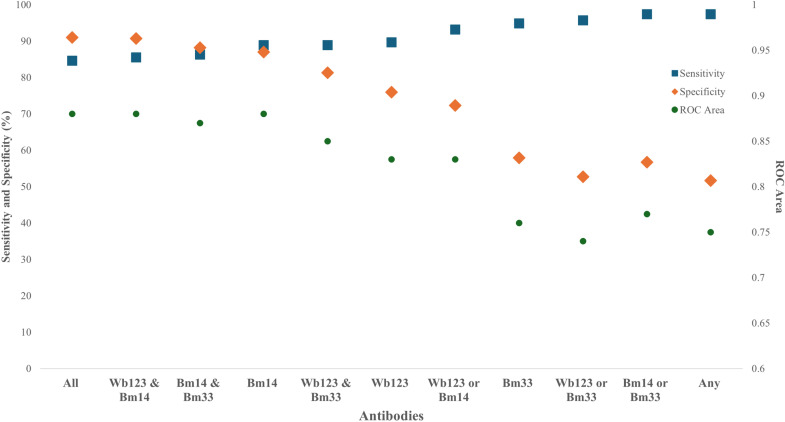
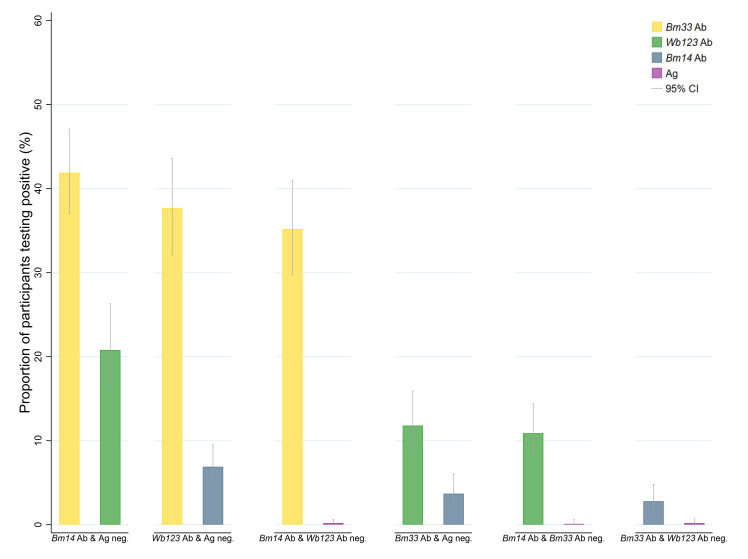
Results: Of 3795 participants (mean age: 20.7; 51.2% female), 1892 (49.9%) were LF-seropositive. If Ag alone was used to identify LF-seropositives, only 5% (117/1892) would be identified. Of the three Ab seromarkers, Bm14 Ab had the highest area under the Receiver-Operating Characteristic Curve ([ROC]=0.88) to classify participants as Ag-positive, followed by Wb123 Ab (ROC=0.83) and Bm33 Ab (ROC=0.76). Participants aged ≥10 years had lower NNTestav compared to participants aged 5-9 years for all seromarkers. NNTestav was lower in purposively versus randomly selected PSUs.
Conclusions: All Ab seromarkers had high ROC values to classify patients as Ag-positive and may be useful tools for LF surveillance in some settings. However, further research is required to fully understand how best Ab serosurveillance can be incorporated into LF elimination programmes.
期刊介绍:
PLOS Neglected Tropical Diseases publishes research devoted to the pathology, epidemiology, prevention, treatment and control of the neglected tropical diseases (NTDs), as well as relevant public policy.
The NTDs are defined as a group of poverty-promoting chronic infectious diseases, which primarily occur in rural areas and poor urban areas of low-income and middle-income countries. Their impact on child health and development, pregnancy, and worker productivity, as well as their stigmatizing features limit economic stability.
All aspects of these diseases are considered, including:
Pathogenesis
Clinical features
Pharmacology and treatment
Diagnosis
Epidemiology
Vector biology
Vaccinology and prevention
Demographic, ecological and social determinants
Public health and policy aspects (including cost-effectiveness analyses).




 京公网安备 11010802042870号
京ICP备2023020795号-1
京公网安备 11010802042870号
京ICP备2023020795号-1

 分享
分享
 求助内容:
求助内容: 应助结果提醒方式:
 扫码关注我们
