{"title":"Emphasis on Financial vs Nonfinancial Criteria in Employer Benefits' Measurements.","authors":"Jeffrey Pfeffer, Esther Olsen, Sara J Singer","doi":"10.1001/jamahealthforum.2024.5229","DOIUrl":null,"url":null,"abstract":"<p><strong>Importance: </strong>Few studies have examined the extent to which employers emphasize financial over nonfinancial criteria in measurement, reporting, and decision-making about health care benefits.</p><p><strong>Objective: </strong>To measure and identify factors associated with financial over nonfinancial emphasis in employer decision-making about health benefits.</p><p><strong>Design, setting, and participants: </strong>A survey was administered to a nationally representative sample of US employers to assess the extent of employers' emphasis on benefits plans' costs over member experience, access to care, and equity, and on financial vs other considerations when choosing third-party benefits administrators. The sample included in-company human resources administrators from randomly selected nongovernmental organizations with at least 50 employees. The survey was administered in 2 waves: May 2022 to July 2022 and November 2022 to April 2023.</p><p><strong>Exposure: </strong>The survey included 41 multipart questions capturing information about the respondent, company, company interactions with benefits consulting firms and benefits administrators, and company approach to managing employee health benefits.</p><p><strong>Main outcomes and measures: </strong>Main outcomes were proportion of financially oriented measures that internal benefits administrators and external benefits consultants use and importance of financial vs other factors in companies' choice of third-party administrators.</p><p><strong>Results: </strong>Of 1159 companies sampled, 251 (22%) responded; 30 with less than 50 employees were excluded. Of the 221 remaining companies, 147 (67%) used a benefits consulting firm. The companies and their benefits consultants focused on financial over nonfinancial performance dimensions in decision-making. While 125 companies (74%) tracked trends in health benefits costs and 109 (64%) tracked spending on the highest cost cases, only 14 (8%) tracked time employees spent having questions answered, and 12 (7%) tracked how often employees delayed receiving care because of an insurance company's actions. This financial focus was largely independent of organizational characteristics and other potential explanatory factors. Of 37 paired differences comparisons in the proportion of financial vs nonfinancial items, only 6 proportions (16%) differed significantly, with differences in proportions of 0.22 or less.</p><p><strong>Conclusions and relevance: </strong>In this survey study, US employers emphasized financial over nonfinancial criteria in their measurement and decision-making about health benefits. To improve health plan performance, employer measurement and decision-making must emphasize both nonfinancial and financial criteria.</p>","PeriodicalId":53180,"journal":{"name":"JAMA Health Forum","volume":"6 1","pages":"e245229"},"PeriodicalIF":11.3000,"publicationDate":"2025-01-03","publicationTypes":"Journal Article","fieldsOfStudy":null,"isOpenAccess":false,"openAccessPdf":"https://www.ncbi.nlm.nih.gov/pmc/articles/PMC11786228/pdf/","citationCount":"0","resultStr":null,"platform":"Semanticscholar","paperid":null,"PeriodicalName":"JAMA Health Forum","FirstCategoryId":"1085","ListUrlMain":"https://doi.org/10.1001/jamahealthforum.2024.5229","RegionNum":0,"RegionCategory":null,"ArticlePicture":[],"TitleCN":null,"AbstractTextCN":null,"PMCID":null,"EPubDate":"","PubModel":"","JCR":"Q1","JCRName":"HEALTH CARE SCIENCES & SERVICES","Score":null,"Total":0}
引用次数: 0
Abstract
Importance: Few studies have examined the extent to which employers emphasize financial over nonfinancial criteria in measurement, reporting, and decision-making about health care benefits.
Objective: To measure and identify factors associated with financial over nonfinancial emphasis in employer decision-making about health benefits.
Design, setting, and participants: A survey was administered to a nationally representative sample of US employers to assess the extent of employers' emphasis on benefits plans' costs over member experience, access to care, and equity, and on financial vs other considerations when choosing third-party benefits administrators. The sample included in-company human resources administrators from randomly selected nongovernmental organizations with at least 50 employees. The survey was administered in 2 waves: May 2022 to July 2022 and November 2022 to April 2023.
Exposure: The survey included 41 multipart questions capturing information about the respondent, company, company interactions with benefits consulting firms and benefits administrators, and company approach to managing employee health benefits.
Main outcomes and measures: Main outcomes were proportion of financially oriented measures that internal benefits administrators and external benefits consultants use and importance of financial vs other factors in companies' choice of third-party administrators.
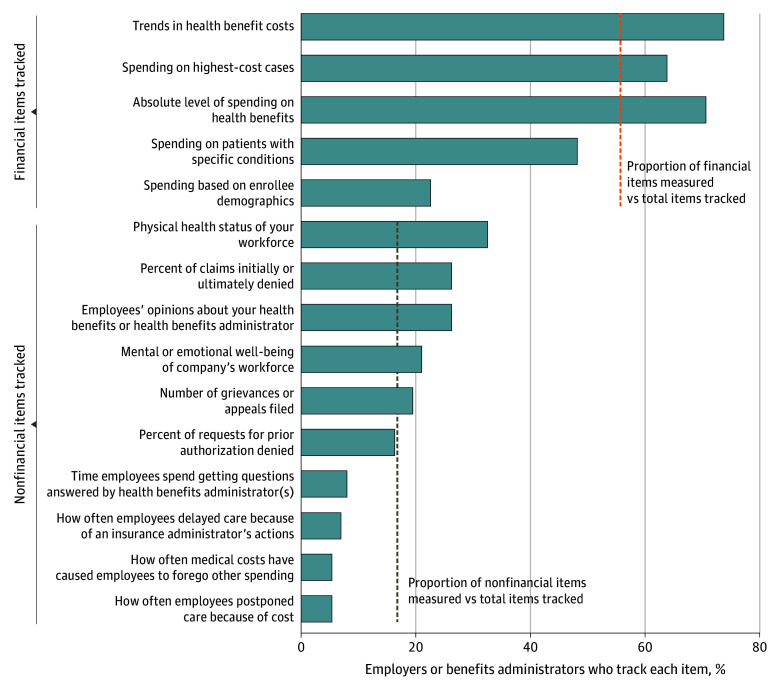
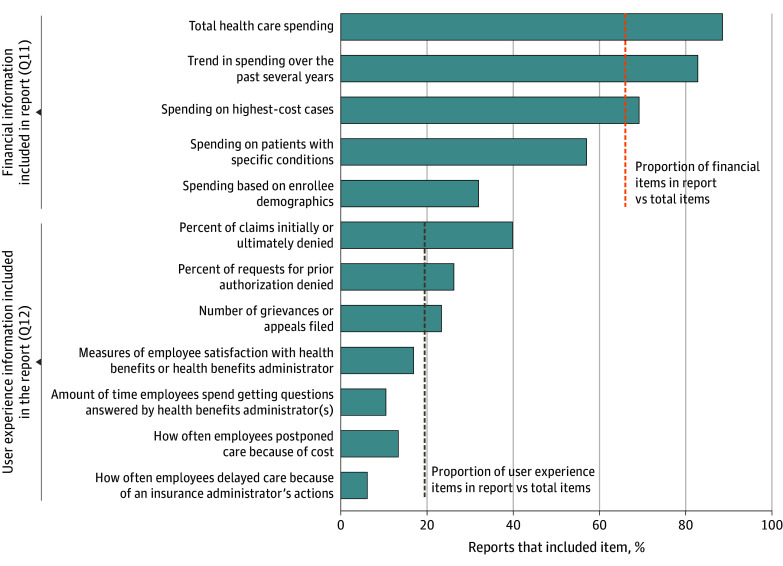
Results: Of 1159 companies sampled, 251 (22%) responded; 30 with less than 50 employees were excluded. Of the 221 remaining companies, 147 (67%) used a benefits consulting firm. The companies and their benefits consultants focused on financial over nonfinancial performance dimensions in decision-making. While 125 companies (74%) tracked trends in health benefits costs and 109 (64%) tracked spending on the highest cost cases, only 14 (8%) tracked time employees spent having questions answered, and 12 (7%) tracked how often employees delayed receiving care because of an insurance company's actions. This financial focus was largely independent of organizational characteristics and other potential explanatory factors. Of 37 paired differences comparisons in the proportion of financial vs nonfinancial items, only 6 proportions (16%) differed significantly, with differences in proportions of 0.22 or less.
Conclusions and relevance: In this survey study, US employers emphasized financial over nonfinancial criteria in their measurement and decision-making about health benefits. To improve health plan performance, employer measurement and decision-making must emphasize both nonfinancial and financial criteria.
期刊介绍:
JAMA Health Forum is an international, peer-reviewed, online, open access journal that addresses health policy and strategies affecting medicine, health, and health care. The journal publishes original research, evidence-based reports, and opinion about national and global health policy. It covers innovative approaches to health care delivery and health care economics, access, quality, safety, equity, and reform.
In addition to publishing articles, JAMA Health Forum also features commentary from health policy leaders on the JAMA Forum. It covers news briefs on major reports released by government agencies, foundations, health policy think tanks, and other policy-focused organizations.
JAMA Health Forum is a member of the JAMA Network, which is a consortium of peer-reviewed, general medical and specialty publications. The journal presents curated health policy content from across the JAMA Network, including journals such as JAMA and JAMA Internal Medicine.




 京公网安备 11010802042870号
京ICP备2023020795号-1
京公网安备 11010802042870号
京ICP备2023020795号-1

 分享
分享
 求助内容:
求助内容: 应助结果提醒方式:
 扫码关注我们
