Prabir Maity, Arjun Singh Bisht, Deepak, Raj Kumar Roy
{"title":"Kinetically Controlled Approach for One-Pot Synthesis of Poly(peptide-<i>b</i>-peptoid) Exhibiting Well-Defined Secondary Structure and Thermal Stability.","authors":"Prabir Maity, Arjun Singh Bisht, Deepak, Raj Kumar Roy","doi":"10.1021/acsmacrolett.4c00823","DOIUrl":null,"url":null,"abstract":"<p><p>Sequence-controlled polymerization aims to bridge the gap between biopolymers and synthetic macromolecules. In a kinetically controlled approach, the inherent reactivity differences among monomers determine the primary structure or sequence of the monomers linked within the resulting copolymer chains. This report outlines a one-pot synthesis of polypeptide-<i>b</i>-polypeptoid by choosing a suitable pair of N-carboxy anhydride (NCA) monomers with significant reactivity differences. We have demonstrated the preparation of well-defined block copolymers, including polyproline-<i>b</i>-polysarcosine (PLP-<i>b</i>-PSar) and poly(propargyl proline)-<i>b</i>-polysarcosine (PLPP-<i>b</i>-PSar) in a single step. <sup>1</sup>H NMR kinetic studies confirmed the sequence-controlled primary structures of these block copolymers. The NMR analysis indicated a striking reactivity ratio difference (<i>r</i><sub>PLP</sub> = 925 and <i>r</i><sub>PSar</sub> = 0.0014; <i>r</i><sub>PLPP</sub> = 860 and <i>r</i><sub>PSar</sub> = 0.0015) between the selected monomer pairs, which was crucial for a one-pot block copolymer synthesis. Notably, these sequence-controlled copolymers' secondary structures and stability were remarkably similar to those of block copolymers synthesized through conventional sequential addition methods. This further underscores the practicality of this kinetically controlled approach.</p>","PeriodicalId":18,"journal":{"name":"ACS Macro Letters","volume":" ","pages":"188-194"},"PeriodicalIF":5.2000,"publicationDate":"2025-02-18","publicationTypes":"Journal Article","fieldsOfStudy":null,"isOpenAccess":false,"openAccessPdf":"","citationCount":"0","resultStr":null,"platform":"Semanticscholar","paperid":null,"PeriodicalName":"ACS Macro Letters","FirstCategoryId":"92","ListUrlMain":"https://doi.org/10.1021/acsmacrolett.4c00823","RegionNum":0,"RegionCategory":null,"ArticlePicture":[],"TitleCN":null,"AbstractTextCN":null,"PMCID":null,"EPubDate":"2025/1/31 0:00:00","PubModel":"Epub","JCR":"Q1","JCRName":"POLYMER SCIENCE","Score":null,"Total":0}
引用次数: 0
Abstract
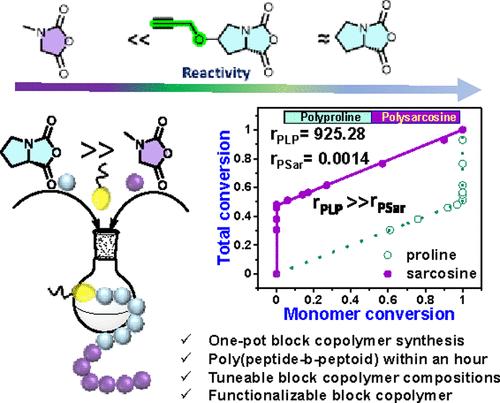
Sequence-controlled polymerization aims to bridge the gap between biopolymers and synthetic macromolecules. In a kinetically controlled approach, the inherent reactivity differences among monomers determine the primary structure or sequence of the monomers linked within the resulting copolymer chains. This report outlines a one-pot synthesis of polypeptide-b-polypeptoid by choosing a suitable pair of N-carboxy anhydride (NCA) monomers with significant reactivity differences. We have demonstrated the preparation of well-defined block copolymers, including polyproline-b-polysarcosine (PLP-b-PSar) and poly(propargyl proline)-b-polysarcosine (PLPP-b-PSar) in a single step. 1H NMR kinetic studies confirmed the sequence-controlled primary structures of these block copolymers. The NMR analysis indicated a striking reactivity ratio difference (rPLP = 925 and rPSar = 0.0014; rPLPP = 860 and rPSar = 0.0015) between the selected monomer pairs, which was crucial for a one-pot block copolymer synthesis. Notably, these sequence-controlled copolymers' secondary structures and stability were remarkably similar to those of block copolymers synthesized through conventional sequential addition methods. This further underscores the practicality of this kinetically controlled approach.
期刊介绍:
ACS Macro Letters publishes research in all areas of contemporary soft matter science in which macromolecules play a key role, including nanotechnology, self-assembly, supramolecular chemistry, biomaterials, energy generation and storage, and renewable/sustainable materials. Submissions to ACS Macro Letters should justify clearly the rapid disclosure of the key elements of the study. The scope of the journal includes high-impact research of broad interest in all areas of polymer science and engineering, including cross-disciplinary research that interfaces with polymer science.
With the launch of ACS Macro Letters, all Communications that were formerly published in Macromolecules and Biomacromolecules will be published as Letters in ACS Macro Letters.



 京公网安备 11010802042870号
京ICP备2023020795号-1
京公网安备 11010802042870号
京ICP备2023020795号-1

 分享
分享
 求助内容:
求助内容: 应助结果提醒方式:
 扫码关注我们
