Norman Jonas Kyala, Innocent Mboya, Elichilia Shao, Francis Sakita, Kajiru Gadiel Kilonzo, Laura Shirima, Abid Sadiq, Elifuraha Mkwizu, Nyasatu Chamba, Annette Marandu, Sophia Muhali, Faryal Raza, Eliasa Ndale, Damas Bayo, Daniel Mujuni, Furaha Lyamuya
{"title":"Neutrophil-to-lymphocyte ratio as a prognostic indicator in COVID-19: Evidence from a northern tanzanian cohort.","authors":"Norman Jonas Kyala, Innocent Mboya, Elichilia Shao, Francis Sakita, Kajiru Gadiel Kilonzo, Laura Shirima, Abid Sadiq, Elifuraha Mkwizu, Nyasatu Chamba, Annette Marandu, Sophia Muhali, Faryal Raza, Eliasa Ndale, Damas Bayo, Daniel Mujuni, Furaha Lyamuya","doi":"10.1371/journal.pone.0300231","DOIUrl":null,"url":null,"abstract":"<p><strong>Background: </strong>COVID-19 caused a profound global impact, resulting in significant cases and deaths. The progression of COVID-19 clinical manifestations is influenced by a dysregulated inflammatory response. Early identification of the subclinical progression is crucial for timely intervention and improved patient outcomes. While there are various biomarkers to predict disease severity and outcomes, their accessibility and affordability pose challenges in resource-limited settings. We explored the potentiality of the neutrophil-to-lymphocyte ratio (NLR) as a cost-effective inflammatory marker to predict disease severity, clinical deterioration, and mortality in affected patients.</p><p><strong>Methodology: </strong>A hospital-based retrospective cohort study was conducted at KCMC Hospital among COVID-19 patients followed from admission to discharge between 1st March 2020 and 31st March 2022. NLR was calculated as the absolute neutrophil count in μL divided by the absolute lymphocyte count in μL. The NLR cut-off value was determined using Receiver Operating Characteristic (ROC) analysis and assessed its predictive ability at admission for in-hospital mortality. The Chi-square test compared the proportion of NLR by patient characteristics. The association of NLR with disease severity and mortality was analyzed using the modified Poisson and Cox regression models, respectively.</p><p><strong>Results: </strong>The study included 504 patients, with a median age of 64 years, 57.1% were males, and 68.3% had severe COVID-19. The in-hospital COVID-19 mortality rate was 37.7%. An NLR cutoff value of 6.1 or higher had a sensitivity of 92.1% (95% CI 89.2%-94.0%) and a specificity of 92.0% (95% CI 89.7%-94.4%). Additionally, 39.5% of patients with an NLR value of 6.1 or higher had increased risk of severe disease, subsequent clinical deterioration, and mortality.</p><p><strong>Conclusion and recommendation: </strong>An NLR value of 6.1 or higher at the time of hospital admission associated with severe disease, clinical deterioration, and mortality in patients with COVID-19. Integration of NLR as a prognostic parameter in COVID-19 prognosis scales could improve risk assessment and guide appropriate management strategies for COVID-19 patients, as well as for potential future viral-related pneumonias. Further prospective studies are necessary to validate these findings and evaluate the clinical utility of NLR in larger cohorts of patients.</p>","PeriodicalId":20189,"journal":{"name":"PLoS ONE","volume":"20 1","pages":"e0300231"},"PeriodicalIF":2.6000,"publicationDate":"2025-01-31","publicationTypes":"Journal Article","fieldsOfStudy":null,"isOpenAccess":false,"openAccessPdf":"https://www.ncbi.nlm.nih.gov/pmc/articles/PMC11785306/pdf/","citationCount":"0","resultStr":null,"platform":"Semanticscholar","paperid":null,"PeriodicalName":"PLoS ONE","FirstCategoryId":"103","ListUrlMain":"https://doi.org/10.1371/journal.pone.0300231","RegionNum":3,"RegionCategory":"综合性期刊","ArticlePicture":[],"TitleCN":null,"AbstractTextCN":null,"PMCID":null,"EPubDate":"2025/1/1 0:00:00","PubModel":"eCollection","JCR":"Q1","JCRName":"MULTIDISCIPLINARY SCIENCES","Score":null,"Total":0}
引用次数: 0
Abstract
Background: COVID-19 caused a profound global impact, resulting in significant cases and deaths. The progression of COVID-19 clinical manifestations is influenced by a dysregulated inflammatory response. Early identification of the subclinical progression is crucial for timely intervention and improved patient outcomes. While there are various biomarkers to predict disease severity and outcomes, their accessibility and affordability pose challenges in resource-limited settings. We explored the potentiality of the neutrophil-to-lymphocyte ratio (NLR) as a cost-effective inflammatory marker to predict disease severity, clinical deterioration, and mortality in affected patients.
Methodology: A hospital-based retrospective cohort study was conducted at KCMC Hospital among COVID-19 patients followed from admission to discharge between 1st March 2020 and 31st March 2022. NLR was calculated as the absolute neutrophil count in μL divided by the absolute lymphocyte count in μL. The NLR cut-off value was determined using Receiver Operating Characteristic (ROC) analysis and assessed its predictive ability at admission for in-hospital mortality. The Chi-square test compared the proportion of NLR by patient characteristics. The association of NLR with disease severity and mortality was analyzed using the modified Poisson and Cox regression models, respectively.
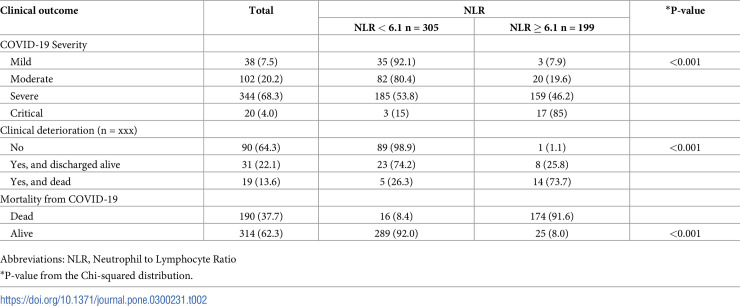
Results: The study included 504 patients, with a median age of 64 years, 57.1% were males, and 68.3% had severe COVID-19. The in-hospital COVID-19 mortality rate was 37.7%. An NLR cutoff value of 6.1 or higher had a sensitivity of 92.1% (95% CI 89.2%-94.0%) and a specificity of 92.0% (95% CI 89.7%-94.4%). Additionally, 39.5% of patients with an NLR value of 6.1 or higher had increased risk of severe disease, subsequent clinical deterioration, and mortality.
Conclusion and recommendation: An NLR value of 6.1 or higher at the time of hospital admission associated with severe disease, clinical deterioration, and mortality in patients with COVID-19. Integration of NLR as a prognostic parameter in COVID-19 prognosis scales could improve risk assessment and guide appropriate management strategies for COVID-19 patients, as well as for potential future viral-related pneumonias. Further prospective studies are necessary to validate these findings and evaluate the clinical utility of NLR in larger cohorts of patients.
背景:2019冠状病毒病造成了深远的全球影响,导致大量病例和死亡。COVID-19临床表现的进展受炎症反应失调的影响。早期识别亚临床进展对于及时干预和改善患者预后至关重要。虽然有各种生物标志物可以预测疾病的严重程度和结果,但在资源有限的环境中,它们的可及性和可负担性构成了挑战。我们探索了中性粒细胞与淋巴细胞比率(NLR)作为预测疾病严重程度、临床恶化和患者死亡率的一种具有成本效益的炎症标志物的潜力。方法:在KCMC医院对2020年3月1日至2022年3月31日入院至出院的COVID-19患者进行了以医院为基础的回顾性队列研究。NLR计算为中性粒细胞绝对计数(μL)除以淋巴细胞绝对计数(μL)。采用受试者工作特征(ROC)分析确定NLR的临界值,并评估其在入院时对住院死亡率的预测能力。卡方检验比较NLR与患者特征的比例。NLR与疾病严重程度和死亡率的关系分别采用改进的泊松和Cox回归模型进行分析。结果:研究纳入504例患者,中位年龄64岁,男性占57.1%,重症病例占68.3%。院内病死率为37.7%。NLR截断值为6.1或更高时,敏感性为92.1% (95% CI 89.2%-94.0%),特异性为92.0% (95% CI 89.7%-94.4%)。此外,39.5% NLR值为6.1或更高的患者出现严重疾病、随后临床恶化和死亡的风险增加。结论和建议:入院时NLR值为6.1或更高与COVID-19患者的严重疾病、临床恶化和死亡率相关。将NLR作为一项预后参数纳入COVID-19预后量表,可以改善COVID-19患者的风险评估,指导适当的管理策略,以及未来可能出现的病毒相关性肺炎。需要进一步的前瞻性研究来验证这些发现,并评估NLR在更大患者群体中的临床应用。
期刊介绍:
PLOS ONE is an international, peer-reviewed, open-access, online publication. PLOS ONE welcomes reports on primary research from any scientific discipline. It provides:
* Open-access—freely accessible online, authors retain copyright
* Fast publication times
* Peer review by expert, practicing researchers
* Post-publication tools to indicate quality and impact
* Community-based dialogue on articles
* Worldwide media coverage






 京公网安备 11010802042870号
京ICP备2023020795号-1
京公网安备 11010802042870号
京ICP备2023020795号-1

 分享
分享
 求助内容:
求助内容: 应助结果提醒方式:
 扫码关注我们
