{"title":"Distributed Intelligent Control Method Based on State Self-Learning and Its Application in Cascade Processes","authors":"Shulong Yin;Yonggang Li;Zhenxiang Feng;Bei Sun;Huiping Liang","doi":"10.1109/TASE.2024.3524472","DOIUrl":null,"url":null,"abstract":"The multiple-reactor cascade operation is a distinctive characteristic in the process industry. However, it is difficult to establish an accurate and global model for multi-reactor cascading processes. Moreover, the intricate and dynamic operating state of the reactor, coupled with rear reactors, poses significant challenges to the fine control of the entire process. Therefore, this paper proposes a distributed intelligent control method based on state self-learning. Initially, the time-varying dynamic model of each reactor unit is established by learning the parameters of the regression model at each state point, achieving a nonlinear description of the reactor under complex conditions. Subsequently, leveraging the dynamic model and the material conservation principle between reactors, multi-step collaborative prediction is conducted along the reactor cascade direction. Thirdly, distributed model predictive control based on error self-correction is adopted to realize distributed intelligent control of the cascade reactor. This method is verified in a zinc smelting leaching process. The results indicate its superiority over common methods, offering higher prediction accuracy for the cascade process and enabling more effective control of individual reactors through distributed intelligence, which provides a novel and promising control paradigm for the cascade process.Note to Practitioners—The future heralds an era of the Internet of Everything, and this transformation extends to the production processes of the process industry. Presently, decentralized control methods are prevalent in the process industry. However, these methods lack communication between controllers and autonomy in learning. While decentralized control methods can effectively regulate most industrial processes, they struggle to achieve optimal control in scenarios with cascading reactors, where the reactors are interdependent. Distributed control methods offer promise to address these limitations. Regrettably, research and application of distributed control in process industry engineering remain limited, lacking suitable methods for controller autonomy and information exchange among different controllers. Consequently, this paper presents a novel control approach for stable and efficient regulation of multi-reactor cascades in the process industry, offering promising avenues for widespread application.","PeriodicalId":51060,"journal":{"name":"IEEE Transactions on Automation Science and Engineering","volume":"22 ","pages":"10533-10545"},"PeriodicalIF":6.4000,"publicationDate":"2025-01-31","publicationTypes":"Journal Article","fieldsOfStudy":null,"isOpenAccess":false,"openAccessPdf":"","citationCount":"0","resultStr":null,"platform":"Semanticscholar","paperid":null,"PeriodicalName":"IEEE Transactions on Automation Science and Engineering","FirstCategoryId":"94","ListUrlMain":"https://ieeexplore.ieee.org/document/10859189/","RegionNum":2,"RegionCategory":"计算机科学","ArticlePicture":[],"TitleCN":null,"AbstractTextCN":null,"PMCID":null,"EPubDate":"","PubModel":"","JCR":"Q1","JCRName":"AUTOMATION & CONTROL SYSTEMS","Score":null,"Total":0}
引用次数: 0
Abstract
The multiple-reactor cascade operation is a distinctive characteristic in the process industry. However, it is difficult to establish an accurate and global model for multi-reactor cascading processes. Moreover, the intricate and dynamic operating state of the reactor, coupled with rear reactors, poses significant challenges to the fine control of the entire process. Therefore, this paper proposes a distributed intelligent control method based on state self-learning. Initially, the time-varying dynamic model of each reactor unit is established by learning the parameters of the regression model at each state point, achieving a nonlinear description of the reactor under complex conditions. Subsequently, leveraging the dynamic model and the material conservation principle between reactors, multi-step collaborative prediction is conducted along the reactor cascade direction. Thirdly, distributed model predictive control based on error self-correction is adopted to realize distributed intelligent control of the cascade reactor. This method is verified in a zinc smelting leaching process. The results indicate its superiority over common methods, offering higher prediction accuracy for the cascade process and enabling more effective control of individual reactors through distributed intelligence, which provides a novel and promising control paradigm for the cascade process.Note to Practitioners—The future heralds an era of the Internet of Everything, and this transformation extends to the production processes of the process industry. Presently, decentralized control methods are prevalent in the process industry. However, these methods lack communication between controllers and autonomy in learning. While decentralized control methods can effectively regulate most industrial processes, they struggle to achieve optimal control in scenarios with cascading reactors, where the reactors are interdependent. Distributed control methods offer promise to address these limitations. Regrettably, research and application of distributed control in process industry engineering remain limited, lacking suitable methods for controller autonomy and information exchange among different controllers. Consequently, this paper presents a novel control approach for stable and efficient regulation of multi-reactor cascades in the process industry, offering promising avenues for widespread application.
期刊介绍:
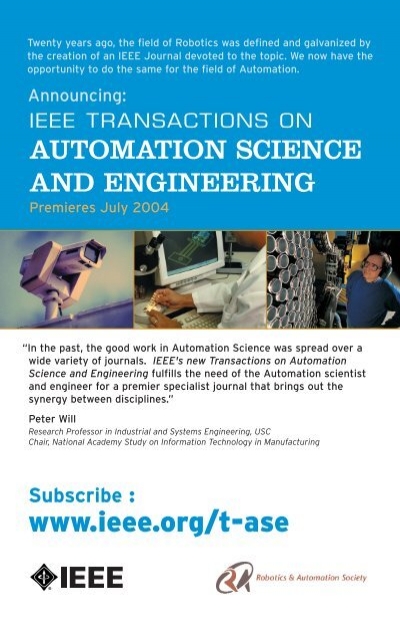
The IEEE Transactions on Automation Science and Engineering (T-ASE) publishes fundamental papers on Automation, emphasizing scientific results that advance efficiency, quality, productivity, and reliability. T-ASE encourages interdisciplinary approaches from computer science, control systems, electrical engineering, mathematics, mechanical engineering, operations research, and other fields. T-ASE welcomes results relevant to industries such as agriculture, biotechnology, healthcare, home automation, maintenance, manufacturing, pharmaceuticals, retail, security, service, supply chains, and transportation. T-ASE addresses a research community willing to integrate knowledge across disciplines and industries. For this purpose, each paper includes a Note to Practitioners that summarizes how its results can be applied or how they might be extended to apply in practice.



 京公网安备 11010802042870号
京ICP备2023020795号-1
京公网安备 11010802042870号
京ICP备2023020795号-1

 分享
分享
 求助内容:
求助内容: 应助结果提醒方式:
 扫码关注我们
