Boyu Lyu , Bharat Manna , Xueyang Zhou , Ivanhoe K.H. Leung , Naresh Singhal
{"title":"Microbial metabolic enzymes, pathways and microbial hosts for co-metabolic degradation of organic micropollutants in wastewater","authors":"Boyu Lyu , Bharat Manna , Xueyang Zhou , Ivanhoe K.H. Leung , Naresh Singhal","doi":"10.1016/j.watres.2025.123229","DOIUrl":null,"url":null,"abstract":"<div><div>Organic micropollutants (OMPs) in wastewater present significant environmental challenges, but effective removal strategies are hindered by our limited understanding of their co-metabolic biodegradation. We aim to elucidate the microbial enzymes, metabolic pathways, and community members involved in OMP co-metabolic degradation, thereby paving the way for more effective wastewater treatment strategies. We integrated multi-omics (metagenomics, metaproteomics, and metabolomics) and functional group analysis to investigate 24 OMPs under three aeration conditions. Our findings reveal that oxidoreductases, particularly cytochrome P450s and peroxidases, are crucial for recalcitrant OMPs containing halogen groups (-Cl, -F) like fluoxetine and diuron. Hydrolases, including amidases, are instrumental in targeting amide-containing (-CONH₂) OMPs such as bezafibrate and carbamazepine. Regarding microbial metabolism involved in OMP co-metabolic degradation, we found that amino acid metabolism is crucial for degrading amine-containing (-NH₂) OMPs like metoprolol and citalopram. Lipid metabolism, particularly for fatty acids, contributes to the degradation of carboxylic acid (-COOH) containing OMPs such as bezafibrate and naproxen. Finally, with <em>Actinobacteria, Bacteroidetes</em>, and <em>Proteobacteria</em> emerging as primary contributors to these functionalities, we established connections between OMP functional groups, degradation enzymes, metabolic pathways, and microbial phyla. Our findings provide generalized insights into structure-function relationships in OMP co-metabolic degradation, offering the potential for improved wastewater treatment strategies.</div></div>","PeriodicalId":443,"journal":{"name":"Water Research","volume":"276 ","pages":"Article 123229"},"PeriodicalIF":12.4000,"publicationDate":"2025-01-31","publicationTypes":"Journal Article","fieldsOfStudy":null,"isOpenAccess":false,"openAccessPdf":"","citationCount":"0","resultStr":null,"platform":"Semanticscholar","paperid":null,"PeriodicalName":"Water Research","FirstCategoryId":"93","ListUrlMain":"https://www.sciencedirect.com/science/article/pii/S0043135425001435","RegionNum":1,"RegionCategory":"环境科学与生态学","ArticlePicture":[],"TitleCN":null,"AbstractTextCN":null,"PMCID":null,"EPubDate":"","PubModel":"","JCR":"Q1","JCRName":"ENGINEERING, ENVIRONMENTAL","Score":null,"Total":0}
引用次数: 0
Abstract
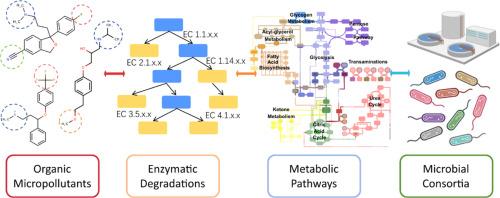
Organic micropollutants (OMPs) in wastewater present significant environmental challenges, but effective removal strategies are hindered by our limited understanding of their co-metabolic biodegradation. We aim to elucidate the microbial enzymes, metabolic pathways, and community members involved in OMP co-metabolic degradation, thereby paving the way for more effective wastewater treatment strategies. We integrated multi-omics (metagenomics, metaproteomics, and metabolomics) and functional group analysis to investigate 24 OMPs under three aeration conditions. Our findings reveal that oxidoreductases, particularly cytochrome P450s and peroxidases, are crucial for recalcitrant OMPs containing halogen groups (-Cl, -F) like fluoxetine and diuron. Hydrolases, including amidases, are instrumental in targeting amide-containing (-CONH₂) OMPs such as bezafibrate and carbamazepine. Regarding microbial metabolism involved in OMP co-metabolic degradation, we found that amino acid metabolism is crucial for degrading amine-containing (-NH₂) OMPs like metoprolol and citalopram. Lipid metabolism, particularly for fatty acids, contributes to the degradation of carboxylic acid (-COOH) containing OMPs such as bezafibrate and naproxen. Finally, with Actinobacteria, Bacteroidetes, and Proteobacteria emerging as primary contributors to these functionalities, we established connections between OMP functional groups, degradation enzymes, metabolic pathways, and microbial phyla. Our findings provide generalized insights into structure-function relationships in OMP co-metabolic degradation, offering the potential for improved wastewater treatment strategies.
期刊介绍:
Water Research, along with its open access companion journal Water Research X, serves as a platform for publishing original research papers covering various aspects of the science and technology related to the anthropogenic water cycle, water quality, and its management worldwide. The audience targeted by the journal comprises biologists, chemical engineers, chemists, civil engineers, environmental engineers, limnologists, and microbiologists. The scope of the journal include:
•Treatment processes for water and wastewaters (municipal, agricultural, industrial, and on-site treatment), including resource recovery and residuals management;
•Urban hydrology including sewer systems, stormwater management, and green infrastructure;
•Drinking water treatment and distribution;
•Potable and non-potable water reuse;
•Sanitation, public health, and risk assessment;
•Anaerobic digestion, solid and hazardous waste management, including source characterization and the effects and control of leachates and gaseous emissions;
•Contaminants (chemical, microbial, anthropogenic particles such as nanoparticles or microplastics) and related water quality sensing, monitoring, fate, and assessment;
•Anthropogenic impacts on inland, tidal, coastal and urban waters, focusing on surface and ground waters, and point and non-point sources of pollution;
•Environmental restoration, linked to surface water, groundwater and groundwater remediation;
•Analysis of the interfaces between sediments and water, and between water and atmosphere, focusing specifically on anthropogenic impacts;
•Mathematical modelling, systems analysis, machine learning, and beneficial use of big data related to the anthropogenic water cycle;
•Socio-economic, policy, and regulations studies.




 京公网安备 11010802042870号
京ICP备2023020795号-1
京公网安备 11010802042870号
京ICP备2023020795号-1

 分享
分享
 求助内容:
求助内容: 应助结果提醒方式:
 扫码关注我们
