Won Dong Lee, Daniel R. Weilandt, Lingfan Liang, Michael R. MacArthur, Natasha Jaiswal, Olivia Ong, Charlotte G. Mann, Qingwei Chu, Craig J. Hunter, Rolf-Peter Ryseck, Wenyun Lu, Anna M. Oschmann, Alexis J. Cowan, Tara A. TeSlaa, Caroline R. Bartman, Cholsoon Jang, Joseph A. Baur, Paul M. Titchenell, Joshua D. Rabinowitz
{"title":"Lactate homeostasis is maintained through regulation of glycolysis and lipolysis","authors":"Won Dong Lee, Daniel R. Weilandt, Lingfan Liang, Michael R. MacArthur, Natasha Jaiswal, Olivia Ong, Charlotte G. Mann, Qingwei Chu, Craig J. Hunter, Rolf-Peter Ryseck, Wenyun Lu, Anna M. Oschmann, Alexis J. Cowan, Tara A. TeSlaa, Caroline R. Bartman, Cholsoon Jang, Joseph A. Baur, Paul M. Titchenell, Joshua D. Rabinowitz","doi":"10.1016/j.cmet.2024.12.009","DOIUrl":null,"url":null,"abstract":"Lactate is among the highest flux circulating metabolites. It is made by glycolysis and cleared by both tricarboxylic acid (TCA) cycle oxidation and gluconeogenesis. Severe lactate elevations are life-threatening, and modest elevations predict future diabetes. How lactate homeostasis is maintained, however, remains poorly understood. Here, we identify, in mice, homeostatic circuits regulating lactate production and consumption. Insulin induces lactate production by upregulating glycolysis. We find that hyperlactatemia inhibits insulin-induced glycolysis, thereby suppressing excess lactate production. Unexpectedly, insulin also promotes lactate TCA cycle oxidation. The mechanism involves lowering circulating fatty acids, which compete with lactate for mitochondrial oxidation. Similarly, lactate can promote its own consumption by lowering circulating fatty acids via the adipocyte-expressed G-protein-coupled receptor hydroxycarboxylic acid receptor 1 (HCAR1). Quantitative modeling suggests that these mechanisms suffice to produce lactate homeostasis, with robustness to noise and perturbation of individual regulatory mechanisms. Thus, through regulation of glycolysis and lipolysis, lactate homeostasis is maintained.","PeriodicalId":9840,"journal":{"name":"Cell metabolism","volume":"84 1","pages":""},"PeriodicalIF":30.9000,"publicationDate":"2025-01-30","publicationTypes":"Journal Article","fieldsOfStudy":null,"isOpenAccess":false,"openAccessPdf":"","citationCount":"0","resultStr":null,"platform":"Semanticscholar","paperid":null,"PeriodicalName":"Cell metabolism","FirstCategoryId":"99","ListUrlMain":"https://doi.org/10.1016/j.cmet.2024.12.009","RegionNum":1,"RegionCategory":"生物学","ArticlePicture":[],"TitleCN":null,"AbstractTextCN":null,"PMCID":null,"EPubDate":"","PubModel":"","JCR":"Q1","JCRName":"CELL BIOLOGY","Score":null,"Total":0}
引用次数: 0
Abstract
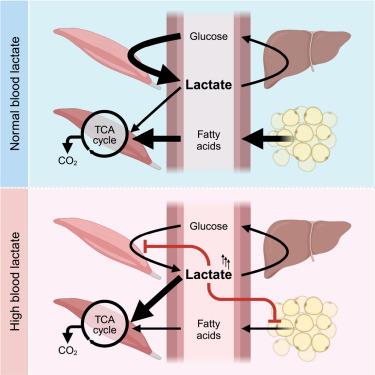
Lactate is among the highest flux circulating metabolites. It is made by glycolysis and cleared by both tricarboxylic acid (TCA) cycle oxidation and gluconeogenesis. Severe lactate elevations are life-threatening, and modest elevations predict future diabetes. How lactate homeostasis is maintained, however, remains poorly understood. Here, we identify, in mice, homeostatic circuits regulating lactate production and consumption. Insulin induces lactate production by upregulating glycolysis. We find that hyperlactatemia inhibits insulin-induced glycolysis, thereby suppressing excess lactate production. Unexpectedly, insulin also promotes lactate TCA cycle oxidation. The mechanism involves lowering circulating fatty acids, which compete with lactate for mitochondrial oxidation. Similarly, lactate can promote its own consumption by lowering circulating fatty acids via the adipocyte-expressed G-protein-coupled receptor hydroxycarboxylic acid receptor 1 (HCAR1). Quantitative modeling suggests that these mechanisms suffice to produce lactate homeostasis, with robustness to noise and perturbation of individual regulatory mechanisms. Thus, through regulation of glycolysis and lipolysis, lactate homeostasis is maintained.
期刊介绍:
Cell Metabolism is a top research journal established in 2005 that focuses on publishing original and impactful papers in the field of metabolic research.It covers a wide range of topics including diabetes, obesity, cardiovascular biology, aging and stress responses, circadian biology, and many others.
Cell Metabolism aims to contribute to the advancement of metabolic research by providing a platform for the publication and dissemination of high-quality research and thought-provoking articles.



 京公网安备 11010802042870号
京ICP备2023020795号-1
京公网安备 11010802042870号
京ICP备2023020795号-1

 分享
分享
 求助内容:
求助内容: 应助结果提醒方式:
 扫码关注我们
