Amanda Darling , Benjamin Davis , Thomas Byrne , Madeline Deck , Gabriel Maldonado Rivera , Sarah Price , Amber Amaral-Torres , Clayton Markham , Raul Gonzalez , Peter Vikesland , Leigh-Anne Krometis , Amy Pruden , Alasdair Cohen
{"title":"Subsewershed analyses of the impacts of inflow and infiltration on viral pathogens and antibiotic resistance markers across a rural sewer system","authors":"Amanda Darling , Benjamin Davis , Thomas Byrne , Madeline Deck , Gabriel Maldonado Rivera , Sarah Price , Amber Amaral-Torres , Clayton Markham , Raul Gonzalez , Peter Vikesland , Leigh-Anne Krometis , Amy Pruden , Alasdair Cohen","doi":"10.1016/j.watres.2025.123230","DOIUrl":null,"url":null,"abstract":"<div><div>As wastewater-based surveillance (WBS) is increasingly used to track community-level disease trends, it is important to understand how pathogen signals can be altered by phenomena that occur within sewersheds such as inflow and infiltration (I&I). Our objectives were to characterize I&I across a rural sewershed and assess potential impacts on viral (rotavirus, norovirus GII, and SARS-CoV-2), fecal indicator (HF183, the hCYTB484 gene specific to the human mitochondrial genome, and crAssphage), and antimicrobial resistance (<em>int</em>I1, <em>bla</em><sub>CTX</sub><sub>−</sub><sub>M-1</sub>) targets. In a small town in Virginia (USA), we collected 107 wastewater samples at monthly intervals over a 12-month period (2022–2023) at the wastewater treatment plant (WWTP) influent and 11 up-sewer sites. Viral, fecal indicator, and antimicrobial resistance targets were enumerated using ddPCR. Physicochemical proxies for organics and nutrient levels in sewage (chemical oxygen demand (COD), total suspended solids (TSS), and NH<sub>3</sub>(aq)) and genetic markers of anthropogenic impact were used to characterize I&I across the sewershed. Overall, precipitation was negatively associated (Spearman test; ρ < 0; <em>p</em> < 0.01) with physicochemical markers (TSS, COD, K, PO<sub>4</sub><sup>3−</sup>-P, NH<sub>3</sub>(aq)) in the WWTP influent. We observed the highest concentrations of human fecal markers and a measure anthropogenic pollution and antibiotic resistance (<em>int</em>I1) in up-sewer sites with limited I&I. However, median viral gene copy concentrations were highest at the WWTP, compared to 100 % (<em>n</em> = 11), 90 % (<em>n</em> = 10), and 55 % (<em>n</em> = 6) of up-sewer sites for rotavirus, norovirus GII, and SARS-CoV-2, respectively. After adjusting for covariates (Ba, COD, dissolved oxygen, groundwater depth, precipitation, sampling date) using generalized linear models, moderate to high I&I was associated with statistically significant reductions in log<sub>10</sub>-transformed rotavirus and norovirus GII concentrations across the sewershed (coefficients = -0.7 and -0.9, <em>p</em> < 0.001, <em>n</em> = 95), though not for SARS-CoV-2 (coefficient = -0.2, <em>p</em> = 0.181, <em>n</em> = 95). Overall, we found that while I&I can diminish biomarker signals throughout a sewershed, including at the WWTP influent, I&I impacts vary depending on the target, and pathogen biomarker signals were, on average, higher and less variable over time at the WWTP compared to most up-sewer sites. As far as we are aware, this is the first study to assess <em>in situ</em> I&I impacts on multiple WBS targets. Taken together, our findings highlight challenges and tradeoffs associated with different sampling strategies for different WBS targets in heavily I&I impacted systems.</div></div>","PeriodicalId":443,"journal":{"name":"Water Research","volume":"276 ","pages":"Article 123230"},"PeriodicalIF":12.4000,"publicationDate":"2025-01-30","publicationTypes":"Journal Article","fieldsOfStudy":null,"isOpenAccess":false,"openAccessPdf":"","citationCount":"0","resultStr":null,"platform":"Semanticscholar","paperid":null,"PeriodicalName":"Water Research","FirstCategoryId":"93","ListUrlMain":"https://www.sciencedirect.com/science/article/pii/S0043135425001447","RegionNum":1,"RegionCategory":"环境科学与生态学","ArticlePicture":[],"TitleCN":null,"AbstractTextCN":null,"PMCID":null,"EPubDate":"","PubModel":"","JCR":"Q1","JCRName":"ENGINEERING, ENVIRONMENTAL","Score":null,"Total":0}
引用次数: 0
Abstract
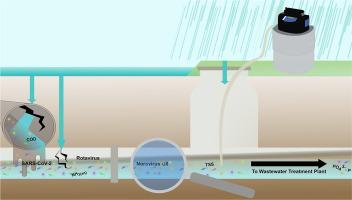
As wastewater-based surveillance (WBS) is increasingly used to track community-level disease trends, it is important to understand how pathogen signals can be altered by phenomena that occur within sewersheds such as inflow and infiltration (I&I). Our objectives were to characterize I&I across a rural sewershed and assess potential impacts on viral (rotavirus, norovirus GII, and SARS-CoV-2), fecal indicator (HF183, the hCYTB484 gene specific to the human mitochondrial genome, and crAssphage), and antimicrobial resistance (intI1, blaCTX−M-1) targets. In a small town in Virginia (USA), we collected 107 wastewater samples at monthly intervals over a 12-month period (2022–2023) at the wastewater treatment plant (WWTP) influent and 11 up-sewer sites. Viral, fecal indicator, and antimicrobial resistance targets were enumerated using ddPCR. Physicochemical proxies for organics and nutrient levels in sewage (chemical oxygen demand (COD), total suspended solids (TSS), and NH3(aq)) and genetic markers of anthropogenic impact were used to characterize I&I across the sewershed. Overall, precipitation was negatively associated (Spearman test; ρ < 0; p < 0.01) with physicochemical markers (TSS, COD, K, PO43−-P, NH3(aq)) in the WWTP influent. We observed the highest concentrations of human fecal markers and a measure anthropogenic pollution and antibiotic resistance (intI1) in up-sewer sites with limited I&I. However, median viral gene copy concentrations were highest at the WWTP, compared to 100 % (n = 11), 90 % (n = 10), and 55 % (n = 6) of up-sewer sites for rotavirus, norovirus GII, and SARS-CoV-2, respectively. After adjusting for covariates (Ba, COD, dissolved oxygen, groundwater depth, precipitation, sampling date) using generalized linear models, moderate to high I&I was associated with statistically significant reductions in log10-transformed rotavirus and norovirus GII concentrations across the sewershed (coefficients = -0.7 and -0.9, p < 0.001, n = 95), though not for SARS-CoV-2 (coefficient = -0.2, p = 0.181, n = 95). Overall, we found that while I&I can diminish biomarker signals throughout a sewershed, including at the WWTP influent, I&I impacts vary depending on the target, and pathogen biomarker signals were, on average, higher and less variable over time at the WWTP compared to most up-sewer sites. As far as we are aware, this is the first study to assess in situ I&I impacts on multiple WBS targets. Taken together, our findings highlight challenges and tradeoffs associated with different sampling strategies for different WBS targets in heavily I&I impacted systems.
期刊介绍:
Water Research, along with its open access companion journal Water Research X, serves as a platform for publishing original research papers covering various aspects of the science and technology related to the anthropogenic water cycle, water quality, and its management worldwide. The audience targeted by the journal comprises biologists, chemical engineers, chemists, civil engineers, environmental engineers, limnologists, and microbiologists. The scope of the journal include:
•Treatment processes for water and wastewaters (municipal, agricultural, industrial, and on-site treatment), including resource recovery and residuals management;
•Urban hydrology including sewer systems, stormwater management, and green infrastructure;
•Drinking water treatment and distribution;
•Potable and non-potable water reuse;
•Sanitation, public health, and risk assessment;
•Anaerobic digestion, solid and hazardous waste management, including source characterization and the effects and control of leachates and gaseous emissions;
•Contaminants (chemical, microbial, anthropogenic particles such as nanoparticles or microplastics) and related water quality sensing, monitoring, fate, and assessment;
•Anthropogenic impacts on inland, tidal, coastal and urban waters, focusing on surface and ground waters, and point and non-point sources of pollution;
•Environmental restoration, linked to surface water, groundwater and groundwater remediation;
•Analysis of the interfaces between sediments and water, and between water and atmosphere, focusing specifically on anthropogenic impacts;
•Mathematical modelling, systems analysis, machine learning, and beneficial use of big data related to the anthropogenic water cycle;
•Socio-economic, policy, and regulations studies.




 京公网安备 11010802042870号
京ICP备2023020795号-1
京公网安备 11010802042870号
京ICP备2023020795号-1

 分享
分享
 求助内容:
求助内容: 应助结果提醒方式:
 扫码关注我们
