Ying Huang , Jiangtao Wang , Pengfei Wu , Zheng Duan , Xiuzhen Li , Jianwu Tang
{"title":"Impacts of Spartina alterniflora invasion on coastal carbon cycling within a native Phragmites australis-dominated wetland","authors":"Ying Huang , Jiangtao Wang , Pengfei Wu , Zheng Duan , Xiuzhen Li , Jianwu Tang","doi":"10.1016/j.agrformet.2025.110405","DOIUrl":null,"url":null,"abstract":"<div><div>Despite its significance for climate adaptation, the impact of non-native <em>Spartina alterniflora</em> on coastal blue carbon cycling remains unclear. While it is generally reported that <em>S. alterniflora</em> invasion increases the soil organic carbon (SOC) stock along China's coastlines from tropical to subtropical climate zones, some cases, such as the Jiuduansha wetland in the Yangtze River estuary, show a different pattern. To clarify the impacts of <em>S. alterniflora</em> invasion on carbon cycling within a native <em>Phragmites australis</em>-dominated wetland, a comprehensive study was conducted in the Yangtze River estuary, employing a multidisciplinary approach that integrated eddy covariance (EC) measurements, soil and water sampling, and satellite remote sensing. The EC measurements revealed that three marshes (<em>S. alterniflora</em> saltmarsh, native <em>Phragmites australis</em> saltmarsh, and <em>P. australis</em> freshwater marsh) functioned as net carbon sinks annually, with <em>S. alterniflora</em> saltmarsh capturing 822.57 g C m<sup>−2</sup> yr<sup>−1</sup>, which was 86.13 % and 54.27 % higher than <em>P. australis</em> saltmarsh (NEE=−441.93 g C m<sup>−2</sup> yr<sup>−1</sup>) and <em>P. australis</em> freshwater marsh (NEE=−533.21 g C m<sup>−2</sup> yr<sup>−1</sup>), respectively. This suggests that enhanced lateral carbon fluxes from the wetland to the estuary underlie the higher primary production but lower SOC storage observed in <em>S. alterniflora</em> wetlands. This possibility is further supported by higher satellite-derived dissolved organic carbon concentrations in the tidal creeks adjacent to <em>S. alterniflora</em> compared to those near <em>P. australis</em> marshes, which were significantly correlated with satellite-derived non-photosynthetic vegetation fractional cover. This study underscores the role of non-native <em>S. alterniflora</em> in facilitating carbon transfer from the atmosphere to the estuary, in contrast to native <em>P. australis</em>, and highlights that effective <em>S. alterniflora</em> management is beneficial for the synergistic enhancement of wetland restoration, conservation, and carbon sequestration.</div></div>","PeriodicalId":50839,"journal":{"name":"Agricultural and Forest Meteorology","volume":"363 ","pages":"Article 110405"},"PeriodicalIF":5.7000,"publicationDate":"2025-01-30","publicationTypes":"Journal Article","fieldsOfStudy":null,"isOpenAccess":false,"openAccessPdf":"","citationCount":"0","resultStr":null,"platform":"Semanticscholar","paperid":null,"PeriodicalName":"Agricultural and Forest Meteorology","FirstCategoryId":"97","ListUrlMain":"https://www.sciencedirect.com/science/article/pii/S0168192325000255","RegionNum":1,"RegionCategory":"农林科学","ArticlePicture":[],"TitleCN":null,"AbstractTextCN":null,"PMCID":null,"EPubDate":"","PubModel":"","JCR":"Q1","JCRName":"AGRONOMY","Score":null,"Total":0}
引用次数: 0
Abstract
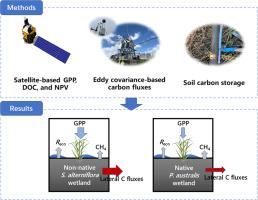
Despite its significance for climate adaptation, the impact of non-native Spartina alterniflora on coastal blue carbon cycling remains unclear. While it is generally reported that S. alterniflora invasion increases the soil organic carbon (SOC) stock along China's coastlines from tropical to subtropical climate zones, some cases, such as the Jiuduansha wetland in the Yangtze River estuary, show a different pattern. To clarify the impacts of S. alterniflora invasion on carbon cycling within a native Phragmites australis-dominated wetland, a comprehensive study was conducted in the Yangtze River estuary, employing a multidisciplinary approach that integrated eddy covariance (EC) measurements, soil and water sampling, and satellite remote sensing. The EC measurements revealed that three marshes (S. alterniflora saltmarsh, native Phragmites australis saltmarsh, and P. australis freshwater marsh) functioned as net carbon sinks annually, with S. alterniflora saltmarsh capturing 822.57 g C m−2 yr−1, which was 86.13 % and 54.27 % higher than P. australis saltmarsh (NEE=−441.93 g C m−2 yr−1) and P. australis freshwater marsh (NEE=−533.21 g C m−2 yr−1), respectively. This suggests that enhanced lateral carbon fluxes from the wetland to the estuary underlie the higher primary production but lower SOC storage observed in S. alterniflora wetlands. This possibility is further supported by higher satellite-derived dissolved organic carbon concentrations in the tidal creeks adjacent to S. alterniflora compared to those near P. australis marshes, which were significantly correlated with satellite-derived non-photosynthetic vegetation fractional cover. This study underscores the role of non-native S. alterniflora in facilitating carbon transfer from the atmosphere to the estuary, in contrast to native P. australis, and highlights that effective S. alterniflora management is beneficial for the synergistic enhancement of wetland restoration, conservation, and carbon sequestration.
尽管互花米草对气候适应具有重要意义,但其对海岸带蓝碳循环的影响尚不清楚。互花草的入侵增加了中国沿海从热带到亚热带的土壤有机碳(SOC)储量,但在长江口的九段沙湿地表现出不同的模式。为明确互花草入侵对芦苇湿地碳循环的影响,采用涡动相关(EC)测量、水土采样和卫星遥感等多学科方法对长江口湿地进行了综合研究。EC测量结果表明,3个湿地(互花草盐沼、芦苇盐沼和芦苇淡水沼泽)具有年净碳汇功能,互花草盐沼捕获822.57 g C m−2 yr−1,分别比芦苇盐沼(NEE= - 441.93 g C m−2 yr−1)和芦苇淡水沼泽(NEE= - 533.21 g C m−2 yr−1)高86.13%和54.27%。这表明互花草湿地从湿地到河口的横向碳通量增强是其初级产量高而有机碳储量低的基础。这种可能性得到了进一步的支持,即互花草附近潮汐溪的溶解有机碳浓度高于南稻沼泽附近,这与卫星计算的非光合植被覆盖度显著相关。本研究强调了非本地互花草在促进从大气到河口的碳转移方面的作用,并强调了有效的互花草管理有利于湿地恢复、保护和碳封存的协同增强。
期刊介绍:
Agricultural and Forest Meteorology is an international journal for the publication of original articles and reviews on the inter-relationship between meteorology, agriculture, forestry, and natural ecosystems. Emphasis is on basic and applied scientific research relevant to practical problems in the field of plant and soil sciences, ecology and biogeochemistry as affected by weather as well as climate variability and change. Theoretical models should be tested against experimental data. Articles must appeal to an international audience. Special issues devoted to single topics are also published.
Typical topics include canopy micrometeorology (e.g. canopy radiation transfer, turbulence near the ground, evapotranspiration, energy balance, fluxes of trace gases), micrometeorological instrumentation (e.g., sensors for trace gases, flux measurement instruments, radiation measurement techniques), aerobiology (e.g. the dispersion of pollen, spores, insects and pesticides), biometeorology (e.g. the effect of weather and climate on plant distribution, crop yield, water-use efficiency, and plant phenology), forest-fire/weather interactions, and feedbacks from vegetation to weather and the climate system.




 京公网安备 11010802042870号
京ICP备2023020795号-1
京公网安备 11010802042870号
京ICP备2023020795号-1

 分享
分享
 求助内容:
求助内容: 应助结果提醒方式:
 扫码关注我们
