Hyokjin Kwak, Marina Puzakova, Ann L. McGill, Junhee Kim
{"title":"When previous relationships limit the new: The interplay between product anthropomorphism and used products","authors":"Hyokjin Kwak, Marina Puzakova, Ann L. McGill, Junhee Kim","doi":"10.1007/s11747-025-01086-5","DOIUrl":null,"url":null,"abstract":"<p>This research contributes novel insights into consumer-brand relationships and pricing literature by establishing the negative impact of product anthropomorphism on buyers’ purchase intentions and purchase prices for used products. Drawing on prior research on relationship-dissolution stigma (a pervasive stereotype toward people with dissolved relationships), we show that buyers apply stigma attributions to anthropomorphized used products. This stigma attribution, in turn, decreases consumers’ purchase intentions compared to their nonanthropomorphized counterparts. We establish this negative effect through the use of AI deep learning neural networks that classify products as anthropomorphized or not and five experiments. We further uncover several important boundary conditions. First, we show that the negative effect is mitigated when a seller describes a high level of attachment toward a used product. Second, our research establishes that the negative effect of product anthropomorphism reverses when consumers learn of external reasons for selling a used product. Finally, we provide significant managerial implications by demonstrating that a used product labeling strategy as certified pre-owned (vs. merely used) attenuates the negative effect of product anthropomorphism on the valuation of used products.</p>","PeriodicalId":17194,"journal":{"name":"Journal of the Academy of Marketing Science","volume":"24 1","pages":""},"PeriodicalIF":10.1000,"publicationDate":"2025-02-01","publicationTypes":"Journal Article","fieldsOfStudy":null,"isOpenAccess":false,"openAccessPdf":"","citationCount":"0","resultStr":null,"platform":"Semanticscholar","paperid":null,"PeriodicalName":"Journal of the Academy of Marketing Science","FirstCategoryId":"91","ListUrlMain":"https://doi.org/10.1007/s11747-025-01086-5","RegionNum":1,"RegionCategory":"管理学","ArticlePicture":[],"TitleCN":null,"AbstractTextCN":null,"PMCID":null,"EPubDate":"","PubModel":"","JCR":"Q1","JCRName":"BUSINESS","Score":null,"Total":0}
引用次数: 0
Abstract
This research contributes novel insights into consumer-brand relationships and pricing literature by establishing the negative impact of product anthropomorphism on buyers’ purchase intentions and purchase prices for used products. Drawing on prior research on relationship-dissolution stigma (a pervasive stereotype toward people with dissolved relationships), we show that buyers apply stigma attributions to anthropomorphized used products. This stigma attribution, in turn, decreases consumers’ purchase intentions compared to their nonanthropomorphized counterparts. We establish this negative effect through the use of AI deep learning neural networks that classify products as anthropomorphized or not and five experiments. We further uncover several important boundary conditions. First, we show that the negative effect is mitigated when a seller describes a high level of attachment toward a used product. Second, our research establishes that the negative effect of product anthropomorphism reverses when consumers learn of external reasons for selling a used product. Finally, we provide significant managerial implications by demonstrating that a used product labeling strategy as certified pre-owned (vs. merely used) attenuates the negative effect of product anthropomorphism on the valuation of used products.
期刊介绍:
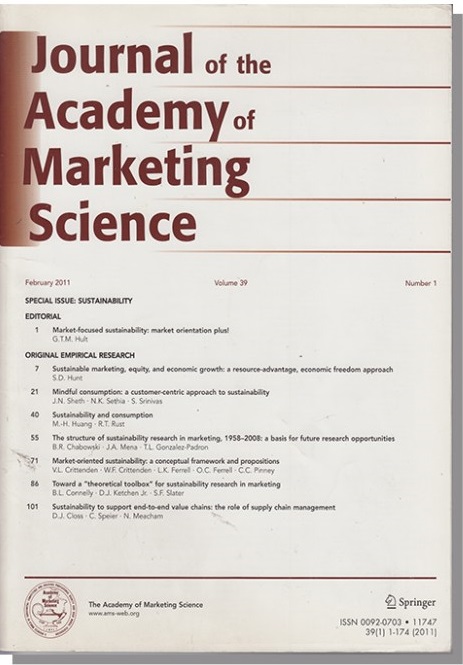
JAMS, also known as The Journal of the Academy of Marketing Science, plays a crucial role in bridging the gap between scholarly research and practical application in the realm of marketing. Its primary objective is to study and enhance marketing practices by publishing research-driven articles.
When manuscripts are submitted to JAMS for publication, they are evaluated based on their potential to contribute to the advancement of marketing science and practice.



 京公网安备 11010802042870号
京ICP备2023020795号-1
京公网安备 11010802042870号
京ICP备2023020795号-1

 分享
分享
 求助内容:
求助内容: 应助结果提醒方式:
 扫码关注我们
