{"title":"Impact of GLP-1 Receptor Agonists on Alcohol-Related Liver Disease Development and Progression in Alcohol Use Disorder","authors":"Chia-Chih Kuo, Chun-Hsien Li, Min-Hsiang Chuang, Po-Yu Huang, Hsing-Tao Kuo, Chih-Cheng Lai","doi":"10.1111/apt.70007","DOIUrl":null,"url":null,"abstract":"<div>\n \n \n <section>\n \n <h3> Background and Aims</h3>\n \n <p>Glucagon-like peptide-1 receptor agonists (GLP-1RAs) have shown promise in reducing alcohol consumption, but their impact on clinical outcomes in patients with alcohol use disorder (AUD) remains unclear. We investigated the association between GLP-1RAs and the development and progression of alcohol-related liver disease (ArLD) in patients with AUD.</p>\n </section>\n \n <section>\n \n <h3> Methods</h3>\n \n <p>Using the TriNetX Research Network, we conducted two retrospective cohort studies comparing GLP-1RAs versus dipeptidyl peptidase-4 inhibitors (DPP-4is) in patients with type 2 diabetes. The first cohort included patients with AUD but without ArLD (<i>n</i> = 7132 after propensity score matching), while the second comprised patients with established ArLD (<i>n</i> = 1896 after matching). Primary outcomes were incident ArLD in the AUD cohort and hepatic decompensation in the ArLD cohort.</p>\n </section>\n \n <section>\n \n <h3> Results</h3>\n \n <p>In the AUD cohort (median follow-up: 63.2 months), GLP-1RA users showed significantly lower risks of developing ArLD compared to DPP-4i users (incidence rate: 6.0 vs. 8.7 per 1000 person-years; HR: 0.62, 95% CI: 0.44–0.87, <i>p</i> = 0.006). GLP-1RAs were also associated with reduced risks of all-cause mortality (HR: 0.53, <i>p</i> < 0.001). In the ArLD cohort (median follow-up: 28.2 months), GLP-1RA users demonstrated lower risks of hepatic decompensation (incidence rate: 39.5 vs. 51.4 per 1000 person-years; HR: 0.66, 95% CI: 0.51–0.85, <i>p</i> = 0.001) and all-cause mortality (HR: 0.53, <i>p</i> < 0.001) compared to DPP-4i users.</p>\n </section>\n \n <section>\n \n <h3> Conclusions</h3>\n \n <p>GLP-1RAs were associated with reduced risks of developing and progressing ArLD in patients with AUD, suggesting potential therapeutic benefits in this population.</p>\n </section>\n </div>","PeriodicalId":121,"journal":{"name":"Alimentary Pharmacology & Therapeutics","volume":"61 8","pages":"1343-1356"},"PeriodicalIF":6.7000,"publicationDate":"2025-01-31","publicationTypes":"Journal Article","fieldsOfStudy":null,"isOpenAccess":false,"openAccessPdf":"","citationCount":"0","resultStr":null,"platform":"Semanticscholar","paperid":null,"PeriodicalName":"Alimentary Pharmacology & Therapeutics","FirstCategoryId":"3","ListUrlMain":"https://onlinelibrary.wiley.com/doi/10.1111/apt.70007","RegionNum":1,"RegionCategory":"医学","ArticlePicture":[],"TitleCN":null,"AbstractTextCN":null,"PMCID":null,"EPubDate":"","PubModel":"","JCR":"Q1","JCRName":"GASTROENTEROLOGY & HEPATOLOGY","Score":null,"Total":0}
引用次数: 0
Abstract
Background and Aims
Glucagon-like peptide-1 receptor agonists (GLP-1RAs) have shown promise in reducing alcohol consumption, but their impact on clinical outcomes in patients with alcohol use disorder (AUD) remains unclear. We investigated the association between GLP-1RAs and the development and progression of alcohol-related liver disease (ArLD) in patients with AUD.
Methods
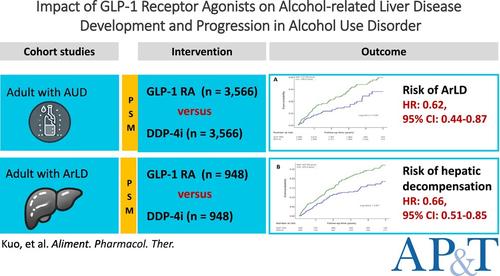
Using the TriNetX Research Network, we conducted two retrospective cohort studies comparing GLP-1RAs versus dipeptidyl peptidase-4 inhibitors (DPP-4is) in patients with type 2 diabetes. The first cohort included patients with AUD but without ArLD (n = 7132 after propensity score matching), while the second comprised patients with established ArLD (n = 1896 after matching). Primary outcomes were incident ArLD in the AUD cohort and hepatic decompensation in the ArLD cohort.
Results
In the AUD cohort (median follow-up: 63.2 months), GLP-1RA users showed significantly lower risks of developing ArLD compared to DPP-4i users (incidence rate: 6.0 vs. 8.7 per 1000 person-years; HR: 0.62, 95% CI: 0.44–0.87, p = 0.006). GLP-1RAs were also associated with reduced risks of all-cause mortality (HR: 0.53, p < 0.001). In the ArLD cohort (median follow-up: 28.2 months), GLP-1RA users demonstrated lower risks of hepatic decompensation (incidence rate: 39.5 vs. 51.4 per 1000 person-years; HR: 0.66, 95% CI: 0.51–0.85, p = 0.001) and all-cause mortality (HR: 0.53, p < 0.001) compared to DPP-4i users.
Conclusions
GLP-1RAs were associated with reduced risks of developing and progressing ArLD in patients with AUD, suggesting potential therapeutic benefits in this population.
期刊介绍:
Alimentary Pharmacology & Therapeutics is a global pharmacology journal focused on the impact of drugs on the human gastrointestinal and hepato-biliary systems. It covers a diverse range of topics, often with immediate clinical relevance to its readership.




 京公网安备 11010802042870号
京ICP备2023020795号-1
京公网安备 11010802042870号
京ICP备2023020795号-1

 分享
分享
 求助内容:
求助内容: 应助结果提醒方式:
 扫码关注我们
