Stephan Maes, Nezha Badi, Johan M. Winne, Filip E. Du Prez
{"title":"Taking dynamic covalent chemistry out of the lab and into reprocessable industrial thermosets","authors":"Stephan Maes, Nezha Badi, Johan M. Winne, Filip E. Du Prez","doi":"10.1038/s41570-025-00686-7","DOIUrl":null,"url":null,"abstract":"Dynamic covalent chemistry (DCC) allows the development of thermally (re)processable and recyclable polymer networks, which is a highly attractive feature for new generations of thermoset materials. However, despite a surge in academic interest wherein soon almost any imaginable DCC platform may have been applied in a thermoset formulation, dynamic or reversible covalent polymer networks have so far found only few industrial applications. This Review provides a perspective on the main strategies for the application of DCC in the design and development of bulk thermoset materials, and it presents some of the key hurdles for their industrial implementation. The polymer design strategies and associated chemistries are viewed from the perspective of how ‘close to market’ their development pathway is, thus providing a roadmap to achieve high-volume breakthrough applications. Ever-increasing society needs have made thermosets crucial, but their recycling poses considerable challenges. Dynamic covalent chemistry (DCC) offers a solution, and industry is ready for its implementation. On the basis of market proximity, three DCC-based strategies are proposed for stimulating industrial uptake of DCC-thermosets.","PeriodicalId":18849,"journal":{"name":"Nature reviews. Chemistry","volume":"9 3","pages":"144-158"},"PeriodicalIF":51.7000,"publicationDate":"2025-01-31","publicationTypes":"Journal Article","fieldsOfStudy":null,"isOpenAccess":false,"openAccessPdf":"","citationCount":"0","resultStr":null,"platform":"Semanticscholar","paperid":null,"PeriodicalName":"Nature reviews. Chemistry","FirstCategoryId":"92","ListUrlMain":"https://www.nature.com/articles/s41570-025-00686-7","RegionNum":1,"RegionCategory":"化学","ArticlePicture":[],"TitleCN":null,"AbstractTextCN":null,"PMCID":null,"EPubDate":"","PubModel":"","JCR":"Q1","JCRName":"CHEMISTRY, MULTIDISCIPLINARY","Score":null,"Total":0}
引用次数: 0
Abstract
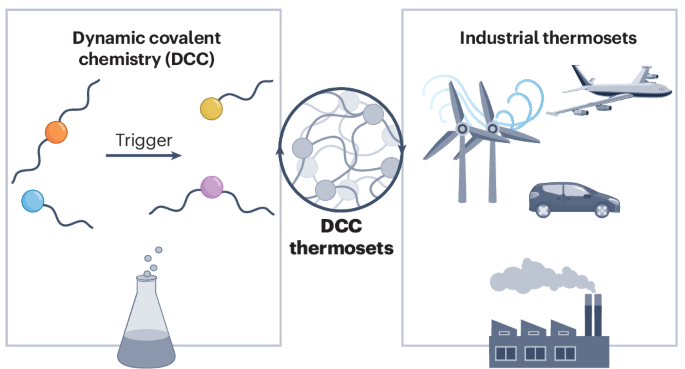
Dynamic covalent chemistry (DCC) allows the development of thermally (re)processable and recyclable polymer networks, which is a highly attractive feature for new generations of thermoset materials. However, despite a surge in academic interest wherein soon almost any imaginable DCC platform may have been applied in a thermoset formulation, dynamic or reversible covalent polymer networks have so far found only few industrial applications. This Review provides a perspective on the main strategies for the application of DCC in the design and development of bulk thermoset materials, and it presents some of the key hurdles for their industrial implementation. The polymer design strategies and associated chemistries are viewed from the perspective of how ‘close to market’ their development pathway is, thus providing a roadmap to achieve high-volume breakthrough applications. Ever-increasing society needs have made thermosets crucial, but their recycling poses considerable challenges. Dynamic covalent chemistry (DCC) offers a solution, and industry is ready for its implementation. On the basis of market proximity, three DCC-based strategies are proposed for stimulating industrial uptake of DCC-thermosets.
期刊介绍:
Nature Reviews Chemistry is an online-only journal that publishes Reviews, Perspectives, and Comments on various disciplines within chemistry. The Reviews aim to offer balanced and objective analyses of selected topics, providing clear descriptions of relevant scientific literature. The content is designed to be accessible to recent graduates in any chemistry-related discipline while also offering insights for principal investigators and industry-based research scientists. Additionally, Reviews should provide the authors' perspectives on future directions and opinions regarding the major challenges faced by researchers in the field.




 京公网安备 11010802042870号
京ICP备2023020795号-1
京公网安备 11010802042870号
京ICP备2023020795号-1

 分享
分享
 求助内容:
求助内容: 应助结果提醒方式:
 扫码关注我们
