Leonoor V Wismans, Tessa E Hendriks, J Annelie Suurmeijer, Joost J Nuyttens, Anna M Bruynzeel, Martijn P Intven, Lydi M van Driel, Roel Haen, Roeland F de Wilde, Bas Groot Koerkamp, Olivier R Busch, Jaap Stoker, Joanne Verheij, Arantza Farina, Onno J de Boer, Michail Doukas, Ignace H de Hingh, Daan J Lips, Erwin van der Harst, Geertjan van Tienhoven, Casper H van Eijck, Marc G Besselink
{"title":"Preoperative stereotactic radiotherapy to prevent pancreatic fistula in high-risk patients undergoing pancreatoduodenectomy (FIBROPANC): prospective multicentre phase II single-arm trial.","authors":"Leonoor V Wismans, Tessa E Hendriks, J Annelie Suurmeijer, Joost J Nuyttens, Anna M Bruynzeel, Martijn P Intven, Lydi M van Driel, Roel Haen, Roeland F de Wilde, Bas Groot Koerkamp, Olivier R Busch, Jaap Stoker, Joanne Verheij, Arantza Farina, Onno J de Boer, Michail Doukas, Ignace H de Hingh, Daan J Lips, Erwin van der Harst, Geertjan van Tienhoven, Casper H van Eijck, Marc G Besselink","doi":"10.1093/bjs/znae327","DOIUrl":null,"url":null,"abstract":"<p><strong>Background: </strong>Postoperative pancreatic fistula is the main driver of morbidity and mortality after pancreatoduodenectomy. In high-risk patients, the rate of postoperative pancreatic fistula approaches 50%, whereas it is below 5% in patients with pancreatic cancer who receive neoadjuvant chemoradiotherapy. The aim of this study was to evaluate the safety, feasibility, and efficacy of preoperative stereotactic body radiotherapy on the pancreatic neck transection margin in high-risk patients undergoing pancreatoduodenectomy to prevent postoperative pancreatic fistula.</p><p><strong>Methods: </strong>In this prospective multicentre open-label single-arm trial (progressing from a safety run-in phase to a phase II design), patients undergoing pancreatoduodenectomy for neoplasms other than pancreatic ductal adenocarcinoma received a single preoperative stereotactic body radiotherapy dose of 12 Gy. Primary endpoints included safety (less than or equal to 15% grade 3-5 toxicity), feasibility (a significant change in pancreatic texture measured using a durometer), and efficacy (a 15% reduction in the grade B/C postoperative pancreatic fistula rate compared with patients from the Dutch Pancreatic Cancer Audit who were eligible but not included in this study). Secondary endpoints assessed tissue fibrosis (collagen density).</p><p><strong>Results: </strong>Overall, 38 patients were included, of whom 33 (87%) completed the study protocol and were included in the per-protocol analysis. The safety cut-off was met, with 3% grade 3-5 toxicity. Pancreatic tissue treated with stereotactic body radiotherapy showed increased firmness using a durometer (median of 47 (interquartile range 36-57) versus 37 (interquartile range 30-41) Shore OO units; P < 0.001) and a higher collagen density (median of 6.1% (interquartile range 4.4%-9.5%) versus 4.6% (interquartile range 2.5%-7.4%); P = 0.003). The grade B/C postoperative pancreatic fistula rate with stereotactic body radiotherapy was 57.6% (95% c.i. 41% to 74%), compared with 34% (95% c.i. 27% to 42%) in audit controls (P = 0.011).</p><p><strong>Conclusion: </strong>Preoperative stereotactic body radiotherapy is safe in high-risk patients undergoing pancreatoduodenectomy and increases parenchymal firmness and fibrosis, but fails to show evidence of efficacy.</p>","PeriodicalId":136,"journal":{"name":"British Journal of Surgery","volume":"112 2","pages":""},"PeriodicalIF":8.8000,"publicationDate":"2025-02-01","publicationTypes":"Journal Article","fieldsOfStudy":null,"isOpenAccess":false,"openAccessPdf":"https://www.ncbi.nlm.nih.gov/pmc/articles/PMC11785728/pdf/","citationCount":"0","resultStr":null,"platform":"Semanticscholar","paperid":null,"PeriodicalName":"British Journal of Surgery","FirstCategoryId":"3","ListUrlMain":"https://doi.org/10.1093/bjs/znae327","RegionNum":1,"RegionCategory":"医学","ArticlePicture":[],"TitleCN":null,"AbstractTextCN":null,"PMCID":null,"EPubDate":"","PubModel":"","JCR":"Q1","JCRName":"SURGERY","Score":null,"Total":0}
引用次数: 0
Abstract
Background: Postoperative pancreatic fistula is the main driver of morbidity and mortality after pancreatoduodenectomy. In high-risk patients, the rate of postoperative pancreatic fistula approaches 50%, whereas it is below 5% in patients with pancreatic cancer who receive neoadjuvant chemoradiotherapy. The aim of this study was to evaluate the safety, feasibility, and efficacy of preoperative stereotactic body radiotherapy on the pancreatic neck transection margin in high-risk patients undergoing pancreatoduodenectomy to prevent postoperative pancreatic fistula.
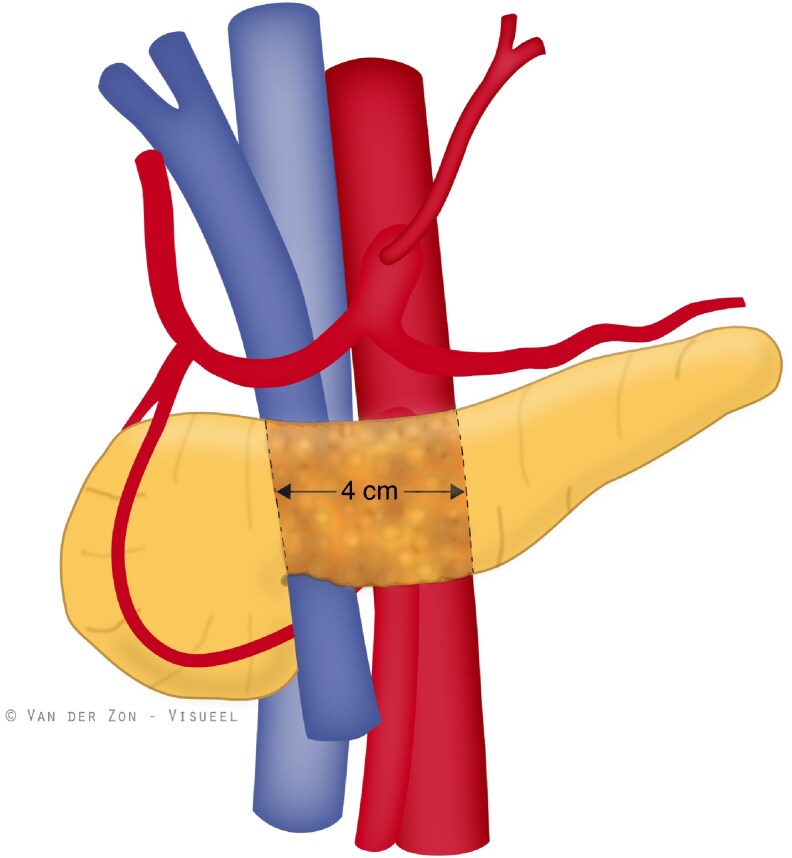
Methods: In this prospective multicentre open-label single-arm trial (progressing from a safety run-in phase to a phase II design), patients undergoing pancreatoduodenectomy for neoplasms other than pancreatic ductal adenocarcinoma received a single preoperative stereotactic body radiotherapy dose of 12 Gy. Primary endpoints included safety (less than or equal to 15% grade 3-5 toxicity), feasibility (a significant change in pancreatic texture measured using a durometer), and efficacy (a 15% reduction in the grade B/C postoperative pancreatic fistula rate compared with patients from the Dutch Pancreatic Cancer Audit who were eligible but not included in this study). Secondary endpoints assessed tissue fibrosis (collagen density).
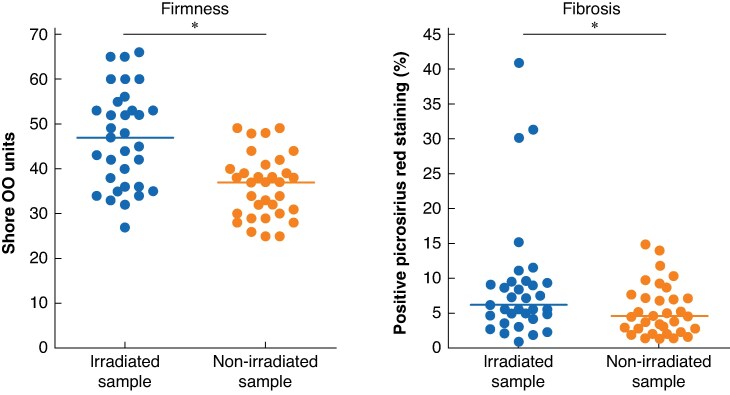
Results: Overall, 38 patients were included, of whom 33 (87%) completed the study protocol and were included in the per-protocol analysis. The safety cut-off was met, with 3% grade 3-5 toxicity. Pancreatic tissue treated with stereotactic body radiotherapy showed increased firmness using a durometer (median of 47 (interquartile range 36-57) versus 37 (interquartile range 30-41) Shore OO units; P < 0.001) and a higher collagen density (median of 6.1% (interquartile range 4.4%-9.5%) versus 4.6% (interquartile range 2.5%-7.4%); P = 0.003). The grade B/C postoperative pancreatic fistula rate with stereotactic body radiotherapy was 57.6% (95% c.i. 41% to 74%), compared with 34% (95% c.i. 27% to 42%) in audit controls (P = 0.011).
Conclusion: Preoperative stereotactic body radiotherapy is safe in high-risk patients undergoing pancreatoduodenectomy and increases parenchymal firmness and fibrosis, but fails to show evidence of efficacy.
期刊介绍:
The British Journal of Surgery (BJS), incorporating the European Journal of Surgery, stands as Europe's leading peer-reviewed surgical journal. It serves as an invaluable platform for presenting high-quality clinical and laboratory-based research across a wide range of surgical topics. In addition to providing a comprehensive coverage of traditional surgical practices, BJS also showcases emerging areas in the field, such as minimally invasive therapy and interventional radiology.
While the journal appeals to general surgeons, it also holds relevance for specialty surgeons and professionals working in closely related fields. By presenting cutting-edge research and advancements, BJS aims to revolutionize the way surgical knowledge is shared and contribute to the ongoing progress of the surgical community.




 京公网安备 11010802042870号
京ICP备2023020795号-1
京公网安备 11010802042870号
京ICP备2023020795号-1

 分享
分享
 求助内容:
求助内容: 应助结果提醒方式:
 扫码关注我们
