Yulun Wu , Mohamed Alaa Mohamed , Tai Yi , Arundhati Das , Clayton L. Rumsey , Martin Trebbin , Christopher K. Breuer , Stelios T. Andreadis
{"title":"Self-healing and cell-free vascular grafts","authors":"Yulun Wu , Mohamed Alaa Mohamed , Tai Yi , Arundhati Das , Clayton L. Rumsey , Martin Trebbin , Christopher K. Breuer , Stelios T. Andreadis","doi":"10.1016/j.biomaterials.2025.123121","DOIUrl":null,"url":null,"abstract":"<div><div>We developed an innovative self-healing tissue engineering vessel (SH-TEV) that heals fast after repeated needle punctures, while maintaining artery like mechanical strength and toughness even under wet conditions. The SH-TEV is designed as a bilayer tube engineered by electrospinning an autonomous self-healing polyurethane, PU-DAA, around a tube of a native biomaterial, small intestinal submucosa (SIS), that can be functionalized with biomolecules to recruit host cells and promote endothelialization. The self-healing PU-DAA was designed to incorporate multi-strength H-bonds and reversible hydrazone bonds and exhibited high strength (3.95 ± 0.16 MPa), toughness (23.01 ± 2.37 MJ/m<sup>3</sup>), and fast autonomous self-healing (86.44 ± 6.65 % after 12 h) under physiological conditions. The self-healing layer supported attachment, spreading and proliferation of fibroblasts, indicating biocompatibility. When SH-TEVs were implanted as interpositional grafts into the rat aorta for 4 weeks, they remained patent without any thrombosis (100 % animal survival and 100 % graft patency), were endothelialized and developed a smooth muscle cell containing vascular wall. In addition, they showed excellent self-healing ability following needle puncture (hemostatic time <40 s) immediately after implantation and four weeks later. Collectively, these results demonstrate the potential of SH-TEVs as vascular access conduits for hemodialysis applications.</div></div>","PeriodicalId":254,"journal":{"name":"Biomaterials","volume":"318 ","pages":"Article 123121"},"PeriodicalIF":12.9000,"publicationDate":"2025-01-25","publicationTypes":"Journal Article","fieldsOfStudy":null,"isOpenAccess":false,"openAccessPdf":"","citationCount":"0","resultStr":null,"platform":"Semanticscholar","paperid":null,"PeriodicalName":"Biomaterials","FirstCategoryId":"5","ListUrlMain":"https://www.sciencedirect.com/science/article/pii/S0142961225000407","RegionNum":1,"RegionCategory":"医学","ArticlePicture":[],"TitleCN":null,"AbstractTextCN":null,"PMCID":null,"EPubDate":"","PubModel":"","JCR":"Q1","JCRName":"ENGINEERING, BIOMEDICAL","Score":null,"Total":0}
引用次数: 0
Abstract
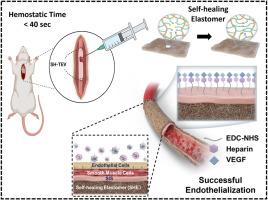
We developed an innovative self-healing tissue engineering vessel (SH-TEV) that heals fast after repeated needle punctures, while maintaining artery like mechanical strength and toughness even under wet conditions. The SH-TEV is designed as a bilayer tube engineered by electrospinning an autonomous self-healing polyurethane, PU-DAA, around a tube of a native biomaterial, small intestinal submucosa (SIS), that can be functionalized with biomolecules to recruit host cells and promote endothelialization. The self-healing PU-DAA was designed to incorporate multi-strength H-bonds and reversible hydrazone bonds and exhibited high strength (3.95 ± 0.16 MPa), toughness (23.01 ± 2.37 MJ/m3), and fast autonomous self-healing (86.44 ± 6.65 % after 12 h) under physiological conditions. The self-healing layer supported attachment, spreading and proliferation of fibroblasts, indicating biocompatibility. When SH-TEVs were implanted as interpositional grafts into the rat aorta for 4 weeks, they remained patent without any thrombosis (100 % animal survival and 100 % graft patency), were endothelialized and developed a smooth muscle cell containing vascular wall. In addition, they showed excellent self-healing ability following needle puncture (hemostatic time <40 s) immediately after implantation and four weeks later. Collectively, these results demonstrate the potential of SH-TEVs as vascular access conduits for hemodialysis applications.
期刊介绍:
Biomaterials is an international journal covering the science and clinical application of biomaterials. A biomaterial is now defined as a substance that has been engineered to take a form which, alone or as part of a complex system, is used to direct, by control of interactions with components of living systems, the course of any therapeutic or diagnostic procedure. It is the aim of the journal to provide a peer-reviewed forum for the publication of original papers and authoritative review and opinion papers dealing with the most important issues facing the use of biomaterials in clinical practice. The scope of the journal covers the wide range of physical, biological and chemical sciences that underpin the design of biomaterials and the clinical disciplines in which they are used. These sciences include polymer synthesis and characterization, drug and gene vector design, the biology of the host response, immunology and toxicology and self assembly at the nanoscale. Clinical applications include the therapies of medical technology and regenerative medicine in all clinical disciplines, and diagnostic systems that reply on innovative contrast and sensing agents. The journal is relevant to areas such as cancer diagnosis and therapy, implantable devices, drug delivery systems, gene vectors, bionanotechnology and tissue engineering.



 京公网安备 11010802042870号
京ICP备2023020795号-1
京公网安备 11010802042870号
京ICP备2023020795号-1

 分享
分享
 求助内容:
求助内容: 应助结果提醒方式:
 扫码关注我们
