{"title":"Update on autoimmune dementia and its precursors","authors":"Niels Hansen","doi":"10.1016/j.bbr.2025.115460","DOIUrl":null,"url":null,"abstract":"<div><div>Autoimmune dementia is a new disease entity increasingly coming into focus, and novel neural antibodies associated with dementia and its precursors have been described. However, the significance of these novel and emerging autoantibodies in conjunction with cognitive disorders is unclear. Antibodies such as Leucin-Rich, Glioma Inactivated 1 (LGI1) and N-Methyl-D-Aspartate Receptor (NMDAR) are already known to be pathogenic by triggering anomalies in synaptic plasticity and learning processes in animal models after having been transferred from humans to animals. In this review we describe various pathogenic mechanisms of antibodies such as complement dependent cytotoxicity, the internalization of membrane receptors, antagonistic effects, and alterations in vesicle endocytosis at the synaptic level. We also discuss established autoantibodies such as membrane-surface and intracellular antibodies in connection with cognitive disorders, as well as autoantibodies associated with neurodegenerative dementia, and autoimmune encephalitis with primary dementia syndrome. Test methods and the response to immunotherapy are also briefly explained. This overview provides a differentiated presentation of a heterogeneous dementia entity with its precursors, which requires more research to develop a differentiated treatment guideline.</div></div>","PeriodicalId":8823,"journal":{"name":"Behavioural Brain Research","volume":"482 ","pages":"Article 115460"},"PeriodicalIF":2.3000,"publicationDate":"2025-01-29","publicationTypes":"Journal Article","fieldsOfStudy":null,"isOpenAccess":false,"openAccessPdf":"","citationCount":"0","resultStr":null,"platform":"Semanticscholar","paperid":null,"PeriodicalName":"Behavioural Brain Research","FirstCategoryId":"102","ListUrlMain":"https://www.sciencedirect.com/science/article/pii/S0166432825000464","RegionNum":3,"RegionCategory":"心理学","ArticlePicture":[],"TitleCN":null,"AbstractTextCN":null,"PMCID":null,"EPubDate":"","PubModel":"","JCR":"Q2","JCRName":"BEHAVIORAL SCIENCES","Score":null,"Total":0}
引用次数: 0
Abstract
Autoimmune dementia is a new disease entity increasingly coming into focus, and novel neural antibodies associated with dementia and its precursors have been described. However, the significance of these novel and emerging autoantibodies in conjunction with cognitive disorders is unclear. Antibodies such as Leucin-Rich, Glioma Inactivated 1 (LGI1) and N-Methyl-D-Aspartate Receptor (NMDAR) are already known to be pathogenic by triggering anomalies in synaptic plasticity and learning processes in animal models after having been transferred from humans to animals. In this review we describe various pathogenic mechanisms of antibodies such as complement dependent cytotoxicity, the internalization of membrane receptors, antagonistic effects, and alterations in vesicle endocytosis at the synaptic level. We also discuss established autoantibodies such as membrane-surface and intracellular antibodies in connection with cognitive disorders, as well as autoantibodies associated with neurodegenerative dementia, and autoimmune encephalitis with primary dementia syndrome. Test methods and the response to immunotherapy are also briefly explained. This overview provides a differentiated presentation of a heterogeneous dementia entity with its precursors, which requires more research to develop a differentiated treatment guideline.
自身免疫性痴呆是一种新的疾病实体,越来越受到关注,与痴呆及其前体相关的新型神经抗体已被描述。然而,这些新的和新兴的自身抗体在认知障碍中的意义尚不清楚。已知富亮素、胶质瘤失活1 (LGI1)和n-甲基- d -天冬氨酸受体(NMDAR)等抗体在动物模型中从人类转移到动物后,通过引发突触可塑性和学习过程的异常而致病。在这篇综述中,我们描述了抗体的各种致病机制,如补体依赖性细胞毒性、膜受体的内化、拮抗作用和突触水平上囊泡内吞作用的改变。我们还讨论了已建立的自身抗体,如与认知障碍有关的膜表面抗体和细胞内抗体,以及与神经退行性痴呆和原发性痴呆综合征的自身免疫性脑炎相关的自身抗体。还简要说明了测试方法和对免疫治疗的反应。本综述提供了异质性痴呆实体及其前体的差异化表现,这需要更多的研究来制定差异化的治疗指南。
期刊介绍:
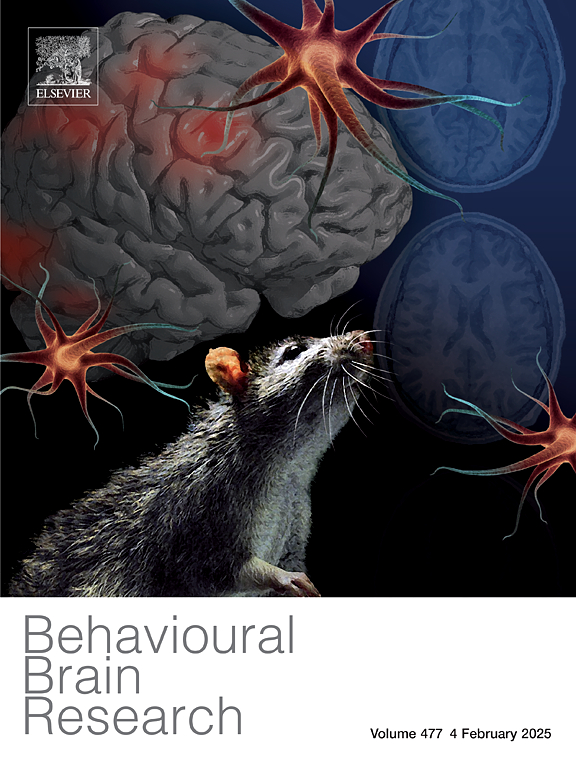
Behavioural Brain Research is an international, interdisciplinary journal dedicated to the publication of articles in the field of behavioural neuroscience, broadly defined. Contributions from the entire range of disciplines that comprise the neurosciences, behavioural sciences or cognitive sciences are appropriate, as long as the goal is to delineate the neural mechanisms underlying behaviour. Thus, studies may range from neurophysiological, neuroanatomical, neurochemical or neuropharmacological analysis of brain-behaviour relations, including the use of molecular genetic or behavioural genetic approaches, to studies that involve the use of brain imaging techniques, to neuroethological studies. Reports of original research, of major methodological advances, or of novel conceptual approaches are all encouraged. The journal will also consider critical reviews on selected topics.



 京公网安备 11010802042870号
京ICP备2023020795号-1
京公网安备 11010802042870号
京ICP备2023020795号-1

 分享
分享
 求助内容:
求助内容: 应助结果提醒方式:
 扫码关注我们
