Seon Y Park, Miaobing Zheng, Kathleen E Lacy, Karen J Campbell, Penelope Love
{"title":"On-site breakfast provision in early childhood education and care (ECEC) services in Australia: a multi-method investigation.","authors":"Seon Y Park, Miaobing Zheng, Kathleen E Lacy, Karen J Campbell, Penelope Love","doi":"10.1007/s00394-025-03590-4","DOIUrl":null,"url":null,"abstract":"<p><strong>Background: </strong>Breakfast is vital for young children's health. In Australia, breakfast is often provided in government-approved Early Childhood Education and Care (ECEC) services. However, research on breakfast provision in Australian ECEC services is limited. This study aimed to evaluate breakfast quality and enablers and barriers of breakfast provision in these settings.</p><p><strong>Methods: </strong>A multi-method, sequential explanatory design was employed, including survey, on-site visits, and semi-structured interviews. ECEC services offering breakfast in Victoria, Australia, participated in an online survey to assess breakfast provision quality based on Victorian Health Eating Advisory Service (HEAS) guidelines. Multivariate logistic regression was utilised to identify the relationship between breakfast quality and service characteristics. A subset of services participated in 1-day observational visits and 30-min semi-structured interviews. The on-site visits observed breakfast foods and environments, while interviews explored enablers or barriers of breakfast provision.</p><p><strong>Results: </strong>Fifty ECEC services participated in the online survey, with common breakfast items such as cereal, bread, and milk being frequently provided, while fruits and vegetables were among the least common items offered. Only 10-16% of services met the HEAS definitions of high-quality standards, and these centres were mostly located in socioeconomically advantaged areas. Of these, four services participated in the on-site observation phase, where the use of full-cream milk and multigrain bread was commonly noted. Additionally, eight interviews (two from each centre) were conducted to explore enablers and barriers to healthy breakfast provision. Key enablers included government funding and the use of nutritional guidelines, while barriers involved time constraints, budget limitations, staffing shortages, and insufficient confidence in applying and utilising nutrition guidance.</p><p><strong>Conclusion: </strong>Fruits and vegetables are rarely provided at breakfast in ECEC settings, and only a small number of ECEC services met high-quality breakfast standards, with those in socio-economically advantaged areas more likely to achieve these standards. Targeted interventions, particularly in disadvantaged areas, are essential to improve the quality of breakfast provision, with a focus on including fruits and vegetables in line with guidelines. While the findings of this study had jurisdictional limitations, this study highlighted the importance of addressing issues such as time constraints, budget limitations, and staffing shortages, along with establishing practical and clear breakfast guidelines to enhance the quality of breakfast provision in ECEC settings. Further research is needed to explore specific and actionable strategies for implementing these improvements.</p>","PeriodicalId":12030,"journal":{"name":"European Journal of Nutrition","volume":"64 2","pages":"78"},"PeriodicalIF":4.3000,"publicationDate":"2025-02-01","publicationTypes":"Journal Article","fieldsOfStudy":null,"isOpenAccess":false,"openAccessPdf":"https://www.ncbi.nlm.nih.gov/pmc/articles/PMC11787215/pdf/","citationCount":"0","resultStr":null,"platform":"Semanticscholar","paperid":null,"PeriodicalName":"European Journal of Nutrition","FirstCategoryId":"3","ListUrlMain":"https://doi.org/10.1007/s00394-025-03590-4","RegionNum":2,"RegionCategory":"医学","ArticlePicture":[],"TitleCN":null,"AbstractTextCN":null,"PMCID":null,"EPubDate":"","PubModel":"","JCR":"Q2","JCRName":"NUTRITION & DIETETICS","Score":null,"Total":0}
引用次数: 0
Abstract
Background: Breakfast is vital for young children's health. In Australia, breakfast is often provided in government-approved Early Childhood Education and Care (ECEC) services. However, research on breakfast provision in Australian ECEC services is limited. This study aimed to evaluate breakfast quality and enablers and barriers of breakfast provision in these settings.
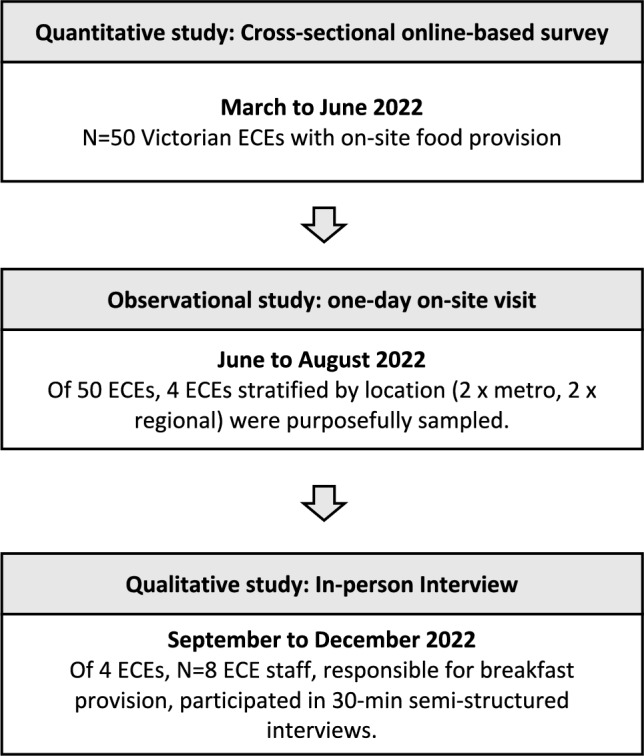
Methods: A multi-method, sequential explanatory design was employed, including survey, on-site visits, and semi-structured interviews. ECEC services offering breakfast in Victoria, Australia, participated in an online survey to assess breakfast provision quality based on Victorian Health Eating Advisory Service (HEAS) guidelines. Multivariate logistic regression was utilised to identify the relationship between breakfast quality and service characteristics. A subset of services participated in 1-day observational visits and 30-min semi-structured interviews. The on-site visits observed breakfast foods and environments, while interviews explored enablers or barriers of breakfast provision.
Results: Fifty ECEC services participated in the online survey, with common breakfast items such as cereal, bread, and milk being frequently provided, while fruits and vegetables were among the least common items offered. Only 10-16% of services met the HEAS definitions of high-quality standards, and these centres were mostly located in socioeconomically advantaged areas. Of these, four services participated in the on-site observation phase, where the use of full-cream milk and multigrain bread was commonly noted. Additionally, eight interviews (two from each centre) were conducted to explore enablers and barriers to healthy breakfast provision. Key enablers included government funding and the use of nutritional guidelines, while barriers involved time constraints, budget limitations, staffing shortages, and insufficient confidence in applying and utilising nutrition guidance.
Conclusion: Fruits and vegetables are rarely provided at breakfast in ECEC settings, and only a small number of ECEC services met high-quality breakfast standards, with those in socio-economically advantaged areas more likely to achieve these standards. Targeted interventions, particularly in disadvantaged areas, are essential to improve the quality of breakfast provision, with a focus on including fruits and vegetables in line with guidelines. While the findings of this study had jurisdictional limitations, this study highlighted the importance of addressing issues such as time constraints, budget limitations, and staffing shortages, along with establishing practical and clear breakfast guidelines to enhance the quality of breakfast provision in ECEC settings. Further research is needed to explore specific and actionable strategies for implementing these improvements.
期刊介绍:
The European Journal of Nutrition publishes original papers, reviews, and short communications in the nutritional sciences. The manuscripts submitted to the European Journal of Nutrition should have their major focus on the impact of nutrients and non-nutrients on
immunology and inflammation,
gene expression,
metabolism,
chronic diseases, or
carcinogenesis,
or a major focus on
epidemiology, including intervention studies with healthy subjects and with patients,
biofunctionality of food and food components, or
the impact of diet on the environment.




 京公网安备 11010802042870号
京ICP备2023020795号-1
京公网安备 11010802042870号
京ICP备2023020795号-1

 分享
分享
 求助内容:
求助内容: 应助结果提醒方式:
 扫码关注我们
