{"title":"An electrochemical biosensor utilizing CRISPR/Cas12a amplification for the detection of E. coli†","authors":"Chenyan Li, Yilan Liang and Qincong Feng","doi":"10.1039/D4AN01441C","DOIUrl":null,"url":null,"abstract":"<p >Electrochemical biosensors are frequently employed to identify harmful microbes and disease indicators. However, their practical applicability is constrained by poor signal amplification efficiency and immobilization processes on the probe surface. To get over these restrictions, we here integrated roll-cycling amplification (RCA) and CRISPR/Cas12a gene editing tools with electrochemical biosensors. We constructed an electrochemical biosensor based on RCA to activate the cleavage activity of Cas12a. First, by double-stranded nucleic acid aptamer (ds Apt) specifically binding to <em>E. coli-2571</em>, Apt-b was competitively isolated to bind to T4 ligase and produce circular DNA. This in turn activates RCA, which in turn activates the accessory cleavage activity of CRISPR/Cas12a, which in turn cleaves DNA sequences loaded onto the electrode, changing electrochemical signals. With a linear range of 1 × 10<small><sup>2</sup></small>–1 × 10<small><sup>7</sup></small> CFU mL<small><sup>−1</sup></small>, a detection limit of 5.28 CFU mL<small><sup>−1</sup></small>, and experimental recoveries of 93.01–101.53%, the measured electrochemical signals were positively connected with the concentration of <em>E. coli-2571</em> under the optimal experimental conditions. Therefore, by combining two approaches—RCA and CRISPR/Cas12a—our electrochemical biosensor was able to detect <em>E. coli-2571</em> specifically and sensitively, providing new research opportunities for the detection of other harmful bacteria.</p>","PeriodicalId":63,"journal":{"name":"Analyst","volume":" 6","pages":" 1158-1166"},"PeriodicalIF":3.3000,"publicationDate":"2025-02-03","publicationTypes":"Journal Article","fieldsOfStudy":null,"isOpenAccess":false,"openAccessPdf":"","citationCount":"0","resultStr":null,"platform":"Semanticscholar","paperid":null,"PeriodicalName":"Analyst","FirstCategoryId":"92","ListUrlMain":"https://pubs.rsc.org/en/content/articlelanding/2025/an/d4an01441c","RegionNum":3,"RegionCategory":"化学","ArticlePicture":[],"TitleCN":null,"AbstractTextCN":null,"PMCID":null,"EPubDate":"","PubModel":"","JCR":"Q2","JCRName":"CHEMISTRY, ANALYTICAL","Score":null,"Total":0}
引用次数: 0
Abstract
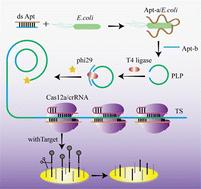
Electrochemical biosensors are frequently employed to identify harmful microbes and disease indicators. However, their practical applicability is constrained by poor signal amplification efficiency and immobilization processes on the probe surface. To get over these restrictions, we here integrated roll-cycling amplification (RCA) and CRISPR/Cas12a gene editing tools with electrochemical biosensors. We constructed an electrochemical biosensor based on RCA to activate the cleavage activity of Cas12a. First, by double-stranded nucleic acid aptamer (ds Apt) specifically binding to E. coli-2571, Apt-b was competitively isolated to bind to T4 ligase and produce circular DNA. This in turn activates RCA, which in turn activates the accessory cleavage activity of CRISPR/Cas12a, which in turn cleaves DNA sequences loaded onto the electrode, changing electrochemical signals. With a linear range of 1 × 10²–1 × 10⁷ CFU mL−1, a detection limit of 5.28 CFU mL−1, and experimental recoveries of 93.01–101.53%, the measured electrochemical signals were positively connected with the concentration of E. coli-2571 under the optimal experimental conditions. Therefore, by combining two approaches—RCA and CRISPR/Cas12a—our electrochemical biosensor was able to detect E. coli-2571 specifically and sensitively, providing new research opportunities for the detection of other harmful bacteria.



 京公网安备 11010802042870号
京ICP备2023020795号-1
京公网安备 11010802042870号
京ICP备2023020795号-1

 分享
分享
 求助内容:
求助内容: 应助结果提醒方式:
 扫码关注我们
