{"title":"A comprehensive view of the molecular features within the serum and serum EV of Alzheimer's disease†","authors":"Jiayi Zhang, Xiaoqin Cheng, Anqi Hu, Xin Zhang, Meng Zhang, Lei Zhang, Jiawei Dai, Guoquan Yan, Huali Shen and Guoqiang Fei","doi":"10.1039/D4AN01018C","DOIUrl":null,"url":null,"abstract":"<p >Conventional Alzheimer's disease research mainly focuses on cerebrospinal fluid, which requires an invasive sampling procedure. This method carries inherent risks for patients and could potentially lower patient compliance. EVs (Extracellular Vesicles) and blood are two emerging noninvasive mediators reflecting the pathological changes of Alzheimer's disease. Integrating the two serum proteomic information based on DIA (Data Independent Acquisition) is conducive to the comparison of serological research strategies, mining pathological information of AD, and evaluating the potential of EVs and blood in the diagnosis of AD. We generated a combined proteomic data resource of 39 serum samples derived from patients with AD and from age-matched controls (AMC) and identified 639 PGs (protein groups) in serum samples and 714 PGs in serum EV samples. The differentially expressed protein groups identified in both serum and serum EV provide a reflective profile of the pathological characteristics associated with AD. The combined strategy performed well, identifying 40 potential diagnostic markers with AUC values above 0.85, including two molecular diagnostic models that achieved an effectiveness score of 0.991.</p>","PeriodicalId":63,"journal":{"name":"Analyst","volume":" 5","pages":" 922-935"},"PeriodicalIF":3.3000,"publicationDate":"2025-02-03","publicationTypes":"Journal Article","fieldsOfStudy":null,"isOpenAccess":false,"openAccessPdf":"","citationCount":"0","resultStr":null,"platform":"Semanticscholar","paperid":null,"PeriodicalName":"Analyst","FirstCategoryId":"92","ListUrlMain":"https://pubs.rsc.org/en/content/articlelanding/2025/an/d4an01018c","RegionNum":3,"RegionCategory":"化学","ArticlePicture":[],"TitleCN":null,"AbstractTextCN":null,"PMCID":null,"EPubDate":"","PubModel":"","JCR":"Q2","JCRName":"CHEMISTRY, ANALYTICAL","Score":null,"Total":0}
引用次数: 0
Abstract
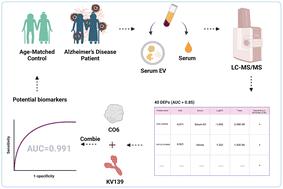
Conventional Alzheimer's disease research mainly focuses on cerebrospinal fluid, which requires an invasive sampling procedure. This method carries inherent risks for patients and could potentially lower patient compliance. EVs (Extracellular Vesicles) and blood are two emerging noninvasive mediators reflecting the pathological changes of Alzheimer's disease. Integrating the two serum proteomic information based on DIA (Data Independent Acquisition) is conducive to the comparison of serological research strategies, mining pathological information of AD, and evaluating the potential of EVs and blood in the diagnosis of AD. We generated a combined proteomic data resource of 39 serum samples derived from patients with AD and from age-matched controls (AMC) and identified 639 PGs (protein groups) in serum samples and 714 PGs in serum EV samples. The differentially expressed protein groups identified in both serum and serum EV provide a reflective profile of the pathological characteristics associated with AD. The combined strategy performed well, identifying 40 potential diagnostic markers with AUC values above 0.85, including two molecular diagnostic models that achieved an effectiveness score of 0.991.




 京公网安备 11010802042870号
京ICP备2023020795号-1
京公网安备 11010802042870号
京ICP备2023020795号-1

 分享
分享
 求助内容:
求助内容: 应助结果提醒方式:
 扫码关注我们
