{"title":"Design High-Entropy Core-Shell Nickel-Rich Cobalt-Free Cathode Material Toward High Performance Lithium Batteries","authors":"Boyang Zhao, Xia Sun, Hongwei Bi, Tingzhou Yang, Haipeng Li, Dan Luo, Yongguang Zhang, Zhongwei Chen","doi":"10.1002/adfm.202423717","DOIUrl":null,"url":null,"abstract":"<p>The structural instability of lithium-based transition metal layered oxides during electrochemical cycling-exacerbated by phenomena such as metal dissolution and phase transitions-induces rapid capacity degradation, thus constraining their applicability in high-energy-density lithium batteries. While coating these materials can bolster stability, the employment of electrochemically inactive coatings may inadvertently undermine energy storage performance, presenting a significant trade-off. In response to this challenge, an innovative core-shell cathode architecture is presented, wherein high entropy doped LiNi<sub>1/6</sub>Mn<sub>1/6</sub>Al<sub>1/6</sub>Ti<sub>1/6</sub>Mo<sub>1/6</sub>Ta<sub>1/6</sub>O<sub>2</sub> serves as the shell and nickel-rich cobalt-free LiNi<sub>0.89</sub>Mn<sub>0.11</sub>O<sub>2</sub> constitutes the core, synthesized through a simple two-step co-precipitation methodology (designated as LHECNM). This high-entropy shell preserves the core's electrochemical performance while effectively mitigating phase transformations and transition metal ion dissolution, thereby enhancing structural robustness. Moreover, the core-shell configuration significantly diminishes the energy barrier for Li<sup>+</sup> diffusion, facilitating superior ion transport dynamics. Consequently, LHECNM demonstrates remarkable electrochemical performance, achieving a discharge capacity of 201.57 mAh g<sup>−1</sup>, a commendable rate capability up to 5C, and an impressive 92% capacity retention over prolonged cycling. This investigation elucidates a promising paradigm for the design of high-entropy cathode materials, offering profound insights for the advancement of future energy storage technologies.</p>","PeriodicalId":112,"journal":{"name":"Advanced Functional Materials","volume":"35 26","pages":""},"PeriodicalIF":19.0000,"publicationDate":"2025-02-02","publicationTypes":"Journal Article","fieldsOfStudy":null,"isOpenAccess":false,"openAccessPdf":"","citationCount":"0","resultStr":null,"platform":"Semanticscholar","paperid":null,"PeriodicalName":"Advanced Functional Materials","FirstCategoryId":"88","ListUrlMain":"https://advanced.onlinelibrary.wiley.com/doi/10.1002/adfm.202423717","RegionNum":1,"RegionCategory":"材料科学","ArticlePicture":[],"TitleCN":null,"AbstractTextCN":null,"PMCID":null,"EPubDate":"","PubModel":"","JCR":"Q1","JCRName":"CHEMISTRY, MULTIDISCIPLINARY","Score":null,"Total":0}
引用次数: 0
Abstract
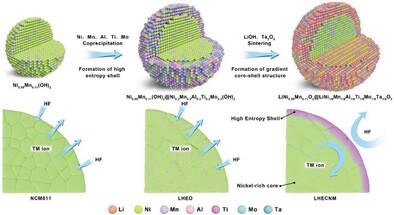
The structural instability of lithium-based transition metal layered oxides during electrochemical cycling-exacerbated by phenomena such as metal dissolution and phase transitions-induces rapid capacity degradation, thus constraining their applicability in high-energy-density lithium batteries. While coating these materials can bolster stability, the employment of electrochemically inactive coatings may inadvertently undermine energy storage performance, presenting a significant trade-off. In response to this challenge, an innovative core-shell cathode architecture is presented, wherein high entropy doped LiNi1/6Mn1/6Al1/6Ti1/6Mo1/6Ta1/6O2 serves as the shell and nickel-rich cobalt-free LiNi0.89Mn0.11O2 constitutes the core, synthesized through a simple two-step co-precipitation methodology (designated as LHECNM). This high-entropy shell preserves the core's electrochemical performance while effectively mitigating phase transformations and transition metal ion dissolution, thereby enhancing structural robustness. Moreover, the core-shell configuration significantly diminishes the energy barrier for Li+ diffusion, facilitating superior ion transport dynamics. Consequently, LHECNM demonstrates remarkable electrochemical performance, achieving a discharge capacity of 201.57 mAh g−1, a commendable rate capability up to 5C, and an impressive 92% capacity retention over prolonged cycling. This investigation elucidates a promising paradigm for the design of high-entropy cathode materials, offering profound insights for the advancement of future energy storage technologies.
锂基过渡金属层状氧化物在电化学循环过程中的结构不稳定性,以及金属溶解和相变等现象的加剧,导致了容量的快速退化,从而限制了其在高能量密度锂电池中的适用性。虽然涂层这些材料可以增强稳定性,但使用电化学不活跃的涂层可能会无意中破坏能量存储性能,这是一个重大的权衡。为了应对这一挑战,提出了一种创新的核壳阴极结构,其中高熵掺杂的LiNi1/6Mn1/6Al1/6Ti1/6Mo1/6Ta1/6O2为壳,富镍的无钴LiNi0.89Mn0.11O2为芯,通过简单的两步共沉淀法(称为LHECNM)合成。这种高熵壳保留了核心的电化学性能,同时有效地减轻了相变和过渡金属离子的溶解,从而增强了结构的稳健性。此外,核壳结构显著降低了Li+扩散的能量势垒,促进了优异的离子传输动力学。因此,LHECNM表现出卓越的电化学性能,实现了201.57 mAh g - 1的放电容量,值得称赞的倍率容量高达5C,并且在长时间循环中具有令人印象深刻的92%的容量保持率。这项研究阐明了高熵正极材料设计的一个有前途的范例,为未来储能技术的进步提供了深刻的见解。
期刊介绍:
Firmly established as a top-tier materials science journal, Advanced Functional Materials reports breakthrough research in all aspects of materials science, including nanotechnology, chemistry, physics, and biology every week.
Advanced Functional Materials is known for its rapid and fair peer review, quality content, and high impact, making it the first choice of the international materials science community.



 京公网安备 11010802042870号
京ICP备2023020795号-1
京公网安备 11010802042870号
京ICP备2023020795号-1

 分享
分享
 求助内容:
求助内容: 应助结果提醒方式:
 扫码关注我们
