Zhe Li, Yueshuai Wang, Hui Liu, Yi Feng, Xiwen Du, Zhiheng Xie, Jihan Zhou, Yang Liu, Yun Song, Fei Wang, Manling Sui, Yue Lu, Fang Fang, Dalin Sun
{"title":"Electroreduction-driven distorted nanotwins activate pure Cu for efficient hydrogen evolution","authors":"Zhe Li, Yueshuai Wang, Hui Liu, Yi Feng, Xiwen Du, Zhiheng Xie, Jihan Zhou, Yang Liu, Yun Song, Fei Wang, Manling Sui, Yue Lu, Fang Fang, Dalin Sun","doi":"10.1038/s41563-024-02098-2","DOIUrl":null,"url":null,"abstract":"Precious metals such as Pt are favoured as catalysts for the hydrogen evolution reaction (HER) due to their excellent catalytic activity. However, the scarcity and high cost of precious metals have prompted researchers to explore cheaper alternatives such as Cu. Nevertheless, Cu shows poor catalytic performance due to weak binding with intermediates. Here the catalytic activity of pure Cu is activated via electroreduction-driven modification of the local structure, achieving a HER catalytic performance superior to commercial Pt/C catalysts for working current densities greater than 100 mA cm−2 in acid electrolyte. Activation involved two steps. First, polycrystalline Cu2O nanoparticles were prepared via pulsed laser ablation, resulting in grain boundaries within the Cu2O particles as observed using electron microscopy. Next, the Cu2O particles were electroreduced to pure Cu, inducing the formation of distorted nanotwins and edge dislocations. These local structures induce high lattice strain and decrease the Cu coordination number, enhancing the interaction between Cu and intermediates—as calculated using density functional theory—leading to the excellent catalytic activity and durability of the catalyst. Our observations show that low-cost pure Cu can be a promising HER catalyst for large-scale industrial applications. Low-cost Cu catalysts for the hydrogen evolution reaction (HER) can transform industrial water electrolysis, but pure Cu typically exhibits a negligible HER. Here, combining pulsed laser ablation and subsequent electroreduction, Cu nanotwins form that enable the HER at an overpotential of 301 mV, with 125 h of stable operation at a current density of 500 mA cm−2.","PeriodicalId":19058,"journal":{"name":"Nature Materials","volume":"24 3","pages":"424-432"},"PeriodicalIF":38.5000,"publicationDate":"2025-02-03","publicationTypes":"Journal Article","fieldsOfStudy":null,"isOpenAccess":false,"openAccessPdf":"","citationCount":"0","resultStr":null,"platform":"Semanticscholar","paperid":null,"PeriodicalName":"Nature Materials","FirstCategoryId":"88","ListUrlMain":"https://www.nature.com/articles/s41563-024-02098-2","RegionNum":1,"RegionCategory":"材料科学","ArticlePicture":[],"TitleCN":null,"AbstractTextCN":null,"PMCID":null,"EPubDate":"","PubModel":"","JCR":"Q1","JCRName":"CHEMISTRY, PHYSICAL","Score":null,"Total":0}
引用次数: 0
Abstract
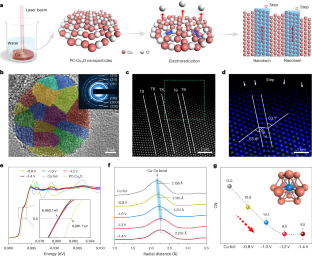
Precious metals such as Pt are favoured as catalysts for the hydrogen evolution reaction (HER) due to their excellent catalytic activity. However, the scarcity and high cost of precious metals have prompted researchers to explore cheaper alternatives such as Cu. Nevertheless, Cu shows poor catalytic performance due to weak binding with intermediates. Here the catalytic activity of pure Cu is activated via electroreduction-driven modification of the local structure, achieving a HER catalytic performance superior to commercial Pt/C catalysts for working current densities greater than 100 mA cm−2 in acid electrolyte. Activation involved two steps. First, polycrystalline Cu2O nanoparticles were prepared via pulsed laser ablation, resulting in grain boundaries within the Cu2O particles as observed using electron microscopy. Next, the Cu2O particles were electroreduced to pure Cu, inducing the formation of distorted nanotwins and edge dislocations. These local structures induce high lattice strain and decrease the Cu coordination number, enhancing the interaction between Cu and intermediates—as calculated using density functional theory—leading to the excellent catalytic activity and durability of the catalyst. Our observations show that low-cost pure Cu can be a promising HER catalyst for large-scale industrial applications. Low-cost Cu catalysts for the hydrogen evolution reaction (HER) can transform industrial water electrolysis, but pure Cu typically exhibits a negligible HER. Here, combining pulsed laser ablation and subsequent electroreduction, Cu nanotwins form that enable the HER at an overpotential of 301 mV, with 125 h of stable operation at a current density of 500 mA cm−2.
铂等贵金属因其优异的催化活性而成为析氢反应的催化剂。然而,贵金属的稀缺性和高成本促使研究人员探索更便宜的替代品,如铜。Cu与中间体结合较弱,表现出较差的催化性能。纯Cu的催化活性是通过电还原驱动的局部结构修饰来激活的,在酸性电解质中,当工作电流密度大于100 mA cm−2时,实现了优于商用Pt/C催化剂的HER催化性能。激活包括两个步骤。首先,通过脉冲激光烧蚀法制备了多晶Cu2O纳米颗粒,在电子显微镜下观察到Cu2O颗粒内部有晶界。然后,将Cu2O颗粒电还原为纯Cu,诱导形成扭曲的纳米孪晶和边缘位错。根据密度泛函理论计算,这些局部结构引起高晶格应变并降低Cu配位数,增强Cu与中间体之间的相互作用,从而导致催化剂具有优异的催化活性和耐久性。我们的观察表明,低成本的纯Cu可以成为大规模工业应用的有前途的HER催化剂。
期刊介绍:
Nature Materials is a monthly multi-disciplinary journal aimed at bringing together cutting-edge research across the entire spectrum of materials science and engineering. It covers all applied and fundamental aspects of the synthesis/processing, structure/composition, properties, and performance of materials. The journal recognizes that materials research has an increasing impact on classical disciplines such as physics, chemistry, and biology.
Additionally, Nature Materials provides a forum for the development of a common identity among materials scientists and encourages interdisciplinary collaboration. It takes an integrated and balanced approach to all areas of materials research, fostering the exchange of ideas between scientists involved in different disciplines.
Nature Materials is an invaluable resource for scientists in academia and industry who are active in discovering and developing materials and materials-related concepts. It offers engaging and informative papers of exceptional significance and quality, with the aim of influencing the development of society in the future.





 京公网安备 11010802042870号
京ICP备2023020795号-1
京公网安备 11010802042870号
京ICP备2023020795号-1

 分享
分享
 求助内容:
求助内容: 应助结果提醒方式:
 扫码关注我们
