{"title":"Quantum electronic strengthening of covalent semiconductor materials by excess electron/hole doping","authors":"Hiroki Noda , Shumpei Sakaguchi , Ryoga Fujita, Susumu Minami , Hiroyuki Hirakata , Takahiro Shimada","doi":"10.1016/j.actamat.2025.120795","DOIUrl":null,"url":null,"abstract":"<div><div>Covalent semiconductor materials are indispensable for the development of modern society because of their excellent semiconductor properties, but they are consistently challenged by failures due to brittle fracture. Recently, both experimental and theoretical attempts to modify the strength of materials by electron doping have been reported. Here, we comprehensively examine the impact of excess electrons and holes on the bonding strength of a typical covalent material based on first-principles calculations. The bond strength is reduced or increased monotonically and linearly with electron doping density, resulting in an approximate 60 % variation at the highest feasible doping density. The degree of strength change per carrier density for each material is found to correlate with its bonding characteristics, with stronger ionic bonding properties exhibiting larger changes. Furthermore, the quantum mechanism of the change in strength is explained by energetic contribution of bonding orbitals occupied by introduced charge. These results indicate that covalent semiconductor materials share a common mechanism of strengthening by electron doping, which could contribute to the design of more robust semiconductor products.</div></div>","PeriodicalId":238,"journal":{"name":"Acta Materialia","volume":"287 ","pages":"Article 120795"},"PeriodicalIF":9.3000,"publicationDate":"2025-02-03","publicationTypes":"Journal Article","fieldsOfStudy":null,"isOpenAccess":false,"openAccessPdf":"","citationCount":"0","resultStr":null,"platform":"Semanticscholar","paperid":null,"PeriodicalName":"Acta Materialia","FirstCategoryId":"88","ListUrlMain":"https://www.sciencedirect.com/science/article/pii/S1359645425000874","RegionNum":1,"RegionCategory":"材料科学","ArticlePicture":[],"TitleCN":null,"AbstractTextCN":null,"PMCID":null,"EPubDate":"","PubModel":"","JCR":"Q1","JCRName":"MATERIALS SCIENCE, MULTIDISCIPLINARY","Score":null,"Total":0}
引用次数: 0
Abstract
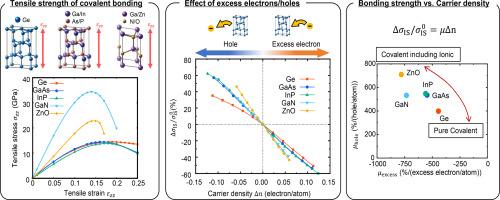
Covalent semiconductor materials are indispensable for the development of modern society because of their excellent semiconductor properties, but they are consistently challenged by failures due to brittle fracture. Recently, both experimental and theoretical attempts to modify the strength of materials by electron doping have been reported. Here, we comprehensively examine the impact of excess electrons and holes on the bonding strength of a typical covalent material based on first-principles calculations. The bond strength is reduced or increased monotonically and linearly with electron doping density, resulting in an approximate 60 % variation at the highest feasible doping density. The degree of strength change per carrier density for each material is found to correlate with its bonding characteristics, with stronger ionic bonding properties exhibiting larger changes. Furthermore, the quantum mechanism of the change in strength is explained by energetic contribution of bonding orbitals occupied by introduced charge. These results indicate that covalent semiconductor materials share a common mechanism of strengthening by electron doping, which could contribute to the design of more robust semiconductor products.
期刊介绍:
Acta Materialia serves as a platform for publishing full-length, original papers and commissioned overviews that contribute to a profound understanding of the correlation between the processing, structure, and properties of inorganic materials. The journal seeks papers with high impact potential or those that significantly propel the field forward. The scope includes the atomic and molecular arrangements, chemical and electronic structures, and microstructure of materials, focusing on their mechanical or functional behavior across all length scales, including nanostructures.




 京公网安备 11010802042870号
京ICP备2023020795号-1
京公网安备 11010802042870号
京ICP备2023020795号-1

 分享
分享
 求助内容:
求助内容: 应助结果提醒方式:
 扫码关注我们
