Melamine holding PbI2 with three “arms”: an effective chelation strategy to control the lead iodide to perovskite conversion for inverted perovskite solar cells†
Shizi Luo, Shuguang Cao, Tongjun Zheng, Zhuoneng Bi, Yupeng Zheng, Yiqun Li, Biniyam Zemene Taye, Victoria V. Ozerova, Lyubov A. Frolova, Nikita A. Emelianov, Eugeniy D. Tarasov, Zheng Liang, Lavrenty G. Gutsev, Sergey M. Aldoshin, Bala R. Ramachandran, Pavel A. Troshin and Xueqing Xu
{"title":"Melamine holding PbI2 with three “arms”: an effective chelation strategy to control the lead iodide to perovskite conversion for inverted perovskite solar cells†","authors":"Shizi Luo, Shuguang Cao, Tongjun Zheng, Zhuoneng Bi, Yupeng Zheng, Yiqun Li, Biniyam Zemene Taye, Victoria V. Ozerova, Lyubov A. Frolova, Nikita A. Emelianov, Eugeniy D. Tarasov, Zheng Liang, Lavrenty G. Gutsev, Sergey M. Aldoshin, Bala R. Ramachandran, Pavel A. Troshin and Xueqing Xu","doi":"10.1039/D4EE04692G","DOIUrl":null,"url":null,"abstract":"<p >It is now well-known that moderate amounts of lead iodide (PbI<small><sub>2</sub></small>) in organic–inorganic hybrid perovskite films are capable of passivating defects and stabilizing the material. However, contrarily, excessive PbI<small><sub>2</sub></small> instead leads to rapid degradation and thus destabilizes the perovskite solar cells (PSCs). To address this challenge, we propose to use melamine (MEA) additive to control the concentration of PbI<small><sub>2</sub></small> in perovskite films fabricated with sequential deposition method. As demonstrated by our calculations and NMR measurement results, MEA has both donor and acceptor regions which combine well with the PbI<small><sub>2</sub></small>'s surface topology: the triazine core units are capable of binding to uncoordinated lead while the amino groups of MEA are capable of coordinating with the iodide anions and effectively “trichelate” PbI<small><sub>2</sub></small>, thus passivating the defects and promoting carrier separation. Furthermore, the simultaneous introduction of MEA and cesium iodide regulated the crystallization of perovskite films, improved the degree of (111) crystal orientation, and enabled the formation of high-quality perovskite films without pinholes. As such, based on the synergistic effect of MEA and cesium iodide, we prepared inverted PSCs by sequential deposition method with a PCE of 25.66% (certified at 25.06%) and high <em>V</em><small><sub>OC</sub></small> approaching 1.2 V with a steady state PCE of 25.19%. The optimized device can maintain more than 90% of the initial efficiency at the maximum power point for 1000 h. In addition, through this strategy, we also prepared a flexible device with an efficiency of up to 24.03%, which can maintain more than 90% of the initial performance after 5000 bending cycles, thus demonstrating an excellent mechanical stability.</p>","PeriodicalId":72,"journal":{"name":"Energy & Environmental Science","volume":" 5","pages":" 2436-2451"},"PeriodicalIF":30.8000,"publicationDate":"2025-02-03","publicationTypes":"Journal Article","fieldsOfStudy":null,"isOpenAccess":false,"openAccessPdf":"","citationCount":"0","resultStr":null,"platform":"Semanticscholar","paperid":null,"PeriodicalName":"Energy & Environmental Science","FirstCategoryId":"88","ListUrlMain":"https://pubs.rsc.org/en/content/articlelanding/2025/ee/d4ee04692g","RegionNum":1,"RegionCategory":"材料科学","ArticlePicture":[],"TitleCN":null,"AbstractTextCN":null,"PMCID":null,"EPubDate":"","PubModel":"","JCR":"Q1","JCRName":"CHEMISTRY, MULTIDISCIPLINARY","Score":null,"Total":0}
引用次数: 0
Abstract
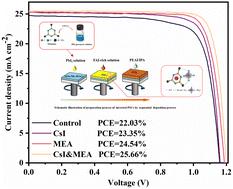
It is now well-known that moderate amounts of lead iodide (PbI2) in organic–inorganic hybrid perovskite films are capable of passivating defects and stabilizing the material. However, contrarily, excessive PbI2 instead leads to rapid degradation and thus destabilizes the perovskite solar cells (PSCs). To address this challenge, we propose to use melamine (MEA) additive to control the concentration of PbI2 in perovskite films fabricated with sequential deposition method. As demonstrated by our calculations and NMR measurement results, MEA has both donor and acceptor regions which combine well with the PbI2's surface topology: the triazine core units are capable of binding to uncoordinated lead while the amino groups of MEA are capable of coordinating with the iodide anions and effectively “trichelate” PbI2, thus passivating the defects and promoting carrier separation. Furthermore, the simultaneous introduction of MEA and cesium iodide regulated the crystallization of perovskite films, improved the degree of (111) crystal orientation, and enabled the formation of high-quality perovskite films without pinholes. As such, based on the synergistic effect of MEA and cesium iodide, we prepared inverted PSCs by sequential deposition method with a PCE of 25.66% (certified at 25.06%) and high VOC approaching 1.2 V with a steady state PCE of 25.19%. The optimized device can maintain more than 90% of the initial efficiency at the maximum power point for 1000 h. In addition, through this strategy, we also prepared a flexible device with an efficiency of up to 24.03%, which can maintain more than 90% of the initial performance after 5000 bending cycles, thus demonstrating an excellent mechanical stability.
期刊介绍:
Energy & Environmental Science, a peer-reviewed scientific journal, publishes original research and review articles covering interdisciplinary topics in the (bio)chemical and (bio)physical sciences, as well as chemical engineering disciplines. Published monthly by the Royal Society of Chemistry (RSC), a not-for-profit publisher, Energy & Environmental Science is recognized as a leading journal. It boasts an impressive impact factor of 8.500 as of 2009, ranking 8th among 140 journals in the category "Chemistry, Multidisciplinary," second among 71 journals in "Energy & Fuels," second among 128 journals in "Engineering, Chemical," and first among 181 scientific journals in "Environmental Sciences."
Energy & Environmental Science publishes various types of articles, including Research Papers (original scientific work), Review Articles, Perspectives, and Minireviews (feature review-type articles of broad interest), Communications (original scientific work of an urgent nature), Opinions (personal, often speculative viewpoints or hypotheses on current topics), and Analysis Articles (in-depth examination of energy-related issues).




 京公网安备 11010802042870号
京ICP备2023020795号-1
京公网安备 11010802042870号
京ICP备2023020795号-1

 分享
分享
 求助内容:
求助内容: 应助结果提醒方式:
 扫码关注我们
