Design of a novel bio-based inherent flame-retardant epoxy resin with anti-dripping, self-healing and reprocessability and its recycling in durable multifunctional Lyocell fabric
{"title":"Design of a novel bio-based inherent flame-retardant epoxy resin with anti-dripping, self-healing and reprocessability and its recycling in durable multifunctional Lyocell fabric","authors":"Chunlong Zuo, Yongli Zhang, Wei Tan, Jieyun Zhao, Lina Jiang, Yuanlin Ren, Xiaohui Liu","doi":"10.1016/j.cej.2025.160196","DOIUrl":null,"url":null,"abstract":"Traditional epoxy resins are manufactured from non-renewable fossil resources and suffer from several drawbacks, including poor flame retardancy, non-reprocessability and recycling difficulties, greatly affecting their wider applications. To address these issues, an inherent flame-retardant epoxy resin (L-Trp@PA/TPEP) was synthesized from biomass tea polyphenols, L-tryptophan, phytic acid and epichlorohydrin. L-Trp@PA/TPEP achieved a limiting oxygen index (LOI) value of 36.4%, with excellent anti-dripping, self-healing and reprocessability. Additionally, due to the limited number of reprocessable cycles, a versatile durable Lyocell fabric (L-Trp@PA/TPEP/Lyocell) was fabricated by finishing with the recycling of non-reprocessable L-Trp@PA/TPEP. L-Trp@PA/TPEP/Lyocell showed an LOI value of 34.5% and ultraviolet protection factor of 137.29. The elongation at break and tensile strength of modified Lyocell fabric increased by 19.2% and 33.6%. In addition, the modified fabric had favorable chemical resistance without mechanical deterioration within the pH range of 1 to 13. Besides, L-Trp@PA/TPEP/Lyocell displayed remarkable anti-fouling and self-cleaning capabilities. This work proposed a comprehensive and eco-friendly approach in terms of raw materials, application and recycling, which was significant for the development of sustainable novel materials and multifunctional textiles.","PeriodicalId":270,"journal":{"name":"Chemical Engineering Journal","volume":"77 2 1","pages":""},"PeriodicalIF":13.2000,"publicationDate":"2025-02-02","publicationTypes":"Journal Article","fieldsOfStudy":null,"isOpenAccess":false,"openAccessPdf":"","citationCount":"0","resultStr":null,"platform":"Semanticscholar","paperid":null,"PeriodicalName":"Chemical Engineering Journal","FirstCategoryId":"5","ListUrlMain":"https://doi.org/10.1016/j.cej.2025.160196","RegionNum":1,"RegionCategory":"工程技术","ArticlePicture":[],"TitleCN":null,"AbstractTextCN":null,"PMCID":null,"EPubDate":"","PubModel":"","JCR":"Q1","JCRName":"ENGINEERING, CHEMICAL","Score":null,"Total":0}
引用次数: 0
Abstract
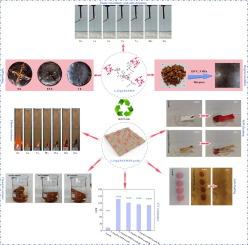
Traditional epoxy resins are manufactured from non-renewable fossil resources and suffer from several drawbacks, including poor flame retardancy, non-reprocessability and recycling difficulties, greatly affecting their wider applications. To address these issues, an inherent flame-retardant epoxy resin (L-Trp@PA/TPEP) was synthesized from biomass tea polyphenols, L-tryptophan, phytic acid and epichlorohydrin. L-Trp@PA/TPEP achieved a limiting oxygen index (LOI) value of 36.4%, with excellent anti-dripping, self-healing and reprocessability. Additionally, due to the limited number of reprocessable cycles, a versatile durable Lyocell fabric (L-Trp@PA/TPEP/Lyocell) was fabricated by finishing with the recycling of non-reprocessable L-Trp@PA/TPEP. L-Trp@PA/TPEP/Lyocell showed an LOI value of 34.5% and ultraviolet protection factor of 137.29. The elongation at break and tensile strength of modified Lyocell fabric increased by 19.2% and 33.6%. In addition, the modified fabric had favorable chemical resistance without mechanical deterioration within the pH range of 1 to 13. Besides, L-Trp@PA/TPEP/Lyocell displayed remarkable anti-fouling and self-cleaning capabilities. This work proposed a comprehensive and eco-friendly approach in terms of raw materials, application and recycling, which was significant for the development of sustainable novel materials and multifunctional textiles.
期刊介绍:
The Chemical Engineering Journal is an international research journal that invites contributions of original and novel fundamental research. It aims to provide an international platform for presenting original fundamental research, interpretative reviews, and discussions on new developments in chemical engineering. The journal welcomes papers that describe novel theory and its practical application, as well as those that demonstrate the transfer of techniques from other disciplines. It also welcomes reports on carefully conducted experimental work that is soundly interpreted. The main focus of the journal is on original and rigorous research results that have broad significance. The Catalysis section within the Chemical Engineering Journal focuses specifically on Experimental and Theoretical studies in the fields of heterogeneous catalysis, molecular catalysis, and biocatalysis. These studies have industrial impact on various sectors such as chemicals, energy, materials, foods, healthcare, and environmental protection.




 京公网安备 11010802042870号
京ICP备2023020795号-1
京公网安备 11010802042870号
京ICP备2023020795号-1

 分享
分享
 求助内容:
求助内容: 应助结果提醒方式:
 扫码关注我们
