{"title":"A full-field non-local crystal plasticity investigation of bi-layered HEA","authors":"Shuai Zhu, Emmanuel Brousseau","doi":"10.1016/j.ijmecsci.2025.110009","DOIUrl":null,"url":null,"abstract":"<div><div>Heterogeneous deformation has been widely proven to provide extra strengthening in heterostructured metallic materials. However, the explicit modelling of underlying plasticity mechanisms at both grain and sample levels remains a challenge for the scientific community. For this reason, the research presented here reports on the development and testing of a novel non-local crystal plasticity finite element model to simulate the deformation of heterostructured metallic materials. This model explicitly includes geometrically necessary dislocations (GNDs), back stress hardening, a damage criterion and does not rely on a homogenisation scheme. This approach enables the numerical investigation of dislocation-mediated plasticity simultaneously at both grain and sample levels. The model was validated against experimental data when simulating the deformation of a bi-layered high entropy alloy (HEA). The obtained results aligned well with experimental findings. In particular, the simulations confirmed that shear bands (SBs) preferably propagate along grains sharing similar orientation while causing severe grain rotation. In addition, for the pair of grain sizes considered here for the bi-layered HEA i.e., 14 μm and 46 μm for the finer and coarser layers, respectively, GNDs did not tend to pile up at the interface between these layers but at the grain boundaries instead. It is suggested that this study provides a solid theoretical framework for the future design of heterostructured metallic materials to achieve optimal strength-ductility balance and to predict potential crack nucleation sites and SB evolution in such materials.</div></div>","PeriodicalId":56287,"journal":{"name":"International Journal of Mechanical Sciences","volume":"288 ","pages":"Article 110009"},"PeriodicalIF":9.4000,"publicationDate":"2025-02-15","publicationTypes":"Journal Article","fieldsOfStudy":null,"isOpenAccess":false,"openAccessPdf":"","citationCount":"0","resultStr":null,"platform":"Semanticscholar","paperid":null,"PeriodicalName":"International Journal of Mechanical Sciences","FirstCategoryId":"5","ListUrlMain":"https://www.sciencedirect.com/science/article/pii/S0020740325000955","RegionNum":1,"RegionCategory":"工程技术","ArticlePicture":[],"TitleCN":null,"AbstractTextCN":null,"PMCID":null,"EPubDate":"2025/1/30 0:00:00","PubModel":"Epub","JCR":"Q1","JCRName":"ENGINEERING, MECHANICAL","Score":null,"Total":0}
引用次数: 0
Abstract
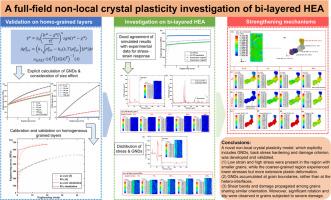
Heterogeneous deformation has been widely proven to provide extra strengthening in heterostructured metallic materials. However, the explicit modelling of underlying plasticity mechanisms at both grain and sample levels remains a challenge for the scientific community. For this reason, the research presented here reports on the development and testing of a novel non-local crystal plasticity finite element model to simulate the deformation of heterostructured metallic materials. This model explicitly includes geometrically necessary dislocations (GNDs), back stress hardening, a damage criterion and does not rely on a homogenisation scheme. This approach enables the numerical investigation of dislocation-mediated plasticity simultaneously at both grain and sample levels. The model was validated against experimental data when simulating the deformation of a bi-layered high entropy alloy (HEA). The obtained results aligned well with experimental findings. In particular, the simulations confirmed that shear bands (SBs) preferably propagate along grains sharing similar orientation while causing severe grain rotation. In addition, for the pair of grain sizes considered here for the bi-layered HEA i.e., 14 μm and 46 μm for the finer and coarser layers, respectively, GNDs did not tend to pile up at the interface between these layers but at the grain boundaries instead. It is suggested that this study provides a solid theoretical framework for the future design of heterostructured metallic materials to achieve optimal strength-ductility balance and to predict potential crack nucleation sites and SB evolution in such materials.
期刊介绍:
The International Journal of Mechanical Sciences (IJMS) serves as a global platform for the publication and dissemination of original research that contributes to a deeper scientific understanding of the fundamental disciplines within mechanical, civil, and material engineering.
The primary focus of IJMS is to showcase innovative and ground-breaking work that utilizes analytical and computational modeling techniques, such as Finite Element Method (FEM), Boundary Element Method (BEM), and mesh-free methods, among others. These modeling methods are applied to diverse fields including rigid-body mechanics (e.g., dynamics, vibration, stability), structural mechanics, metal forming, advanced materials (e.g., metals, composites, cellular, smart) behavior and applications, impact mechanics, strain localization, and other nonlinear effects (e.g., large deflections, plasticity, fracture).
Additionally, IJMS covers the realms of fluid mechanics (both external and internal flows), tribology, thermodynamics, and materials processing. These subjects collectively form the core of the journal's content.
In summary, IJMS provides a prestigious platform for researchers to present their original contributions, shedding light on analytical and computational modeling methods in various areas of mechanical engineering, as well as exploring the behavior and application of advanced materials, fluid mechanics, thermodynamics, and materials processing.



 京公网安备 11010802042870号
京ICP备2023020795号-1
京公网安备 11010802042870号
京ICP备2023020795号-1

 分享
分享
 求助内容:
求助内容: 应助结果提醒方式:
 扫码关注我们
