Mei Wen , Pu Qiu , Jialan Meng , Wenjing Zhao , Xiao Wang , Shining Niu , Cheng Tao , Nuo Yu , Zhigang Chen , Dong Xie
{"title":"Multifunctional nanozymes for sonodynamic-enhanced immune checkpoint blockade therapy by inactivating PI3K/AKT signal pathway","authors":"Mei Wen , Pu Qiu , Jialan Meng , Wenjing Zhao , Xiao Wang , Shining Niu , Cheng Tao , Nuo Yu , Zhigang Chen , Dong Xie","doi":"10.1016/j.biomaterials.2025.123125","DOIUrl":null,"url":null,"abstract":"<div><div>Insufficient activation efficacy and tumor immunosuppressive microenvironments hinder the infiltration of cytotoxic T lymphocytes (CTLs) for effective immunotherapy. Herein, the pH-selective multienzyme-mimetic nanozymes have been developed based on Pd-hemoporfin (Pd<sup>0</sup>/Pd<sup>2+</sup>‒H) nanoagents for tumor sono-immunotherapy via the phosphatidylinositol 3-kinase/protein kinase B (PI3K/AKT) pathway inactivation. The Pd<sup>0</sup>/Pd<sup>2+</sup>‒H is capable of catalase-mimetic, peroxidase-mimetic, and sonodynamic effects, creating an O<sub>2</sub>-rich environment and elevating the reactive oxygen species (ROS) levels. The elevated ROS levels down-regulate the expression of PI3K and <em>p</em>-AKT on both gene and protein levels, leading to PI3K/AKT pathway inactivation. Subsequently, the augmented immunogenic cell death effectively recruits dendritic cells, presents tumor-associated antigens, and activates antitumor T-cell immunity. As a result, the combination of Pd<sup>0</sup>/Pd<sup>2+</sup>‒H and anti-programmed cell death protein ligand 1 results in growth restraints of primary and precaution of tumor metastases. This work offers insights into developing multienzyme-mimetic nanozymes in signaling pathway regulation and antitumor strategy.</div></div>","PeriodicalId":254,"journal":{"name":"Biomaterials","volume":"318 ","pages":"Article 123125"},"PeriodicalIF":12.9000,"publicationDate":"2025-07-01","publicationTypes":"Journal Article","fieldsOfStudy":null,"isOpenAccess":false,"openAccessPdf":"","citationCount":"0","resultStr":null,"platform":"Semanticscholar","paperid":null,"PeriodicalName":"Biomaterials","FirstCategoryId":"5","ListUrlMain":"https://www.sciencedirect.com/science/article/pii/S0142961225000444","RegionNum":1,"RegionCategory":"医学","ArticlePicture":[],"TitleCN":null,"AbstractTextCN":null,"PMCID":null,"EPubDate":"2025/1/27 0:00:00","PubModel":"Epub","JCR":"Q1","JCRName":"ENGINEERING, BIOMEDICAL","Score":null,"Total":0}
引用次数: 0
Abstract
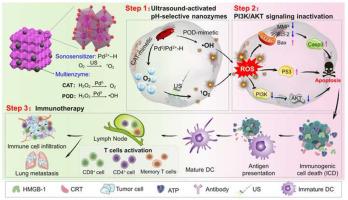
Insufficient activation efficacy and tumor immunosuppressive microenvironments hinder the infiltration of cytotoxic T lymphocytes (CTLs) for effective immunotherapy. Herein, the pH-selective multienzyme-mimetic nanozymes have been developed based on Pd-hemoporfin (Pd0/Pd2+‒H) nanoagents for tumor sono-immunotherapy via the phosphatidylinositol 3-kinase/protein kinase B (PI3K/AKT) pathway inactivation. The Pd0/Pd2+‒H is capable of catalase-mimetic, peroxidase-mimetic, and sonodynamic effects, creating an O2-rich environment and elevating the reactive oxygen species (ROS) levels. The elevated ROS levels down-regulate the expression of PI3K and p-AKT on both gene and protein levels, leading to PI3K/AKT pathway inactivation. Subsequently, the augmented immunogenic cell death effectively recruits dendritic cells, presents tumor-associated antigens, and activates antitumor T-cell immunity. As a result, the combination of Pd0/Pd2+‒H and anti-programmed cell death protein ligand 1 results in growth restraints of primary and precaution of tumor metastases. This work offers insights into developing multienzyme-mimetic nanozymes in signaling pathway regulation and antitumor strategy.
期刊介绍:
Biomaterials is an international journal covering the science and clinical application of biomaterials. A biomaterial is now defined as a substance that has been engineered to take a form which, alone or as part of a complex system, is used to direct, by control of interactions with components of living systems, the course of any therapeutic or diagnostic procedure. It is the aim of the journal to provide a peer-reviewed forum for the publication of original papers and authoritative review and opinion papers dealing with the most important issues facing the use of biomaterials in clinical practice. The scope of the journal covers the wide range of physical, biological and chemical sciences that underpin the design of biomaterials and the clinical disciplines in which they are used. These sciences include polymer synthesis and characterization, drug and gene vector design, the biology of the host response, immunology and toxicology and self assembly at the nanoscale. Clinical applications include the therapies of medical technology and regenerative medicine in all clinical disciplines, and diagnostic systems that reply on innovative contrast and sensing agents. The journal is relevant to areas such as cancer diagnosis and therapy, implantable devices, drug delivery systems, gene vectors, bionanotechnology and tissue engineering.



 京公网安备 11010802042870号
京ICP备2023020795号-1
京公网安备 11010802042870号
京ICP备2023020795号-1

 分享
分享
 求助内容:
求助内容: 应助结果提醒方式:
 扫码关注我们
