{"title":"Implantable Port Catheters versus Peripherally Inserted Central Catheters for Cancer Patients Requiring Chemotherapy: An RCT-Based Meta-Analysis.","authors":"Juan Qiu, Shanshan Huang, Pei Wen, Yingxin Jiang, Zan Luo, Wenxiong Zhang, Jianyun Wen","doi":"10.7150/jca.103631","DOIUrl":null,"url":null,"abstract":"<p><p><b>Background:</b> Implantable port catheters (IPCs) and peripherally inserted central catheters (PICCs) are commonly used venous access methods for chemotherapy in cancer patients. However, the question of which is superior remains controversial. This meta-analysis, based on randomized controlled trials (RCTs), systematically compares the safety, cost, and impact on quality of life between these two methods. <b>Methods:</b> Eligible RCTs comparing IPC and PICC were identified through searches in seven databases. Complications were the primary endpoint, while secondary endpoints included cost, impact on chemotherapy, and quality of life assessments. <b>Results:</b> Six studies based on five RCTs, including a total of 1,127 patients, were analyzed. Patient data indicated that the PICC group experienced a higher incidence of total complications, thrombosis, deep vein thrombosis, implantation failure, unplanned catheter removal, and local reactions. Conversely, the IPC group had a higher incidence of pocket infection/exit-site infection without septicemia and pain. When considering catheter days, the PICC group again showed a higher incidence of total complications, thrombosis, deep vein thrombosis, implantation failure, unplanned catheter removal, edema, and local reactions. Complication-free survival was better in the IPC group. Although the impact on chemotherapy tended to favor the IPC group, this difference was not statistically significant. The total cost was higher in the IPC group, while the cost per catheter day was similar between the two groups. Quality of life assessments (using EORTC QLQ-C30) revealed similar global health status between the two groups during the post-implantation, mid-treatment, and end-treatment periods. However, the IPC group experienced a smaller decline in global health status post-implantation compared to the PICC group. <b>Conclusions:</b> Compared to PICC, IPC appears to be a safer and more comfortable intravenous catheterization option for cancer patients undergoing chemotherapy.</p>","PeriodicalId":15183,"journal":{"name":"Journal of Cancer","volume":"16 4","pages":"1127-1136"},"PeriodicalIF":3.2000,"publicationDate":"2025-01-06","publicationTypes":"Journal Article","fieldsOfStudy":null,"isOpenAccess":false,"openAccessPdf":"https://www.ncbi.nlm.nih.gov/pmc/articles/PMC11786043/pdf/","citationCount":"0","resultStr":null,"platform":"Semanticscholar","paperid":null,"PeriodicalName":"Journal of Cancer","FirstCategoryId":"3","ListUrlMain":"https://doi.org/10.7150/jca.103631","RegionNum":3,"RegionCategory":"医学","ArticlePicture":[],"TitleCN":null,"AbstractTextCN":null,"PMCID":null,"EPubDate":"2025/1/1 0:00:00","PubModel":"eCollection","JCR":"Q2","JCRName":"ONCOLOGY","Score":null,"Total":0}
引用次数: 0
Abstract
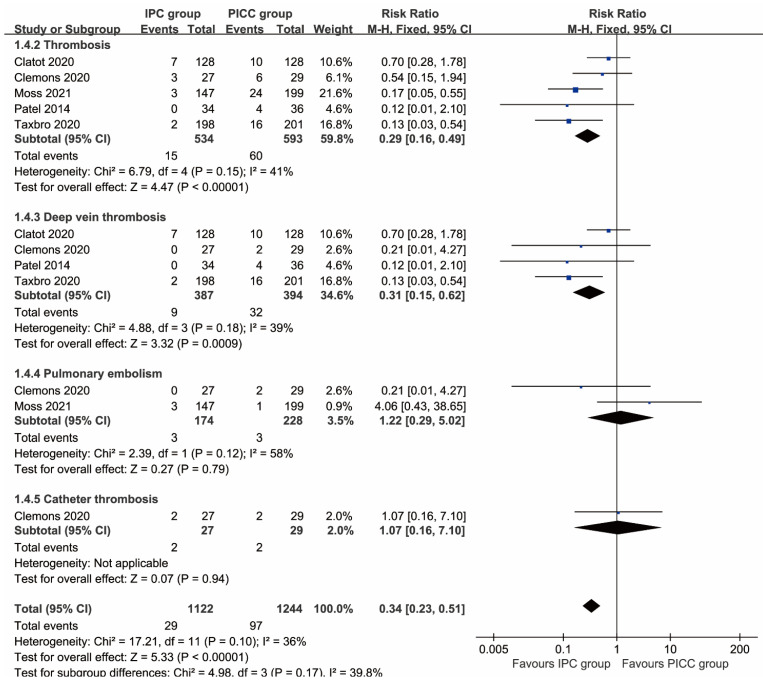
Background: Implantable port catheters (IPCs) and peripherally inserted central catheters (PICCs) are commonly used venous access methods for chemotherapy in cancer patients. However, the question of which is superior remains controversial. This meta-analysis, based on randomized controlled trials (RCTs), systematically compares the safety, cost, and impact on quality of life between these two methods. Methods: Eligible RCTs comparing IPC and PICC were identified through searches in seven databases. Complications were the primary endpoint, while secondary endpoints included cost, impact on chemotherapy, and quality of life assessments. Results: Six studies based on five RCTs, including a total of 1,127 patients, were analyzed. Patient data indicated that the PICC group experienced a higher incidence of total complications, thrombosis, deep vein thrombosis, implantation failure, unplanned catheter removal, and local reactions. Conversely, the IPC group had a higher incidence of pocket infection/exit-site infection without septicemia and pain. When considering catheter days, the PICC group again showed a higher incidence of total complications, thrombosis, deep vein thrombosis, implantation failure, unplanned catheter removal, edema, and local reactions. Complication-free survival was better in the IPC group. Although the impact on chemotherapy tended to favor the IPC group, this difference was not statistically significant. The total cost was higher in the IPC group, while the cost per catheter day was similar between the two groups. Quality of life assessments (using EORTC QLQ-C30) revealed similar global health status between the two groups during the post-implantation, mid-treatment, and end-treatment periods. However, the IPC group experienced a smaller decline in global health status post-implantation compared to the PICC group. Conclusions: Compared to PICC, IPC appears to be a safer and more comfortable intravenous catheterization option for cancer patients undergoing chemotherapy.
期刊介绍:
Journal of Cancer is an open access, peer-reviewed journal with broad scope covering all areas of cancer research, especially novel concepts, new methods, new regimens, new therapeutic agents, and alternative approaches for early detection and intervention of cancer. The Journal is supported by an international editorial board consisting of a distinguished team of cancer researchers. Journal of Cancer aims at rapid publication of high quality results in cancer research while maintaining rigorous peer-review process.





 京公网安备 11010802042870号
京ICP备2023020795号-1
京公网安备 11010802042870号
京ICP备2023020795号-1

 分享
分享
 求助内容:
求助内容: 应助结果提醒方式:
 扫码关注我们
