{"title":"Digital wear analysis of onlay restorations constructed from two pressable glass-based ceramics against natural enamel: An in vitro study.","authors":"Abdelaziz Elhamrawy, Hussein Ramadan, Tamer Hamza","doi":"10.34172/joddd.41124","DOIUrl":null,"url":null,"abstract":"<p><strong>Background: </strong>The wear resistance of lithium disilicate glass ceramics remains inadequately understood. Therefore, the primary objective of this in vitro study was to digitally assess the wear characteristics of lithium disilicate and zirconia-reinforced lithium disilicate pressable ceramics following chewing simulation.</p><p><strong>Methods: </strong>Twenty-two onlay ceramic restorations were fabricated on epoxy dies replicated from the maxillary first premolar ivory tooth master die. The onlay samples were randomly allocated to two equal groups (n=11) based on the material used: group L (lithium disilicate [IPS e.max Press]) and group Z (zirconia-reinforced lithium disilicate [Vita Ambria]). Self-adhesive resin cement was used to cement all of the samples. Each sample was occluded with the buccal cusps of healthy human upper first premolar teeth (n=22). Subsequently, all the samples were scanned using an intraoral scanner (Medit i500) at baseline and after chewing simulation. The acquired standard tessellation language (STL) files of baseline and post-chewing simulation data were superimposed, and the volumetric loss (mm<sup>3</sup>) and wear depth (μm) of the materials and their enamel antagonists were calculated. Statistical analysis was performed using independent t-test (<i>P</i>=0.05).</p><p><strong>Results: </strong>There was no statistically significant difference in the wear behavior of Vita Ambria compared to IPS e.max (<i>P</i><0.05). Similarly, there was no statistically significant difference in the wear behavior of their enamel antagonists (<i>P</i><0.05).</p><p><strong>Conclusion: </strong>IPS e.max Press and Vita Ambria ceramics demonstrated comparable wear behavior.</p>","PeriodicalId":15599,"journal":{"name":"Journal of Dental Research, Dental Clinics, Dental Prospects","volume":"18 4","pages":"242-248"},"PeriodicalIF":0.0000,"publicationDate":"2024-01-01","publicationTypes":"Journal Article","fieldsOfStudy":null,"isOpenAccess":false,"openAccessPdf":"https://www.ncbi.nlm.nih.gov/pmc/articles/PMC11786004/pdf/","citationCount":"0","resultStr":null,"platform":"Semanticscholar","paperid":null,"PeriodicalName":"Journal of Dental Research, Dental Clinics, Dental Prospects","FirstCategoryId":"1085","ListUrlMain":"https://doi.org/10.34172/joddd.41124","RegionNum":0,"RegionCategory":null,"ArticlePicture":[],"TitleCN":null,"AbstractTextCN":null,"PMCID":null,"EPubDate":"2024/12/14 0:00:00","PubModel":"Epub","JCR":"Q4","JCRName":"Dentistry","Score":null,"Total":0}
引用次数: 0
Abstract
Background: The wear resistance of lithium disilicate glass ceramics remains inadequately understood. Therefore, the primary objective of this in vitro study was to digitally assess the wear characteristics of lithium disilicate and zirconia-reinforced lithium disilicate pressable ceramics following chewing simulation.
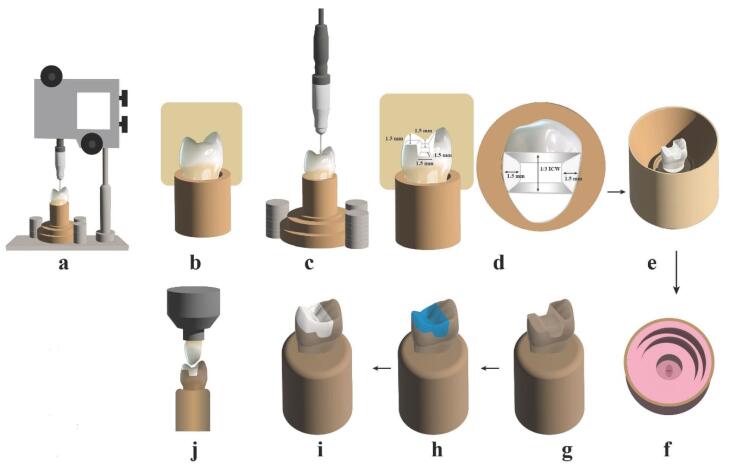
Methods: Twenty-two onlay ceramic restorations were fabricated on epoxy dies replicated from the maxillary first premolar ivory tooth master die. The onlay samples were randomly allocated to two equal groups (n=11) based on the material used: group L (lithium disilicate [IPS e.max Press]) and group Z (zirconia-reinforced lithium disilicate [Vita Ambria]). Self-adhesive resin cement was used to cement all of the samples. Each sample was occluded with the buccal cusps of healthy human upper first premolar teeth (n=22). Subsequently, all the samples were scanned using an intraoral scanner (Medit i500) at baseline and after chewing simulation. The acquired standard tessellation language (STL) files of baseline and post-chewing simulation data were superimposed, and the volumetric loss (mm3) and wear depth (μm) of the materials and their enamel antagonists were calculated. Statistical analysis was performed using independent t-test (P=0.05).
Results: There was no statistically significant difference in the wear behavior of Vita Ambria compared to IPS e.max (P<0.05). Similarly, there was no statistically significant difference in the wear behavior of their enamel antagonists (P<0.05).
Conclusion: IPS e.max Press and Vita Ambria ceramics demonstrated comparable wear behavior.
期刊介绍:
Journal of Dental Research Dental Clinics Dental Prospects (JODDD) is a Platinum* Open Access, peer-reviewed quarterly indexed journal that publishes articles of basic, clinical, and prospective nature in all areas of dentistry and oral health.






 京公网安备 11010802042870号
京ICP备2023020795号-1
京公网安备 11010802042870号
京ICP备2023020795号-1

 分享
分享
 求助内容:
求助内容: 应助结果提醒方式:
 扫码关注我们
