{"title":"Collective Reflective Equilibrium, Algorithmic Bioethics and Complex Ethics.","authors":"Julian Savulescu","doi":"10.1017/S0963180124000719","DOIUrl":null,"url":null,"abstract":"<p><p>John Harris has made many seminal contributions to bioethics. Two of these are in the ethics of resource allocation. Firstly, he proposed the \"fair innings argument\" which was the first sufficientarian approach to distributive justice. Resources should be provided to ensure people have a fair innings-when Harris first wrote this, around 70 years of life, but perhaps now 80. Secondly, Harris famously advanced the egalitarian position in response to utilitarian approaches to allocation (such as maximizing Quality Adjusted Life Years [QALYs]) that what people want is the greatest chance of the longest, best quality life for themselves, and justice requires treating these claims equally. Harris thus proposed both sufficientarian and egalitarian approaches. This chapter compares these approaches with utilitarian and contractualist approaches and provides a methodology for deciding among these (Collective Reflective Equilibrium). This methodology is applied to the allocation of ventilators in the pandemic (as an example) and an ethical algorithm for their deployment created. This paper describes the concept of algorithmic bioethics as a way of addressing pluralism of values and context specificity of moral judgment and policy, and addressing complex ethics.</p>","PeriodicalId":55300,"journal":{"name":"Cambridge Quarterly of Healthcare Ethics","volume":" ","pages":"204-219"},"PeriodicalIF":2.3000,"publicationDate":"2025-04-01","publicationTypes":"Journal Article","fieldsOfStudy":null,"isOpenAccess":false,"openAccessPdf":"https://www.ncbi.nlm.nih.gov/pmc/articles/PMC7617835/pdf/","citationCount":"0","resultStr":null,"platform":"Semanticscholar","paperid":null,"PeriodicalName":"Cambridge Quarterly of Healthcare Ethics","FirstCategoryId":"3","ListUrlMain":"https://doi.org/10.1017/S0963180124000719","RegionNum":4,"RegionCategory":"医学","ArticlePicture":[],"TitleCN":null,"AbstractTextCN":null,"PMCID":null,"EPubDate":"","PubModel":"","JCR":"Q3","JCRName":"HEALTH CARE SCIENCES & SERVICES","Score":null,"Total":0}
引用次数: 0
Abstract
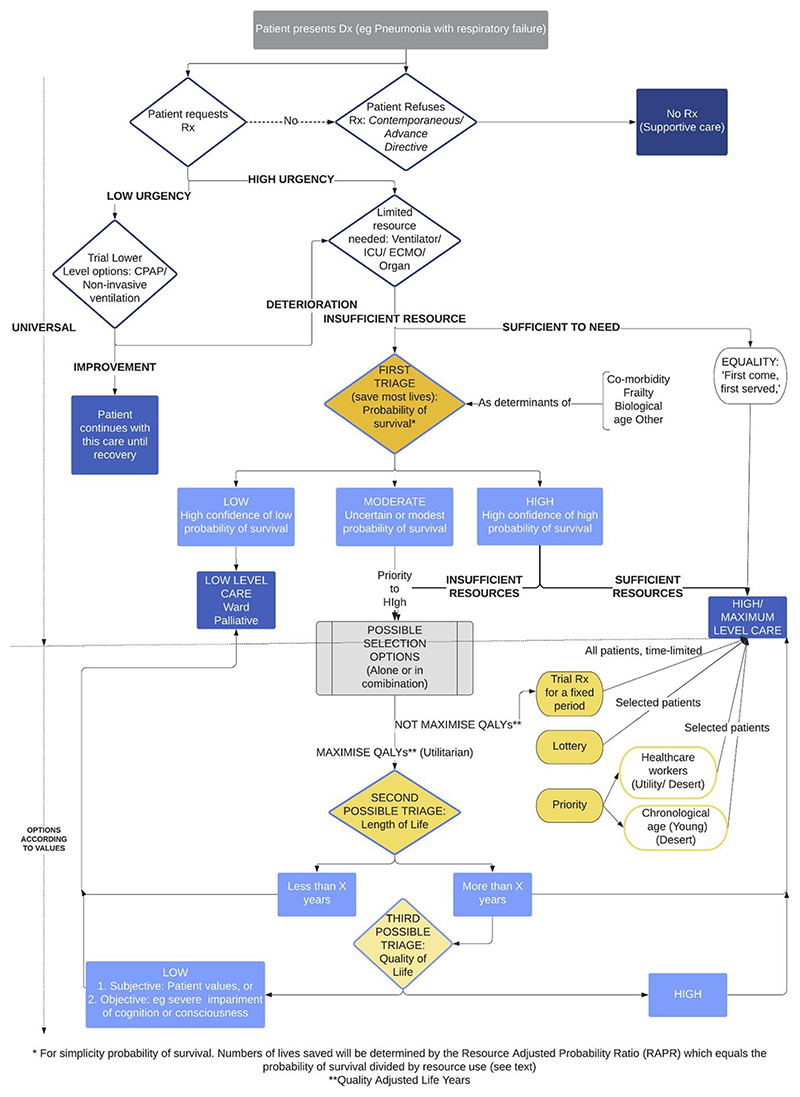
John Harris has made many seminal contributions to bioethics. Two of these are in the ethics of resource allocation. Firstly, he proposed the "fair innings argument" which was the first sufficientarian approach to distributive justice. Resources should be provided to ensure people have a fair innings-when Harris first wrote this, around 70 years of life, but perhaps now 80. Secondly, Harris famously advanced the egalitarian position in response to utilitarian approaches to allocation (such as maximizing Quality Adjusted Life Years [QALYs]) that what people want is the greatest chance of the longest, best quality life for themselves, and justice requires treating these claims equally. Harris thus proposed both sufficientarian and egalitarian approaches. This chapter compares these approaches with utilitarian and contractualist approaches and provides a methodology for deciding among these (Collective Reflective Equilibrium). This methodology is applied to the allocation of ventilators in the pandemic (as an example) and an ethical algorithm for their deployment created. This paper describes the concept of algorithmic bioethics as a way of addressing pluralism of values and context specificity of moral judgment and policy, and addressing complex ethics.
期刊介绍:
The Cambridge Quarterly of Healthcare Ethics is designed to address the challenges of biology, medicine and healthcare and to meet the needs of professionals serving on healthcare ethics committees in hospitals, nursing homes, hospices and rehabilitation centres. The aim of the journal is to serve as the international forum for the wide range of serious and urgent issues faced by members of healthcare ethics committees, physicians, nurses, social workers, clergy, lawyers and community representatives.



 京公网安备 11010802042870号
京ICP备2023020795号-1
京公网安备 11010802042870号
京ICP备2023020795号-1

 分享
分享
 求助内容:
求助内容: 应助结果提醒方式:
 扫码关注我们
