Elke Pfaff, Kathrin Schramm, Mirjam Blattner-Johnson, Barbara C Jones, Sebastian Stark, Gnana Prakash Balasubramanian, Christopher Previti, Robert J Autry, Petra Fiesel, Felix Sahm, David Reuss, Andreas von Deimling, Cornelis M van Tilburg, Kristian W Pajtler, Till Milde, Uta Dirksen, Christof M Kramm, André O von Bueren, Monica C Munthe-Kaas, Ingrid Øra, Stefan M Pfister, Olaf Witt, David T W Jones
{"title":"Pediatric spinal high-grade glioma in the pediatric precision oncology registry INFORM: Identification of potential therapeutic targets.","authors":"Elke Pfaff, Kathrin Schramm, Mirjam Blattner-Johnson, Barbara C Jones, Sebastian Stark, Gnana Prakash Balasubramanian, Christopher Previti, Robert J Autry, Petra Fiesel, Felix Sahm, David Reuss, Andreas von Deimling, Cornelis M van Tilburg, Kristian W Pajtler, Till Milde, Uta Dirksen, Christof M Kramm, André O von Bueren, Monica C Munthe-Kaas, Ingrid Øra, Stefan M Pfister, Olaf Witt, David T W Jones","doi":"10.1093/noajnl/vdae185","DOIUrl":null,"url":null,"abstract":"<p><strong>Background: </strong>High-grade glioma (HGG) of the spinal cord constitutes rare tumors in the pediatric population. Knowledge of the molecular profile of this pediatric HGG (pedHGG) subgroup is limited and the clinical outcome is poor. Therefore, the aim of this study is to provide more profound investigations of molecular characteristics and clinical features of these tumors.</p><p><strong>Methods: </strong>Between January 2015 and October 2023, 17 spinal tumors with HGG histology were analyzed by the Individualized Therapy For Relapsed Malignancies in Childhood (INFORM) precision oncology registry. Comprehensive molecular profiling (including next-generation sequencing approaches and DNA methylation analysis) was performed. Clinical data provided by the treating centers were evaluated regarding treatment approaches and outcomes.</p><p><strong>Results: </strong>Subgroup classification based on DNA methylation analysis revealed molecular HGG subgroups in 12/17 cases, while 2/17 were classified as molecular low-grade glioma (LGG) and 3/17 were not unequivocally classifiable. Typical genetic alterations described in pedHGG usually presenting at other localizations were also present in the counterparts located in the spinal cohort. Alterations that might serve as a promising target for personalized therapy approaches were identified in a subset of tumors.</p><p><strong>Conclusion: </strong>With this cohort of 12 molecularly confirmed spinal pedHGG cases, we provide a compilation of genomic as well as clinical features of this rare subgroup, contributing to a better understanding and eventually to future treatment approaches.</p>","PeriodicalId":94157,"journal":{"name":"Neuro-oncology advances","volume":"7 1","pages":"vdae185"},"PeriodicalIF":4.1000,"publicationDate":"2024-11-08","publicationTypes":"Journal Article","fieldsOfStudy":null,"isOpenAccess":false,"openAccessPdf":"https://www.ncbi.nlm.nih.gov/pmc/articles/PMC11783565/pdf/","citationCount":"0","resultStr":null,"platform":"Semanticscholar","paperid":null,"PeriodicalName":"Neuro-oncology advances","FirstCategoryId":"1085","ListUrlMain":"https://doi.org/10.1093/noajnl/vdae185","RegionNum":0,"RegionCategory":null,"ArticlePicture":[],"TitleCN":null,"AbstractTextCN":null,"PMCID":null,"EPubDate":"2025/1/1 0:00:00","PubModel":"eCollection","JCR":"Q1","JCRName":"CLINICAL NEUROLOGY","Score":null,"Total":0}
引用次数: 0
Abstract
Background: High-grade glioma (HGG) of the spinal cord constitutes rare tumors in the pediatric population. Knowledge of the molecular profile of this pediatric HGG (pedHGG) subgroup is limited and the clinical outcome is poor. Therefore, the aim of this study is to provide more profound investigations of molecular characteristics and clinical features of these tumors.
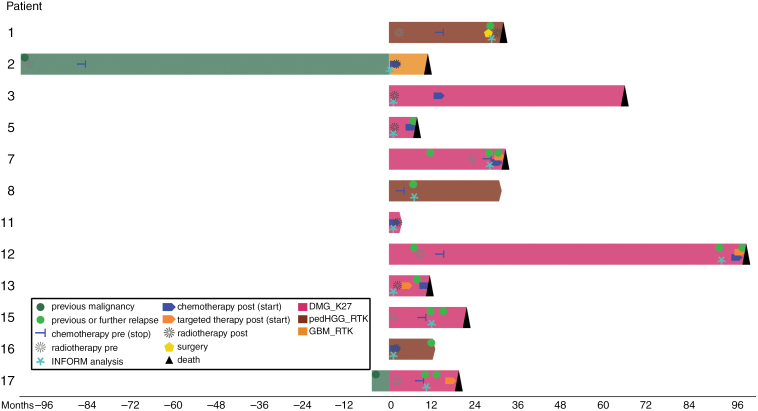
Methods: Between January 2015 and October 2023, 17 spinal tumors with HGG histology were analyzed by the Individualized Therapy For Relapsed Malignancies in Childhood (INFORM) precision oncology registry. Comprehensive molecular profiling (including next-generation sequencing approaches and DNA methylation analysis) was performed. Clinical data provided by the treating centers were evaluated regarding treatment approaches and outcomes.
Results: Subgroup classification based on DNA methylation analysis revealed molecular HGG subgroups in 12/17 cases, while 2/17 were classified as molecular low-grade glioma (LGG) and 3/17 were not unequivocally classifiable. Typical genetic alterations described in pedHGG usually presenting at other localizations were also present in the counterparts located in the spinal cohort. Alterations that might serve as a promising target for personalized therapy approaches were identified in a subset of tumors.
Conclusion: With this cohort of 12 molecularly confirmed spinal pedHGG cases, we provide a compilation of genomic as well as clinical features of this rare subgroup, contributing to a better understanding and eventually to future treatment approaches.





 京公网安备 11010802042870号
京ICP备2023020795号-1
京公网安备 11010802042870号
京ICP备2023020795号-1

 分享
分享

 求助内容:
求助内容: 应助结果提醒方式:
 扫码关注我们
