Xianwei Fu, Ruijuan Shi, Ye Liu, Xiaxiao He, Qian Li, Yan Zhang, Yong Zhao and Shilong Jiao
{"title":"Expanding the temperature range of stable aqueous batteries: strategies, mechanisms and perspectives","authors":"Xianwei Fu, Ruijuan Shi, Ye Liu, Xiaxiao He, Qian Li, Yan Zhang, Yong Zhao and Shilong Jiao","doi":"10.1039/D4EE05304D","DOIUrl":null,"url":null,"abstract":"<p >Aqueous batteries (ABs) based on water-containing electrolytes are intrinsically safe and serve as promising candidates for the grid-scale energy storage and power supplies of wearable electronics. The severe temperature fluctuations due to fickle weather conditions across the world worsen the parasitic reactions during the electrochemical reactions, which limits the practical application scenarios of the aqueous batteries. Focusing on the electrolyte and electrode optimizations, substantial progress has been achieved in enhancing the temperature adaptability of the aqueous batteries with various charge carriers by considering the kinetic and thermodynamic processes during the electrochemical reactions. Here in this review, we present a comprehensive discussion of the recently reported temperature-dependent electrochemical performance of aqueous batteries by combining experimental and theoretical results. The necessity to develop the aqueous batteries with superior temperature adaptability is firstly emphasized. The experimental approaches and corresponding physicochemical principles are summarized and classified. Then, recent progress in widening the temperature range for the stable operation of the aqueous batteries <em>via</em> electrolyte and electrode engineering is discussed in detail. Last but not least, we provide some perspectives on this important and prospering field from our point of view.</p>","PeriodicalId":72,"journal":{"name":"Energy & Environmental Science","volume":" 5","pages":" 2165-2215"},"PeriodicalIF":30.8000,"publicationDate":"2025-02-04","publicationTypes":"Journal Article","fieldsOfStudy":null,"isOpenAccess":false,"openAccessPdf":"","citationCount":"0","resultStr":null,"platform":"Semanticscholar","paperid":null,"PeriodicalName":"Energy & Environmental Science","FirstCategoryId":"88","ListUrlMain":"https://pubs.rsc.org/en/content/articlelanding/2025/ee/d4ee05304d","RegionNum":1,"RegionCategory":"材料科学","ArticlePicture":[],"TitleCN":null,"AbstractTextCN":null,"PMCID":null,"EPubDate":"","PubModel":"","JCR":"Q1","JCRName":"CHEMISTRY, MULTIDISCIPLINARY","Score":null,"Total":0}
引用次数: 0
Abstract
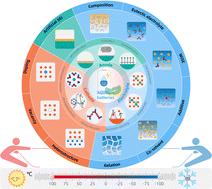
Aqueous batteries (ABs) based on water-containing electrolytes are intrinsically safe and serve as promising candidates for the grid-scale energy storage and power supplies of wearable electronics. The severe temperature fluctuations due to fickle weather conditions across the world worsen the parasitic reactions during the electrochemical reactions, which limits the practical application scenarios of the aqueous batteries. Focusing on the electrolyte and electrode optimizations, substantial progress has been achieved in enhancing the temperature adaptability of the aqueous batteries with various charge carriers by considering the kinetic and thermodynamic processes during the electrochemical reactions. Here in this review, we present a comprehensive discussion of the recently reported temperature-dependent electrochemical performance of aqueous batteries by combining experimental and theoretical results. The necessity to develop the aqueous batteries with superior temperature adaptability is firstly emphasized. The experimental approaches and corresponding physicochemical principles are summarized and classified. Then, recent progress in widening the temperature range for the stable operation of the aqueous batteries via electrolyte and electrode engineering is discussed in detail. Last but not least, we provide some perspectives on this important and prospering field from our point of view.
期刊介绍:
Energy & Environmental Science, a peer-reviewed scientific journal, publishes original research and review articles covering interdisciplinary topics in the (bio)chemical and (bio)physical sciences, as well as chemical engineering disciplines. Published monthly by the Royal Society of Chemistry (RSC), a not-for-profit publisher, Energy & Environmental Science is recognized as a leading journal. It boasts an impressive impact factor of 8.500 as of 2009, ranking 8th among 140 journals in the category "Chemistry, Multidisciplinary," second among 71 journals in "Energy & Fuels," second among 128 journals in "Engineering, Chemical," and first among 181 scientific journals in "Environmental Sciences."
Energy & Environmental Science publishes various types of articles, including Research Papers (original scientific work), Review Articles, Perspectives, and Minireviews (feature review-type articles of broad interest), Communications (original scientific work of an urgent nature), Opinions (personal, often speculative viewpoints or hypotheses on current topics), and Analysis Articles (in-depth examination of energy-related issues).



 京公网安备 11010802042870号
京ICP备2023020795号-1
京公网安备 11010802042870号
京ICP备2023020795号-1

 分享
分享
 求助内容:
求助内容: 应助结果提醒方式:
 扫码关注我们
