Xuehao Li , Peng Wang , Mang Niu , Wenbo Cui , Yong Wan , Jun Zhang , Jie Zheng , Yun-Ze Long
{"title":"High-entropy heterostructure electrocatalyst with built-in electric field regulation for efficient oxygen evolution reaction","authors":"Xuehao Li , Peng Wang , Mang Niu , Wenbo Cui , Yong Wan , Jun Zhang , Jie Zheng , Yun-Ze Long","doi":"10.1016/j.apsusc.2025.162626","DOIUrl":null,"url":null,"abstract":"<div><div>Space-charge transfer is an effective strategy to enhance electrocatalytic activity by modulating the surface electron density of catalysts. Herein, a multichannel carbon nanofibers–supported FeCoNiCuMoSe high-entropy metal selenide heterojunction catalyst was designed to achieve an efficient electrocatalytic oxygen evolution reaction (OER). This catalyst uses the work function difference between NiSe<sub>2</sub> and (Co,Cu)Se<sub>2</sub> to induce a built-in electric field at the interface, which effectively promotes interfacial charge transfer and subsequently regulates the adsorption/desorption of oxygen-containing intermediates. Furthermore, constructing a high-entropy system and synergistic interactions between multiple elements accelerate the OER kinetics. In an alkaline electrolyte, the electrocatalyst exhibits excellent performance, requiring an overpotential of 187 mV to achieve a current density of 10 mA cm<sup>−2</sup> and maintaining excellent stability for at least 100 h without noticeable degradation. Herein, a novel perspective on the rational design of high-performance multiphasic electrocatalysts is presented, and robust technical support is provided for efficient and durable electrocatalytic OER.</div></div>","PeriodicalId":247,"journal":{"name":"Applied Surface Science","volume":"690 ","pages":"Article 162626"},"PeriodicalIF":6.9000,"publicationDate":"2025-05-01","publicationTypes":"Journal Article","fieldsOfStudy":null,"isOpenAccess":false,"openAccessPdf":"","citationCount":"0","resultStr":null,"platform":"Semanticscholar","paperid":null,"PeriodicalName":"Applied Surface Science","FirstCategoryId":"88","ListUrlMain":"https://www.sciencedirect.com/science/article/pii/S016943322500340X","RegionNum":2,"RegionCategory":"材料科学","ArticlePicture":[],"TitleCN":null,"AbstractTextCN":null,"PMCID":null,"EPubDate":"2025/2/4 0:00:00","PubModel":"Epub","JCR":"Q2","JCRName":"CHEMISTRY, PHYSICAL","Score":null,"Total":0}
引用次数: 0
Abstract
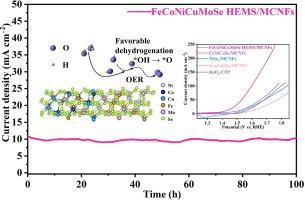
Space-charge transfer is an effective strategy to enhance electrocatalytic activity by modulating the surface electron density of catalysts. Herein, a multichannel carbon nanofibers–supported FeCoNiCuMoSe high-entropy metal selenide heterojunction catalyst was designed to achieve an efficient electrocatalytic oxygen evolution reaction (OER). This catalyst uses the work function difference between NiSe2 and (Co,Cu)Se2 to induce a built-in electric field at the interface, which effectively promotes interfacial charge transfer and subsequently regulates the adsorption/desorption of oxygen-containing intermediates. Furthermore, constructing a high-entropy system and synergistic interactions between multiple elements accelerate the OER kinetics. In an alkaline electrolyte, the electrocatalyst exhibits excellent performance, requiring an overpotential of 187 mV to achieve a current density of 10 mA cm−2 and maintaining excellent stability for at least 100 h without noticeable degradation. Herein, a novel perspective on the rational design of high-performance multiphasic electrocatalysts is presented, and robust technical support is provided for efficient and durable electrocatalytic OER.
空间电荷转移是通过调节催化剂表面电子密度来提高电催化活性的一种有效策略。本文设计了一种多通道纳米碳纤维负载的FeCoNiCuMoSe高熵金属硒化物异质结催化剂,以实现高效的电催化析氧反应(OER)。该催化剂利用NiSe2与(Co,Cu)Se2的功函数差,在界面处诱发内建电场,有效促进界面电荷转移,进而调控含氧中间体的吸附/解吸。此外,高熵系统的构建和多元素之间的协同作用加速了OER动力学。在碱性电解质中,电催化剂表现出优异的性能,需要187 mV的过电位才能达到10 mA cm - 2的电流密度,并在至少100 h的时间内保持优异的稳定性,而不会出现明显的退化。本文为高性能多相电催化剂的合理设计提供了新的视角,为高效、耐用的电催化OER提供了强有力的技术支持。
期刊介绍:
Applied Surface Science covers topics contributing to a better understanding of surfaces, interfaces, nanostructures and their applications. The journal is concerned with scientific research on the atomic and molecular level of material properties determined with specific surface analytical techniques and/or computational methods, as well as the processing of such structures.





 京公网安备 11010802042870号
京ICP备2023020795号-1
京公网安备 11010802042870号
京ICP备2023020795号-1

 分享
分享
 求助内容:
求助内容: 应助结果提醒方式:
 扫码关注我们
