Matthew Alsaloum, Sulayman D. Dib-Hajj, Dana A. Page, Peter C. Ruben, Adrian R. Krainer, Stephen G. Waxman
{"title":"Voltage-gated sodium channels in excitable cells as drug targets","authors":"Matthew Alsaloum, Sulayman D. Dib-Hajj, Dana A. Page, Peter C. Ruben, Adrian R. Krainer, Stephen G. Waxman","doi":"10.1038/s41573-024-01108-x","DOIUrl":null,"url":null,"abstract":"Excitable cells — including neurons, muscle cells and cardiac myocytes — are unique in expressing high densities of voltage-gated sodium (NaV) channels. This molecular adaptation enables these cells to produce action potentials, and is essential to their function. With the advent of the molecular revolution, the concept of ‘the’ sodium channel has been supplanted by understanding that excitable cells in mammals can express any of nine different forms of sodium channels (NaV1.1–NaV1.9). Selective expression in particular types of cells, together with a key role in controlling action potential firing, makes some of these NaV subtypes especially attractive molecular targets for drug development. Although these different channel subtypes display a common overall structure, differences in their amino acid sequences have provided a basis for the development of subtype-specific drugs. This approach has resulted in exciting progress in the development of drugs for epilepsy, cardiac disorders and pain. In this Review, we discuss recent progress in the development of drugs that selectively target each of the sodium channel subtypes. The family of voltage-gated sodium channels (NaVs) are key mediators of electrical signals in excitable cells. In their broad Review, Waxman and colleagues discuss the potential to target NaVs in neurons, cardiac and skeletal muscle cells for the treatment of various neurological and muscular disorders.","PeriodicalId":19068,"journal":{"name":"Nature Reviews. Drug Discovery","volume":"24 5","pages":"358-378"},"PeriodicalIF":101.8000,"publicationDate":"2025-02-03","publicationTypes":"Journal Article","fieldsOfStudy":null,"isOpenAccess":false,"openAccessPdf":"","citationCount":"0","resultStr":null,"platform":"Semanticscholar","paperid":null,"PeriodicalName":"Nature Reviews. Drug Discovery","FirstCategoryId":"3","ListUrlMain":"https://www.nature.com/articles/s41573-024-01108-x","RegionNum":1,"RegionCategory":"医学","ArticlePicture":[],"TitleCN":null,"AbstractTextCN":null,"PMCID":null,"EPubDate":"","PubModel":"","JCR":"Q1","JCRName":"BIOTECHNOLOGY & APPLIED MICROBIOLOGY","Score":null,"Total":0}
引用次数: 0
Abstract
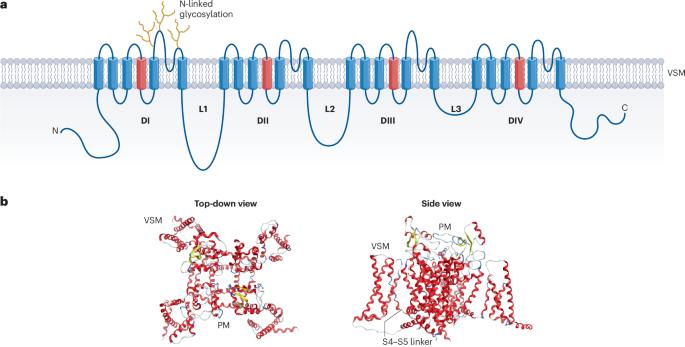
Excitable cells — including neurons, muscle cells and cardiac myocytes — are unique in expressing high densities of voltage-gated sodium (NaV) channels. This molecular adaptation enables these cells to produce action potentials, and is essential to their function. With the advent of the molecular revolution, the concept of ‘the’ sodium channel has been supplanted by understanding that excitable cells in mammals can express any of nine different forms of sodium channels (NaV1.1–NaV1.9). Selective expression in particular types of cells, together with a key role in controlling action potential firing, makes some of these NaV subtypes especially attractive molecular targets for drug development. Although these different channel subtypes display a common overall structure, differences in their amino acid sequences have provided a basis for the development of subtype-specific drugs. This approach has resulted in exciting progress in the development of drugs for epilepsy, cardiac disorders and pain. In this Review, we discuss recent progress in the development of drugs that selectively target each of the sodium channel subtypes. The family of voltage-gated sodium channels (NaVs) are key mediators of electrical signals in excitable cells. In their broad Review, Waxman and colleagues discuss the potential to target NaVs in neurons, cardiac and skeletal muscle cells for the treatment of various neurological and muscular disorders.
期刊介绍:
Nature Reviews Drug Discovery is a monthly journal aimed at everyone working in the drug discovery and development arena.
Each issue includes:
Highest-quality reviews and perspectives covering a broad scope.
News stories investigating the hottest topics in drug discovery.
Timely summaries of key primary research papers.
Concise updates on the latest advances in areas such as new drug approvals, patent law, and emerging industry trends and strategies.




 京公网安备 11010802042870号
京ICP备2023020795号-1
京公网安备 11010802042870号
京ICP备2023020795号-1

 分享
分享
 求助内容:
求助内容: 应助结果提醒方式:
 扫码关注我们
