Maria C. Hesselman, Marius Zeeb, Peter Rusert, Chloé Pasin, Jennifer Mamrosh, Samuel Kariuki, Ian Pichler, Michèle Sickmann, Masako M. Kaufmann, Daniel Schmidt, Nikolas Friedrich, Karin J. Metzner, Audrey Rindler, Herbert Kuster, Craig Adams, Ruwayhida Thebus, Michael Huber, Sabine Yerly, Karoline Leuzinger, Matthieu Perreau, Alexandra Trkola
{"title":"Rare twin cysteine residues in the HIV-1 envelope variable region 1 link to neutralization escape and breadth development","authors":"Maria C. Hesselman, Marius Zeeb, Peter Rusert, Chloé Pasin, Jennifer Mamrosh, Samuel Kariuki, Ian Pichler, Michèle Sickmann, Masako M. Kaufmann, Daniel Schmidt, Nikolas Friedrich, Karin J. Metzner, Audrey Rindler, Herbert Kuster, Craig Adams, Ruwayhida Thebus, Michael Huber, Sabine Yerly, Karoline Leuzinger, Matthieu Perreau, Alexandra Trkola","doi":"10.1016/j.chom.2025.01.004","DOIUrl":null,"url":null,"abstract":"Identifying HIV-1 envelope (Env) traits associated with neutralization cross-reactivity is crucial for vaccine design. Variable loops 1 and 2 (V1V2), positioned at the Env trimer apex, are key regions linked to neutralization. We describe non-canonical cysteine (Cys) residues in V1 that are enriched in individuals with elite neutralization breadth. Analyzing over 65,000 V1 sequences from the CATNAP database, AMP trials, and longitudinal HIV-1 cohorts (SHCS, ZPHI, and CAPRISA), we found that Env variants with extra V1 Cys are present at low levels and fluctuate over time. Extra V1 Cys associate with elite plasma neutralization, and two additional Cys are preferred, suggesting stabilization through disulfide bonds. Among 34 broadly neutralizing antibody (bnAb)-inducer Envs, 17.6% had elongated V1 regions with extra Cys. These extra Cys moderately increased neutralization resistance and altered bnAb epitope accessibility. Collectively, altering epitope exposure alongside Env stabilization renders the V1 twin Cys motif a promising feature for HIV-1 bnAb immunogens.","PeriodicalId":9693,"journal":{"name":"Cell host & microbe","volume":"19 1","pages":""},"PeriodicalIF":18.7000,"publicationDate":"2025-02-04","publicationTypes":"Journal Article","fieldsOfStudy":null,"isOpenAccess":false,"openAccessPdf":"","citationCount":"0","resultStr":null,"platform":"Semanticscholar","paperid":null,"PeriodicalName":"Cell host & microbe","FirstCategoryId":"3","ListUrlMain":"https://doi.org/10.1016/j.chom.2025.01.004","RegionNum":1,"RegionCategory":"医学","ArticlePicture":[],"TitleCN":null,"AbstractTextCN":null,"PMCID":null,"EPubDate":"","PubModel":"","JCR":"Q1","JCRName":"MICROBIOLOGY","Score":null,"Total":0}
引用次数: 0
Abstract
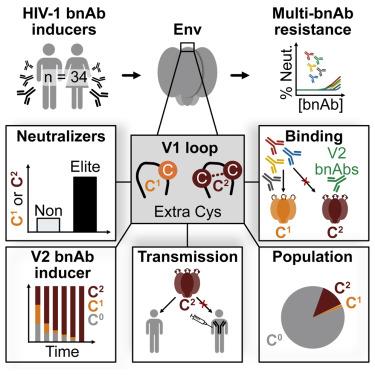
Identifying HIV-1 envelope (Env) traits associated with neutralization cross-reactivity is crucial for vaccine design. Variable loops 1 and 2 (V1V2), positioned at the Env trimer apex, are key regions linked to neutralization. We describe non-canonical cysteine (Cys) residues in V1 that are enriched in individuals with elite neutralization breadth. Analyzing over 65,000 V1 sequences from the CATNAP database, AMP trials, and longitudinal HIV-1 cohorts (SHCS, ZPHI, and CAPRISA), we found that Env variants with extra V1 Cys are present at low levels and fluctuate over time. Extra V1 Cys associate with elite plasma neutralization, and two additional Cys are preferred, suggesting stabilization through disulfide bonds. Among 34 broadly neutralizing antibody (bnAb)-inducer Envs, 17.6% had elongated V1 regions with extra Cys. These extra Cys moderately increased neutralization resistance and altered bnAb epitope accessibility. Collectively, altering epitope exposure alongside Env stabilization renders the V1 twin Cys motif a promising feature for HIV-1 bnAb immunogens.
期刊介绍:
Cell Host & Microbe is a scientific journal that was launched in March 2007. The journal aims to provide a platform for scientists to exchange ideas and concepts related to the study of microbes and their interaction with host organisms at a molecular, cellular, and immune level. It publishes novel findings on a wide range of microorganisms including bacteria, fungi, parasites, and viruses. The journal focuses on the interface between the microbe and its host, whether the host is a vertebrate, invertebrate, or plant, and whether the microbe is pathogenic, non-pathogenic, or commensal. The integrated study of microbes and their interactions with each other, their host, and the cellular environment they inhabit is a unifying theme of the journal. The published work in Cell Host & Microbe is expected to be of exceptional significance within its field and also of interest to researchers in other areas. In addition to primary research articles, the journal features expert analysis, commentary, and reviews on current topics of interest in the field.



 京公网安备 11010802042870号
京ICP备2023020795号-1
京公网安备 11010802042870号
京ICP备2023020795号-1

 分享
分享
 求助内容:
求助内容: 应助结果提醒方式:
 扫码关注我们
