Ying Zheng;Peiming Wang;Yang Wang;David Shan-Hill Wong
{"title":"A Projective Weighted DTW-Based Monitoring Approach for Multi-Stage Processes With Unequal Durations","authors":"Ying Zheng;Peiming Wang;Yang Wang;David Shan-Hill Wong","doi":"10.1109/TASE.2025.3537687","DOIUrl":null,"url":null,"abstract":"Multi-stage processes, such as batch and transition processes, often have unequal operation duration due to differing conditions, posing significant challenges to process monitoring. Although dynamic time warping (DTW) has been applied for offline synchronization, it cannot adequately align an evolving, incomplete online batch with completed historical batches due to inherent inconsistencies in their progression. Moreover, traditional methods generally overlook time-scale faults in the operational progress of the process, which undermines overall monitoring performance. To address these issues, a novel projective weighted DTW (PwDTW)-based method is proposed to monitor multi-stage processes with unequal durations. First, the asymmetric weighted DTW is adopted to offline align the original training dataset with different lengths, incorporating the Itakura parallelogram constraint to restrict the region of the warping path. Then, the PwDTW with an open-ended strategy is proposed to handle the online asynchronization problem by assessing the progress and similarity of the ongoing trajectory against each training trajectory. Further, the k-nearest neighbor (KNN) is used to identify the most similar subsequences of the training dataset with the online trajectory. Leveraging these subsequences, two monitoring indices are designed to monitor the process in not only amplitude scale but also time scale. The two indices reflect both the strength and speed of the process. Finally, a benchmark Tennessee Eastman process and a practical semiconductor manufacturing case are introduced to prove the effectiveness of the proposed method. Note to Practitioners—This paper aims to solve the practical problem of on-line monitoring multi-stage processes with unequal durations from both amplitude and time perspectives. Traditional methods typically focus on offline alignment of processes with different durations and lack online applicability. Additionally, their focus on monitoring only the signal amplitude also limits the potential to monitor whether the process is progressing too fast or too slowly. This paper proposes a novel PwDTW-based monitoring method to address these issues. The approach begins by using asymmetric weighted DTW (wDTW) for offline alignment of historical data, synchronizing datasets with varying durations. When new samples arrive, this paper develops a PwDTW method with an open-ended strategy that evaluates process progress and identifies similar patterns for the online sample. Further, by assessing both the strength and the speed of the process, this paper provides dual-perspective monitoring that is more comprehensive than traditional methods. The effectiveness of this approach has been demonstrated through its application to the TE process and a real-world semiconductor manufacturing process. The proposed method is universal and can be adapted to other industries, such as energy production or pharmaceuticals, where varying durations are ubiquitous in the systems.","PeriodicalId":51060,"journal":{"name":"IEEE Transactions on Automation Science and Engineering","volume":"22 ","pages":"11564-11576"},"PeriodicalIF":6.4000,"publicationDate":"2025-02-03","publicationTypes":"Journal Article","fieldsOfStudy":null,"isOpenAccess":false,"openAccessPdf":"","citationCount":"0","resultStr":null,"platform":"Semanticscholar","paperid":null,"PeriodicalName":"IEEE Transactions on Automation Science and Engineering","FirstCategoryId":"94","ListUrlMain":"https://ieeexplore.ieee.org/document/10869344/","RegionNum":2,"RegionCategory":"计算机科学","ArticlePicture":[],"TitleCN":null,"AbstractTextCN":null,"PMCID":null,"EPubDate":"","PubModel":"","JCR":"Q1","JCRName":"AUTOMATION & CONTROL SYSTEMS","Score":null,"Total":0}
引用次数: 0
Abstract
Multi-stage processes, such as batch and transition processes, often have unequal operation duration due to differing conditions, posing significant challenges to process monitoring. Although dynamic time warping (DTW) has been applied for offline synchronization, it cannot adequately align an evolving, incomplete online batch with completed historical batches due to inherent inconsistencies in their progression. Moreover, traditional methods generally overlook time-scale faults in the operational progress of the process, which undermines overall monitoring performance. To address these issues, a novel projective weighted DTW (PwDTW)-based method is proposed to monitor multi-stage processes with unequal durations. First, the asymmetric weighted DTW is adopted to offline align the original training dataset with different lengths, incorporating the Itakura parallelogram constraint to restrict the region of the warping path. Then, the PwDTW with an open-ended strategy is proposed to handle the online asynchronization problem by assessing the progress and similarity of the ongoing trajectory against each training trajectory. Further, the k-nearest neighbor (KNN) is used to identify the most similar subsequences of the training dataset with the online trajectory. Leveraging these subsequences, two monitoring indices are designed to monitor the process in not only amplitude scale but also time scale. The two indices reflect both the strength and speed of the process. Finally, a benchmark Tennessee Eastman process and a practical semiconductor manufacturing case are introduced to prove the effectiveness of the proposed method. Note to Practitioners—This paper aims to solve the practical problem of on-line monitoring multi-stage processes with unequal durations from both amplitude and time perspectives. Traditional methods typically focus on offline alignment of processes with different durations and lack online applicability. Additionally, their focus on monitoring only the signal amplitude also limits the potential to monitor whether the process is progressing too fast or too slowly. This paper proposes a novel PwDTW-based monitoring method to address these issues. The approach begins by using asymmetric weighted DTW (wDTW) for offline alignment of historical data, synchronizing datasets with varying durations. When new samples arrive, this paper develops a PwDTW method with an open-ended strategy that evaluates process progress and identifies similar patterns for the online sample. Further, by assessing both the strength and the speed of the process, this paper provides dual-perspective monitoring that is more comprehensive than traditional methods. The effectiveness of this approach has been demonstrated through its application to the TE process and a real-world semiconductor manufacturing process. The proposed method is universal and can be adapted to other industries, such as energy production or pharmaceuticals, where varying durations are ubiquitous in the systems.
期刊介绍:
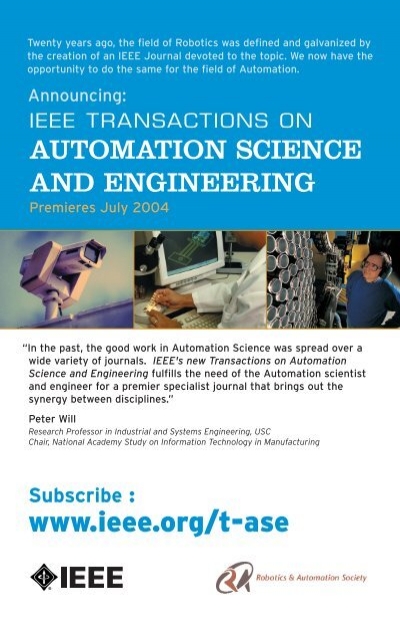
The IEEE Transactions on Automation Science and Engineering (T-ASE) publishes fundamental papers on Automation, emphasizing scientific results that advance efficiency, quality, productivity, and reliability. T-ASE encourages interdisciplinary approaches from computer science, control systems, electrical engineering, mathematics, mechanical engineering, operations research, and other fields. T-ASE welcomes results relevant to industries such as agriculture, biotechnology, healthcare, home automation, maintenance, manufacturing, pharmaceuticals, retail, security, service, supply chains, and transportation. T-ASE addresses a research community willing to integrate knowledge across disciplines and industries. For this purpose, each paper includes a Note to Practitioners that summarizes how its results can be applied or how they might be extended to apply in practice.



 京公网安备 11010802042870号
京ICP备2023020795号-1
京公网安备 11010802042870号
京ICP备2023020795号-1

 分享
分享
 求助内容:
求助内容: 应助结果提醒方式:
 扫码关注我们
